When Will I Get Married? Using KP Astrology Dasha and Sub-Lord Analysis

Timing Marriage with KP Astrology
“When will I get married?” is one of the most common questions people bring to astrology, and for good reason. Marriage changes daily life, family structure, finances, social identity, and long-term plans. KP Astrology is especially useful here because it does not stop at broad promises. It aims to narrow the timing to a particular Dasha-Bhukti period and, with transit confirmation, to a smaller window inside that period.
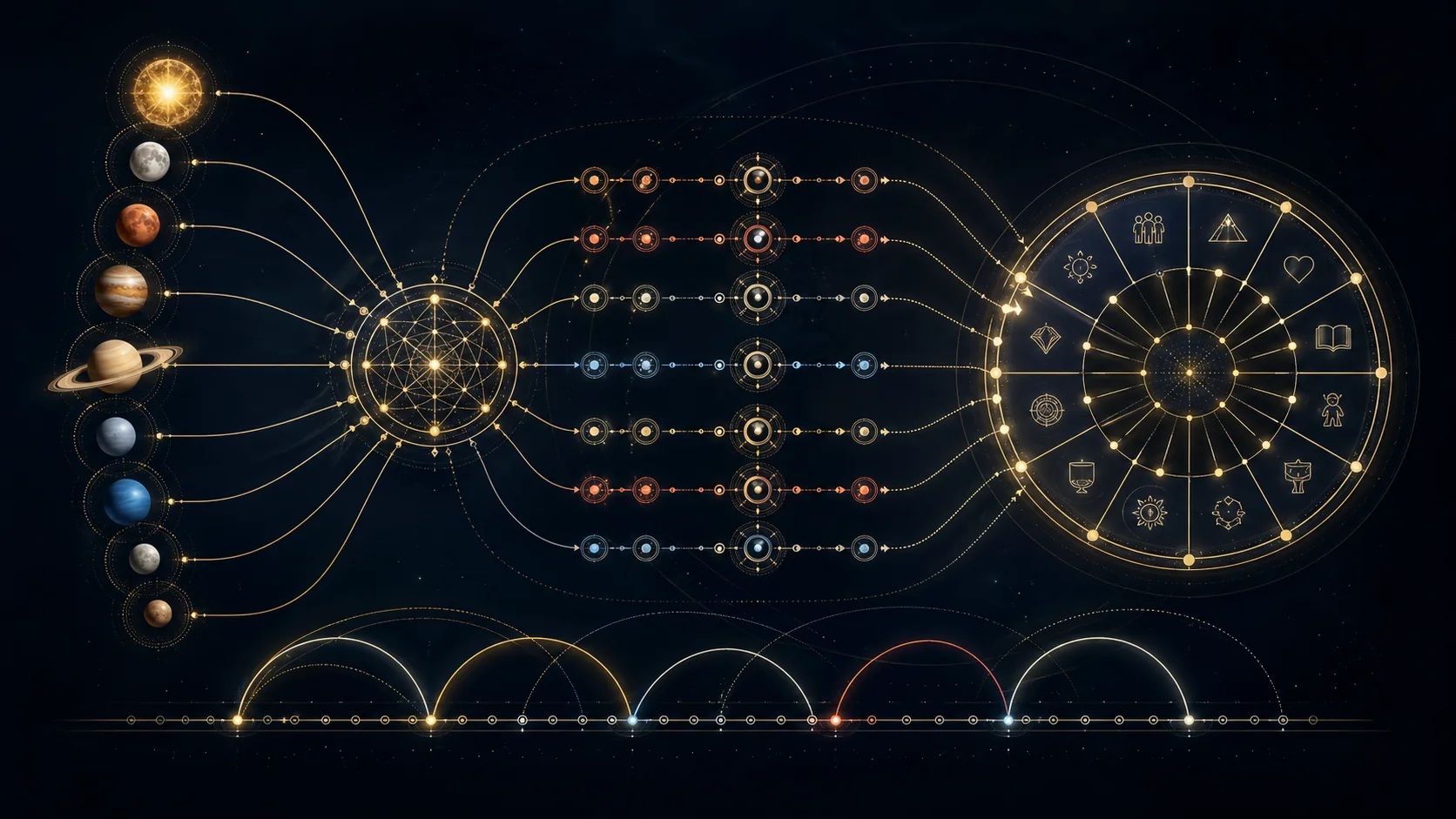
A practical KP marriage analysis usually begins with three layers: first, confirm whether marriage is promised in the chart; second, identify which planets signify the relevant houses; and third, find the Dasha-Bhukti and transit combination that can trigger the event. When these pieces line up, the chart often shows a realistic marriage window rather than a vague “sometime in life” prediction.
To see this more clearly, imagine two people with the same question. One is in a stable relationship and wants to know whether the next year is favorable for engagement and marriage. Another is single and trying to understand whether the chart supports marriage at all, or whether delay is likely. KP analysis handles both situations by asking different questions at different stages, instead of forcing every chart into the same pattern.
- Marriage Houses: 2nd house for family formation, 7th house for spouse and partnership, 11th house for fulfilment of desire.
- Dasha-Bhukti Alignment: The running Dasha lord and Bhukti lord must both connect strongly with 2, 7, or 11.
- Transit Confirmation: Slow-moving planets, especially Saturn and Jupiter, help seal the timing when they activate the right significators.
This method is practical because it reflects how major life events often unfold. Marriage rarely happens just because one favorable factor appears. In real life, there may be family discussions, travel, job changes, proposal delays, or emotional hesitation. KP timing works better when multiple indicators support the same event within a manageable period.
Step 1: Confirm the Marriage Promise
Before asking when marriage will happen, the first task is to check whether the chart promises marriage in the first place. This is one of the most important habits in KP Astrology, because timing without promise can create confusion. A person may have a strong Dasha period, but if the chart does not support marriage through the relevant cusp and significators, that period may bring only discussion, attraction, or proposal attempts without actual settlement.
The key point is the 7th house cusp and its Cusp Sub Lord. In KP practice, if the 7th cusp sub lord signifies 2, 7, or 11, marriage is generally considered promised. If it signifies 1, 6, or 10, marriage may be denied or significantly delayed. This is why the promise check comes before timing. It prevents false certainty and makes the rest of the analysis more meaningful.
A simple real-world example helps. Suppose a woman in her early thirties has excellent career progress and several admirers, but her relationship history has repeatedly ended before commitment. Her chart may show a 7th cusp sub lord linked to 1 and 6, while 2, 7, and 11 are weakly connected. In such a case, the issue is not lack of opportunity; the chart may simply not support smooth marriage timing yet. On the other hand, another person may have a modest social life but a 7th cusp sub lord connected to 2, 7, and 11. That chart can show a marriage promise even if the person has not yet found the right partner.
Promise confirmation is also useful for family counselling. Many people assume delay means denial. KP analysis is more precise than that. A chart can show promise but delay, promise with obstacles, or promise with a specific age range. The promise check tells you whether the rest of the timing work is worth pursuing in detail.
In practical terms, the 7th cusp sub lord acts like the gatekeeper of marriage events. If it supports marriage houses, the chart opens the door to timing analysis. If it does not, you should be cautious about reading every good period as a marriage period.
Step 2: Identify Marriage Significators
Once the promise is confirmed, the next step is to identify which planets signify houses 2, 7, and 11. These are the marriage-related houses used in KP timing because they together describe family formation, partnership, and fulfillment of the desire to marry. A house does not need to be connected only by one route. In KP, a planet can signify a house in several ways, and the strength of that signification matters.
Use the KP significator table or any reliable significator method to list the planets connected with these houses. The usual hierarchy of signification is:
- Occupant of the star of the planet in the house — the strongest level of signification
- Occupant of the house — direct signification
- Occupant of the star of the owner of the house — secondary signification
- Owner of the house — the weakest level of signification
This hierarchy matters because not every planet connected to a house will carry the same event power. A planet strongly linked to the star of a 7th-house occupant is usually more active for marriage than a planet that merely owns a relevant house in a weak way. For this reason, careful analysis is more valuable than simply listing all possible planets.
Consider a common chart pattern. Venus may signify the 7th house through occupation or star connection, Jupiter may signify the 2nd and 11th houses, and Mercury may connect to both 7th and 11th through star and ownership links. If these three planets are prominent, they form a useful marriage significator set. Then the timing question becomes: which Dasha-Bhukti period activates them most strongly?
Another useful point is that significators can be mixed. A planet may support marriage in one context but not in another. For example, a planet may signify 11th house fulfillment, but if it is also tied to 6th house conflict, the event may come with obstacles or arguments. That is why KP marriage analysis works best when the same planet or period repeatedly supports 2, 7, and 11 with minimal counter-significations to denial houses.
It is also common for two charts to have the same Dasha lord but different results because the significator structure differs. That is one reason why broad rules alone are not enough. Two people may both run Venus periods, but only the one whose Venus strongly signifies marriage houses is likely to see marriage events in that period.
When evaluating the significators, it helps to think in terms of practical event strength rather than abstract symbolism. Ask: does this planet actually connect the chart to family formation, committed partnership, and desire fulfillment? If yes, it becomes part of the marriage timing shortlist.
Step 3: Find the Matching Dasha-Bhukti Period
After the significators are identified, scan the Vimshottari Dasha sequence for the periods that activate those significators. In KP marriage timing, the Dasha lord should be a strong significator of 2, 7, or 11, and the Bhukti lord should also connect to these houses. The event becomes far more likely when both layers support the same outcome.
This is where the timing becomes useful in daily life. People often want to know whether marriage will happen this year, next year, or after a longer wait. A Dasha-Bhukti combination gives a clear window. For example, if a native runs a Dasha lord that signifies 7th and 11th houses, and the Bhukti lord also connects to 2nd and 7th houses, the chart is more likely to deliver relationship settlement than a period where only one of the two lords is relevant.
Think of the Dasha as the broad climate and the Bhukti as the local weather. The climate may be favorable for partnership, but the local weather determines whether the actual event is ready to happen. A marriage event often needs both.
Here is a realistic example. A man has been in a long-term relationship for several years, but marriage has kept getting postponed because of family pressure and job instability. His chart shows strong marriage promise, but the earlier Dasha periods were tied more to career and relocation houses. Later, he enters a Dasha of Venus with a Bhukti of Jupiter, and both planets are strong marriage significators. That period is much more likely to bring final commitment than the earlier years, even if the relationship itself already existed.
Sometimes the pattern is not immediate marriage but marriage-related activity. A period may first bring proposal discussions, family meetings, engagement, or formal acceptance, followed by the actual wedding during the next supportive sub-period. KP analysis is useful because it can track these transitions. In many cases, the marriage event is not a single instant but a sequence of steps that build toward it.
When scanning Dasha-Bhukti periods, it helps to look for repetition. If the Dasha lord signifies 7th house, the Bhukti lord also signifies 7th, and both are additionally linked to 2 or 11, the probability improves. If one of them is weakly linked to the relevant houses and the other is strongly linked, the event may still happen, but the result may be less clean or more delayed.
Do not ignore the context of the native’s life. A promising Dasha-Bhukti can still express itself through practical conditions: family readiness, meeting the right partner, agreement between households, or completion of personal goals. Astrology identifies the window, but the life circumstances determine the visible form of the event.
Step 4: Use Transit Confirmation
After the Dasha-Bhukti period has been identified, transit confirmation narrows the timing further. In KP Astrology, slow-moving planets like Saturn and Jupiter are especially useful for this stage because their movement often correlates with concrete development in major events. They help show when the Dasha-Bhukti potential becomes active enough to manifest.
Within the selected Dasha-Bhukti, check when Jupiter and Saturn transit through the star or sub of the Dasha-Bhukti lords. This can narrow the period from months to a more focused window. For even finer timing, the Sun or Moon can be checked for transiting through the star of the Dasha lord on specific days, especially when the Ruling Planets align with marriage significators.
In practice, transit confirmation works like a final filter. A chart may show a favorable marriage Dasha-Bhukti over several months, but only certain weeks may trigger actual talks, engagement, or ceremony. If Jupiter enters a supportive star while Saturn also activates the relevant significator chain, the chance of concrete movement increases. This is why a broader time range can often be reduced to a smaller and more actionable period.
Imagine a couple already approved by both families. The wedding is waiting on venue availability and a few practical decisions. In this case, the Dasha-Bhukti may already promise marriage, but transit may show the exact week when matters move from discussion to scheduling. A change in transit does not create the entire event by itself, but it often marks the moment when conditions become ready enough to proceed.
Transit confirmation is also valuable when there are multiple possible marriage windows. Suppose one Dasha-Bhukti is promising in the first half of the year and another is promising later. Transit can help distinguish which window is stronger. It may reveal that one period brings only a proposal, while another brings finalization and ceremony.
People sometimes expect a single day to be “the marriage day” in advance. In real life, astrology more often shows a band of time within which the event is likely to happen. Transit helps refine that band. The closer the Dasha-Bhukti and transit indicators are aligned, the more useful the timing becomes.
How a Marriage Timing Judgment Comes Together
A good KP marriage judgment is rarely built from one factor alone. The process becomes clearer when each layer supports the next:
- First, the 7th cusp sub lord must support marriage promise.
- Second, the planets connected to 2, 7, and 11 should be identified and ranked by strength.
- Third, the running Dasha-Bhukti should activate those same significators.
- Finally, transit should confirm the most likely month or week.
When these layers line up, the prediction becomes more practical. When they do not, the analysis should remain cautious. This layered approach is one reason KP Astrology is often preferred by people who want event-oriented prediction rather than broad personality descriptions.
A good example is the difference between “marriage is possible soon” and “marriage is likely in this period if family conditions cooperate.” The first statement is generic. The second is usable. KP analysis aims for the second kind of answer, because it takes into account not only promise and timing but also the real mechanisms that bring marriage into form.
It also helps explain why a person may feel ready long before the chart shows settlement. Emotional readiness, social pressure, and age do not by themselves create the event. The chart must still show the right promise, significators, and activation. In many cases, people discover that the period of frustration begins to make sense once they compare their life story with the chart sequence.
Example: Timing a Marriage
Suppose a chart shows Venus, Jupiter, and Mercury as strong significators of houses 2, 7, and 11. The native is running Venus Dasha and Jupiter Bhukti from March 2025 to November 2025. That alone creates a useful marriage window because both planets are relevant to the same event.
Now add transit. Saturn transits through the star of Venus in July 2025, while Jupiter continues to support the relevant house chain. On the day the analysis is done, the Ruling Planets also show Venus and Jupiter strongly. In such a case, July 2025 becomes a highly likely month for marriage-related development.
What might that look like in reality? One person might receive a formal proposal and family approval. Another might fix the wedding date after repeated delays. A third might register the marriage after a long engagement. The exact form can vary, but the common thread is that the event moves from intention to settlement during the activated period.
Now consider a different version of the same chart. The Dasha-Bhukti is still Venus-Jupiter, but Saturn transits in a way that slows negotiations, and the family is already dealing with a relocation issue. The same favorable period may still support marriage, but the final event could shift within the broader window. That is why timing should be read as a practical guide rather than a rigid guarantee of a specific day.
People often ask whether astrology can show the difference between engagement and marriage. In many cases, yes, because the chart may show the first commitment during one sub-period and final marriage during another. A careful reading of the Dasha-Bhukti and transit sequence can help distinguish the two. The event may unfold in stages, and KP helps identify those stages.
Common Real-Life Patterns in Marriage Timing
Marriage timing is rarely identical from one native to another, even when the main signifying planets are similar. Some common patterns help make the method easier to understand:
- Early promise, late settlement: The chart supports marriage, but the event comes after career or family matters stabilize.
- Relationship first, marriage later: The person is already in a relationship, and KP timing shows when commitment becomes formal.
- Family-arranged settlement: The chart may show strong 2nd-house and 7th-house activation during a period when relatives play a major role.
- Delay followed by sudden progress: Several years may pass with little movement, then one strong Dasha-Bhukti and transit combination triggers quick action.
- Proposal without finalization: A weaker period may bring talks, introductions, or engagement plans without immediate marriage.
These patterns matter because they help people interpret their own charts with more patience and less anxiety. Not every favorable period produces the same stage of marriage. Sometimes the first visible result is a family meeting, a proposal, or acceptance from the partner’s side. The actual wedding may follow after another supportive transit or sub-period.
For someone who has been waiting for years, this can be reassuring. The chart may not be saying “no.” It may be saying “not yet.” KP timing gives structure to that distinction.
How to Read Marriage Timing More Responsibly
It is easy to become overly focused on a single prediction when the question of marriage is emotionally important. A responsible KP reading keeps a few practical points in mind.
First, do not rely on only one factor. A good marriage timing judgment combines promise, significators, Dasha-Bhukti, and transit. Second, do not assume every relationship-related period means marriage. Some periods bring attraction, some bring conflict, and some bring choices. Third, remember that human decisions still matter. Astrology shows likely timing, but real-life outcomes also depend on communication, family support, and readiness to commit.
For example, a person may have a favorable marriage period but still postpone the event because of job relocation or unfinished education. Another person may move quickly because both families are aligned and the practical steps are easy. The same chart pattern can therefore express differently depending on circumstances.
This is why the best use of marriage timing is planning, not panic. If a promising period is approaching, a couple can use it to prepare documents, discuss expectations, and resolve pending concerns. If a period is weak, the native can avoid forcing a marriage decision and instead wait for a more supportive time.
KP Astrology becomes especially useful when it supports practical preparation. A person who knows a favorable window is approaching can pay attention to conversations, family meetings, or formal steps that may otherwise be ignored. In that sense, astrology helps people use timing intelligently rather than passively.
Analyse Your Marriage Timing
If you want a deeper look at your own chart, you can use the Marriage Matchmaking Calculator to identify marriage significators and Dasha periods. This is a helpful first step if you want to understand the structure of your chart before moving into a more detailed event analysis.
For people who want a precise reading that includes promise, significators, Dasha-Bhukti, and transit confirmation, book a consultation with I Navin. A consultation can be especially useful when the question is not just whether marriage is promised, but whether the timing is likely to show engagement, family approval, or the actual marriage event.
If you are still comparing different approaches to prediction, it can also help to review the broader discussion in KP Astrology vs Vedic Astrology. For deeper timing logic, the article on Vimshottari Dasha analysis is a useful companion. Together, these resources give a more complete picture of how event timing is judged in KP Astrology.
Marriage questions often come with hope, uncertainty, and pressure from family or society. A structured KP analysis can reduce that uncertainty by turning a vague question into a clear sequence: promise, significators, Dasha-Bhukti, and transit. When all of those factors support the same event, the timing becomes much easier to read.
For users who like to verify things themselves, the available tools can help you move from curiosity to practical analysis. The Cusp Promise Calculator supports the promise check. The Marriage Matchmaking Calculator helps with significators and timing foundations. The Ruling Planets calculator can support the final timing confirmation. Used together, these tools make the process more transparent and easier to follow.
In the end, the question “When will I get married?” is best answered through a careful sequence of checks rather than a single quick rule. KP Astrology offers that sequence in a way that is concrete, testable, and closely tied to the actual life event you want to understand.
Explore More from KP Astro Academy
Related Tools & Features
- Childbirth Selection Tool
- Birth Time Rectification Tool
- Ruling Planets Calculator
- Marriage Matchmaking Calculator
- Career & Education Finder
- Transit Search & Prediction
- Planetary Remedies Finder
- Free KP Kundli
- Daily Panchang Calculator
- Vedic Ephemeris Calculator
- Hora Chart Calculator
- Ashtak Varga Calculator
- KP Event Finder
- Personal Muhurat Finder
- Cusp Promise Calculator
- Bhav & Dasa Phal Predictions
- Dasha Promise Calculator
- KP Astrology Consultation
Further Reading
- Childbirth in KP Astrology: Promise, Delay, Denial, and Hope
- Gemstone Remedy Ecommerce Integration
- Birth Time Rectification: Why Every Second Counts in KP Horoscope Accuracy
- Understanding LSRD in KP Astrology: Lagna, Star, Rashi, and Dasha Lords
- Why all marriages should not be saved?
- From Chaos to Calm: The Immediate and Long-Term Benefits of Daily Meditation
- When to Start a Remedy: Using Ruling Planets for Remedy Timing
- How and Why Science Finally Agrees with KP Astrology!
- Vastu Shastra and KP Astrology: Using Geographic North for Building Orientation (Diya Drishti Method)
- How to Check Marriage Compatibility Using KP Sub-Lord Method
- How to Rectify Birth Time Using KP Astrology: A Step-by-Step Guide
- Mastering the Dasha Sequence in KP Astrology
Loading article...