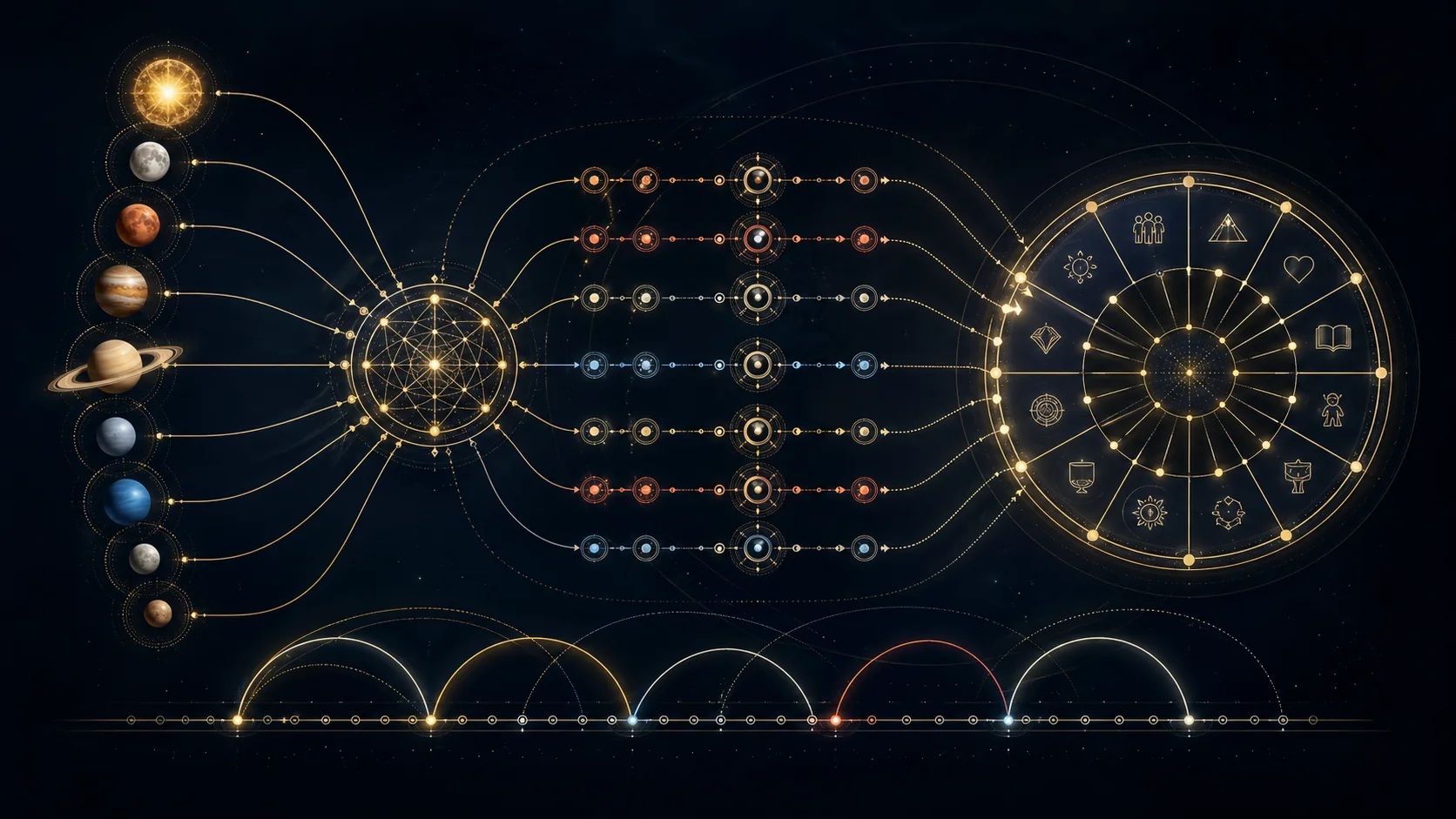
Vimshottari Dasha Analysis: The Foundation of Timing Predictions
Structure of Vimshottari Dasha
Vimshottari Dasha is one of the most important timing systems used in Vedic astrology and KP Astrology. It gives a practical way to understand not only what may happen in life, but also when the chart is more likely to deliver a result.
- 120-Year Cycle of 9 Planets: A complete Dasha sequence divides a theoretical 120-year lifespan into nine major planetary periods.
- Dasha, Bhukti, and Antara: Each major period is further divided into sub-periods so timing can be narrowed with greater clarity.
- Activation of House Promises: Results usually come from the houses a planet signifies during its active period, rather than from its strength alone.
Your birth chart is often described as the blueprint of life, but the Dasha is the clock that tells you when parts of that blueprint start becoming visible in real life. A chart may show many possibilities, yet only some of them become active at a given time. That is why two people with similar placements can experience very different lives, or even the same person can go through long quiet stretches followed by sudden developments.
For example, one student may have a strong promise for higher education in the chart, but if that promise is not activated by the running Dasha, the opportunity may not materialize during the expected years. Another person may see a job offer, a relationship, or a relocation exactly in a sub-period that supports those specific houses. This is where Vimshottari Dasha becomes practical: it helps the astrologer move from broad promise to a time window that can actually be tested against events.
Why Vimshottari Dasha Matters for Timing
A chart can contain many strong indicators, but a strong planet does not automatically produce its result all the time. Its results are more likely to appear when its Dasha, Bhukti, or Antara is running and when the planet is connected to the relevant houses in the chart. Without timing, prediction becomes too general. With timing, astrology becomes more useful for real decisions.
Think about how life unfolds in stages. A person may study for years, then suddenly enter a career phase. Another may remain single for a long time and then meet a serious partner within a short period. Someone may spend months preparing to shift city, but the actual move may happen quickly when the right period arrives. Vimshottari Dasha provides the framework for reading those shifts in sequence rather than as random events.
This is also why the Dasha system is used so widely in both learning and practice. It gives structure to a prediction. If the chart shows a promise for marriage, profession, child birth, foreign travel, property, or academic success, the astrologer still needs to identify the active period that can trigger the result. The promise and the timing work together.
In practical reading, the Dasha also helps explain delays. A person may ask why a desired event has not happened yet even though the chart appears supportive. The answer is often that the favorable significators are not active in the current period, or the active period is supporting a different theme altogether. This can be reassuring because it shifts the focus from uncertainty to sequence. In many cases, the issue is not that the promise is absent; it is that the right time has not arrived.
How the 120-Year Cycle is Organized
The Vimshottari system divides a 120-year cycle among nine planetary rulers. Each planet receives a fixed number of years, and these years form the broad background of the life journey. The sequence is not arbitrary; it creates a rhythm that astrologers use to map major phases, turning points, and transitions.
The nine planetary periods are usually read as major chapters in life. Some chapters may feel active and eventful, while others may feel quieter, more internal, or more preparatory. The experience depends not only on the planet itself but also on its placement, ownership, associations, and the houses it signifies. A well-placed Dasha lord can bring ease in one area, while a difficultly placed one can bring pressure, responsibility, or repeated effort.
It is important to remember that the Dasha sequence does not simply mean one event after another in a neat order. Life is more layered than that. A person may start a career during one period, deepen it during another, and then switch direction later. In the same way, relationships can begin in one cycle, become serious in another, and stabilize in a different sub-period. The value of the 120-year framework is that it gives a reliable skeleton for studying this flow.
For students of astrology, this is one of the first places where timing becomes visible in a structured way. Instead of guessing based only on transits or only on natal promises, the astrologer can place events inside the correct major planetary framework. This makes the reading more disciplined and easier to validate against actual life events.
Dasha, Bhukti, and Antara: Why Sub-Periods Matter
The major Dasha alone is usually too broad to pinpoint an event. That is why Vimshottari is commonly read through three layers: Dasha, Bhukti, and Antara. These layers narrow the timing progressively, much like zooming in from a city map to a street and then to a building.
The Dasha shows the larger theme. The Bhukti refines the theme and often shows a more specific direction. The Antara can narrow the result further and identify the most active span for a visible outcome. In practice, this means an astrologer does not stop at saying, “This planet’s period is running.” The next question is, “Which sub-period is running, and what houses are being activated now?”
A simple example can help. Suppose a person is in a period connected to career matters. The larger Dasha may indicate professional growth, the Bhukti may bring a new role or responsibility, and the Antara may coincide with the actual interview, offer, joining date, or project launch. The same logic applies to marriage, travel, education, health concerns, or property matters. Each layer adds clarity.
This layered reading also explains why some events appear to build gradually. A person may first feel restless in one sub-period, then begin searching for a new direction in another, and finally make the actual move in a later one. Astrologically, the event is not a single isolated moment; it is often the result of a sequence of activations.
For clients, this can be extremely helpful. Instead of waiting passively for a whole planetary period to end, they can understand which part of the period is more likely to be productive and which part may be better for preparation, observation, or patience. This makes the Dasha system not just predictive, but also practical.
How the Moon’s Nakshatra Sets the Starting Point
The starting Dasha at birth is determined by the exact position of the Moon. The Nakshatra occupied by the Moon decides which planetary period begins first, and the remaining balance of that Dasha depends on how far the Moon has already moved within that Nakshatra.
This detail matters because two children born in the same month may still begin life with different Dasha balances. Even a small difference in Moon position can change the remaining years of the first period. One child may enter a strong Dasha with many years left, while another may have only a short balance and move to the next planetary period much earlier. That difference can influence the early tone of life.
For example, one person may spend much of childhood under a supportive period that gives stability, education, or protection. Another may begin with a more demanding period, which can create an early sense of responsibility, change, or adjustment. Neither case tells the whole story by itself, but it helps explain why people with seemingly similar backgrounds often start life differently.
In a practical consultation, this is one of the first things an astrologer checks after the birth chart is prepared. If the birth time and Moon position are accurate, the Dasha calculation becomes a powerful starting point for timing. If the birth time is uncertain, the reading can become less reliable, because even a small change in Moon placement can affect the starting sequence and the balance of years.
This is one reason why accurate birth data matters so much. The Dasha system is timing-sensitive. If the foundation is off, the timing windows may also shift. That is why tools such as a kundli viewer are useful for visualizing the chart and understanding how the Moon-based sequence begins.
Vimshottari Dasha in Real-Life Prediction
The value of Vimshottari Dasha becomes clearest when it is applied to real-life questions. In actual practice, people do not usually ask abstract questions like “What is my chart doing?” They ask things like: Will I get the job? Is marriage likely soon? Will I move abroad? Should I expect a promotion? Is this the right phase for a business decision? The Dasha helps connect the chart to these concrete concerns.
Consider a professional who has been working steadily for years but feels stuck. The chart may show that the current period is more focused on learning, service, or background preparation than on large public recognition. In that case, the person may not see a dramatic career rise immediately, even if the overall chart supports success. But when the appropriate Dasha changes, the pace may shift. A new role, a transfer, or a visible accomplishment may arrive almost suddenly compared to the earlier years.
Or consider someone waiting for marriage. The natal chart may show the promise, and transit patterns may look supportive, but the actual event often becomes easier to narrow down when the Dasha activates the relevant houses. A period connected to partnership, commitment, family expansion, or social connection can make the result more likely than a period focused on solitude, work pressure, or internal growth.
The same is true for education. A student may be capable and motivated, yet exam success, admission, scholarship, or overseas study often becomes more evident in the correct sub-period. Many students do their best preparation during one phase and receive the visible outcome in another. The Dasha does not replace effort; it helps explain the timing of the result.
This is why a good prediction is rarely based on only one factor. The Dasha is the timing backbone, but it works best when read along with chart promises and transit triggers. Together, they create a more complete picture of what may happen and when it may happen.
Applying Vimshottari Dasha in KP Astrology
In KP Astrology, the focus is on the Star Lord and Sub-Lord of the active Dasha, Bhukti, and Antara planets. This is where the method becomes especially practical. Instead of relying only on the planet’s general nature, the astrologer checks what houses the planet signifies through its stellar and sub connections. If the active DBA planets signify the houses relevant to the question, the event becomes more likely in that sub-period.
For example, if the question is about marriage, the houses commonly examined include 2, 7, and 11. If the active Dasha, Bhukti, and Antara planets connect strongly to those houses through their significations, that period becomes important for the event. If they do not, then even a promising-looking period may not produce the desired result in that specific time window.
This is one reason KP readers often feel that timing becomes sharper when the significations are checked carefully. A planet may be generally benefic, but if it is not linking to the desired houses, it may not deliver the specific outcome the person is waiting for. On the other hand, even a seemingly ordinary period can become eventful if the relevant house connections are active.
A realistic example is a person asking about a job change. The astrologer does not simply look for a “good” planet. The astrologer checks whether the current period supports the houses connected to profession, change, gain, and movement in status. If the Dasha sequence activates these houses, the person may receive an offer, shift roles, or decide to leave an old position. If the sequence does not support it yet, the person may still be preparing, applying, or waiting.
Another example is relocation. Some people assume that a strong period should automatically bring travel or foreign settlement. In reality, the relevant house connections must be active. A period may support career growth but not relocation, or it may support movement without long-term settlement. The Dasha helps distinguish between these possibilities.
Why Dasha and Transit Should Be Read Together
Vimshottari Dasha shows when the promise is activated, while transits often show the short-term trigger. That is why timing becomes stronger when both are studied together. A favorable Dasha can set the stage for an event, and a relevant transit can act like the final signal that makes it visible.
For instance, a person may be in a period that supports marriage, but the actual step may happen when transits also support commitment or movement in relationship houses. Similarly, a professional promotion may be promised in the Dasha, but the outer event may appear when transits highlight the same areas. The two methods do not compete with each other; they complement each other.
This point is often misunderstood by beginners. They may look at a strong Dasha and expect immediate results, or they may see a favorable transit and expect a major event without checking the broader period. But timing becomes more reliable when the long-term and short-term layers agree. The Dasha shows the stage. The transit often shows the cue.
The practical benefit of combining them is precision. Instead of speaking in broad terms like “sometime this year,” the astrologer can identify a more focused time range. This is valuable in consultations because people usually need decision-making support, not vague possibilities. Whether the topic is career, family, education, relocation, or partnership, the combined reading can help narrow the likely window.
How to Read a Dasha Period in Everyday Life
It helps to think of each Dasha period as a season. Some seasons are meant for growth, some for correction, some for visibility, and some for inner restructuring. When a person understands the season they are in, they can make better choices instead of forcing results too early.
For example, during a period that supports groundwork, someone may benefit more from training, skill-building, savings, or preparation than from chasing immediate recognition. During another period, the same person may be ready for bold steps, public exposure, or decisive commitments. This does not mean effort should stop in quiet phases. It means the style of effort should match the running period.
A student may use one period to build fundamentals and another to take exams or seek admission. A business owner may use one phase to stabilize operations and another to expand. A person in a relationship may use one period to understand compatibility and another to formalize commitment. The Dasha system becomes powerful when it is read as a roadmap for action, not as a fatalistic script.
In consultation, this approach also helps manage expectations. If the current period is not supportive for the desired event, the astrologer can explain that the person may need to wait for the right sub-period rather than rushing decisions. If the period is supportive, the person can use the opportunity more consciously. In this way, astrology becomes a tool for timing and planning, not just prediction.
Common Mistakes People Make with Dasha Analysis
One common mistake is to judge the Dasha without looking at the houses involved. A planet may be running, but what matters is what it signifies in the chart. Without house analysis, the reading becomes too general.
Another mistake is to ignore the sub-periods. People often focus only on the major Dasha and miss the fact that the event is more likely in the Bhukti or Antara. This can lead to predictions that are too broad, too early, or too late.
A third mistake is to assume every positive period must produce dramatic results. Sometimes a supportive period simply brings steady improvement, relief, stability, or preparation rather than a headline event. The result may be real even if it is not flashy.
There is also the opposite problem: assuming a challenging period means nothing good can happen. In practice, difficult periods can still produce progress if the chart supports it. The event may come with effort, responsibility, or pressure, but it can still be meaningful. Astrology works best when it is descriptive, not absolute.
Finally, people sometimes try to use timing methods without accurate birth details. Since the Moon’s position determines the starting Dasha, even a small birth-time issue can affect the reading. That is why careful data collection matters before any serious prediction is made.
Learning and Practicing Vimshottari Dasha Effectively
For students of astrology, the best way to learn Vimshottari Dasha is to compare chart promises with real events. Pick a birth chart, note the major Dasha periods, and then match them to actual life milestones such as education, job changes, marriage, childbirth, relocation, or losses. Over time, patterns become easier to see.
It is also helpful to study one life area at a time. For example, first examine career events across the Dasha sequence. Then compare relationship milestones. Then look at education, residence changes, or family developments. This step-by-step method is more effective than trying to read everything at once.
Tools and resources can also make learning smoother. A kundli viewer is useful for checking the chart structure while you study the Dasha sequence. Blog explanations and comparison articles can help you understand how timing logic differs across systems. If you are exploring how KP Astrology handles accuracy and prediction style, the discussion in KP Astrology vs Vedic Astrology can give useful context.
If you want to go deeper, it often helps to watch practical examples and case-based explanations rather than only memorizing rules. A consultation can also be valuable when you need to see how the Dasha applies to a specific life question. In real reading, the system becomes clearer when it is used on actual birth charts and actual events.
Conclusion: Why Vimshottari Dasha Remains the Foundation of Timing
Vimshottari Dasha remains one of the most useful foundations for prediction because it organizes life into meaningful time periods. It tells the astrologer when a planet is active, when its significations are likely to come forward, and how those results may unfold through major periods and sub-periods.
Its real strength is not just in describing a planetary cycle, but in making prediction usable. It helps answer the question people care about most: not only what the chart says, but when it may happen. When combined with house analysis, transits, and the specific logic of KP Astrology, the Dasha becomes a practical timing tool rather than a theoretical one.
For anyone learning astrology, this is a system worth mastering carefully. For anyone seeking a consultation, it provides a structured way to understand delays, opportunities, and likely turning points. And for anyone trying to make sense of life’s timing, Vimshottari Dasha offers a simple but powerful idea: the promise may already be in the chart, but the period decides when it becomes active.
In that sense, the birth chart is the map, the Dasha is the schedule, and life is the journey that unfolds step by step.
Explore More from KP Astro Academy
Explore More from KP Astro Academy
Related Tools & Features
- Childbirth Selection Tool
- Birth Time Rectification Tool
- Ruling Planets Calculator
- Marriage Matchmaking Calculator
- Career & Education Finder
- Transit Search & Prediction
- Planetary Remedies Finder
- Free KP Kundli
- Daily Panchang Calculator
- Vedic Ephemeris Calculator
- Hora Chart Calculator
- Ashtak Varga Calculator
- KP Event Finder
- Personal Muhurat Finder
- Cusp Promise Calculator
- Bhav & Dasa Phal Predictions
- Dasha Promise Calculator
- KP Astrology Consultation
Further Reading
- Childbirth in KP Astrology: Promise, Delay, Denial, and Hope
- Saturn Transit Effects on Each House: A KP Astrology Perspective
- How to Activate the 12 Houses: A Behaviour-First Framework for Real Astrology
- How to Read a KP Birth Chart: Planets, Houses, and Sub-Lords Explained
- Effective Remedies for Weak Planets in KP Astrology
- KP Birth Time Rectification: Why Geographic Coordinates Are as Critical as the Time Itself
- Dasha Timing Api For Indian Astrology Apps
- The Secret of Day Lord (Vara Lord) and its Weight in KP Signification
- Can KP Horary (Prashna) Answer Yes/No Questions?
- Selecting the Perfect Auspicious Birth Time: A Guide to KP Astrology Childbirth Selection
- Why Two People With the Same Chart Live Completely Different Lives
- Career Prediction & Job Stability: When Will I Get a Promotion?