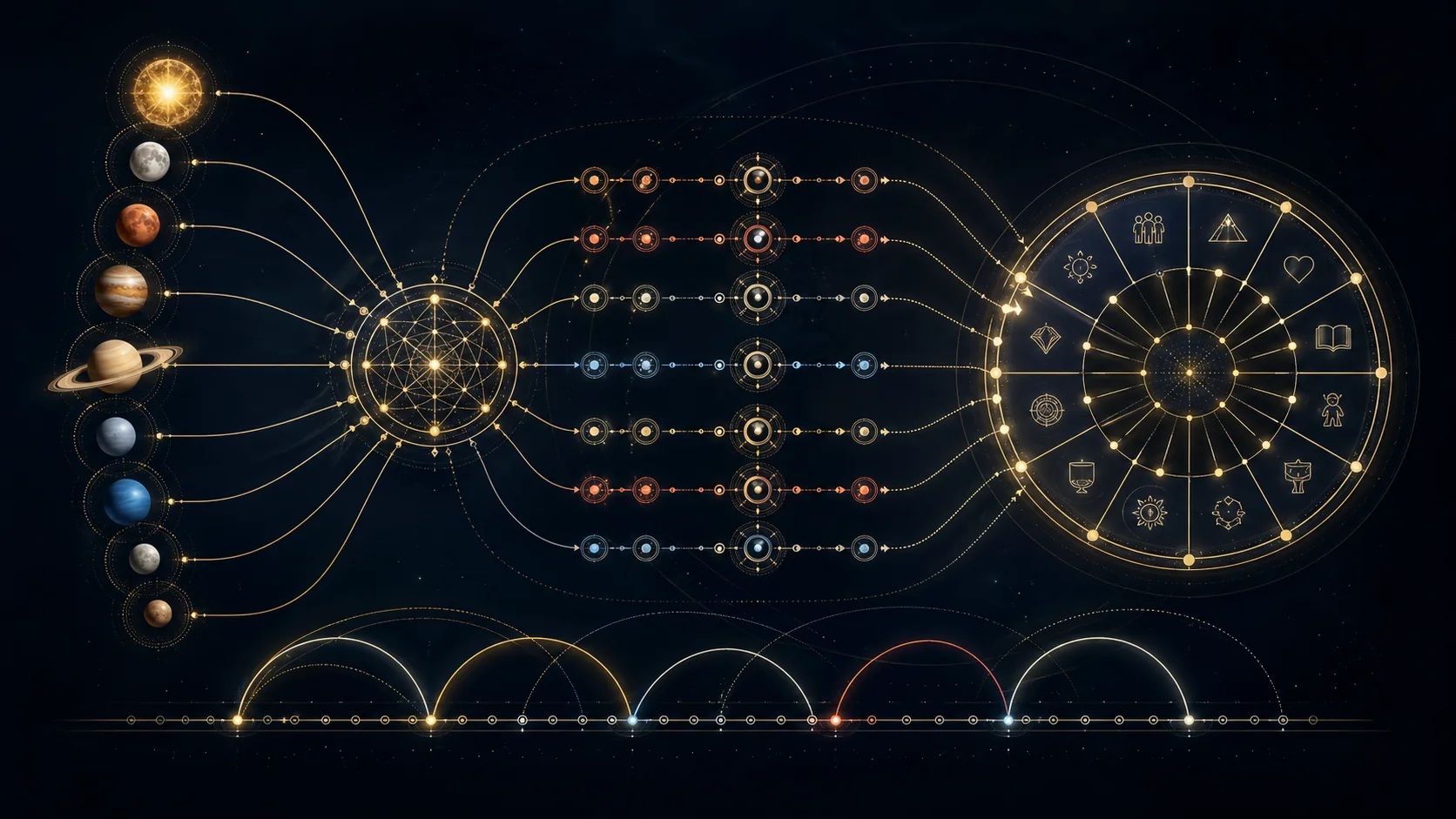
The Secret of Day Lord (Vara Lord) and its Weight in KP Signification

The Day Lord (Vara Lord) in KP
In traditional calculations, the day begins at midnight. In Vedic and KP astrology, the day begins at sunrise. This small shift changes the entire logic of the Day Lord, also called the Vara Lord, because the planet that rules the day is not determined by the clock date alone but by the actual solar sunrise at the native’s location. In practice, this means that two people born only a few hours apart can fall under different day lords if one birth happens before sunrise and the other after it. That is why KP practitioners treat the Vara Lord as a living, location-based factor rather than a simple calendar label.
- Day Starts at Sunrise: Calculating the Day Lord based on local sunrise times, not midnight.
- Ultimate Veto Planet: The Day Lord acts as a filter to validate or veto other ruling planets.
- Strength of Day Lord in RP: Used to resolve ties when multiple planets compete as significators.
Never ignore the Day Lord; it represents the primary planetary energy ruling the physical day. In a KP context, this is not a decorative rule but a practical one. If the sunrise-based day is ignored, the entire chain of judgment can begin with the wrong anchor. A question that seems to point toward one planet may actually be filtered through another, and that difference can alter how the chart is read, especially in horary work and in time-sensitive event judgment. The Day Lord is one of those factors that appears simple at first glance, yet becomes crucial when a chart sits on the boundary between two outcomes.
Why Day Lord (Vara Lord) is Often Overlooked
Modern software often incorrectly uses the Gregorian calendar day to determine the Day Lord, causing errors for births occurring between midnight and sunrise. A correct KP engine always calculates the day lord based on the local coordinate's sunrise. The reason this gets overlooked is not because astrologers do not care about accuracy, but because many tools are built around standard civil time, which is convenient for administration but not always suitable for astrological judgment. Civil time rolls over at midnight, yet the sky does not necessarily shift its practical meaning at that instant. KP, being deeply sensitive to real astronomical conditions, asks a different question: what is the sunrise at the native’s place, and which planet rules that sunrise day?
This distinction matters more than many beginners expect. If a chart is labeled by calendar date without adjusting for sunrise, a birth before dawn may be assigned the wrong day lord even though the person was still functionally in the previous astrological day. That error can cascade into ruling planet interpretation, event timing, and the general tone of a horary reading. In many cases, the mistake remains hidden because the rest of the chart may still look plausible. But when predictions become inconsistent, the root cause is often this exact oversight.
Think of it like reading a train schedule using the wrong station time zone. The numbers may appear clean, but the meaning is off. In astrology, the same hour can belong to different meanings depending on whether the Sun has risen locally. That is why the Day Lord is not a theoretical footnote; it is a working principle.
Calculating the Correct Day Lord at Sunrise
If a child is born at 2:00 AM on a Tuesday, but the sunrise is at 6:00 AM, the Vedic/KP Day Lord is actually the ruler of Monday (Moon), not Tuesday (Mars). Using the wrong Day Lord will ruin the ruling planet configuration and lead to wrong predictions. This example is useful because it shows how intuition can fail when it depends only on the printed calendar. A person reading the date might naturally say, "It is Tuesday, so Mars rules," but KP does not stop at the label on the page. It checks the sky. Since sunrise has not occurred yet, the previous day’s solar rule remains active until dawn.
For a beginner, this can feel strange at first. We are used to thinking of a day as beginning at 12:00 AM, and in daily life that convention is perfectly acceptable. But astrological judgment asks for a more precise astronomical boundary. Sunrise acts like the turning of a cosmic page. Until that page turns, the current day is still in force, even if the civil date has changed on paper. That is why births, questions, and other event charts close to dawn must always be reviewed carefully.
Here is a practical way to think about it. Suppose there are two people born on the same civil date in the same city. One is born at 5:10 AM and the other at 6:20 AM. If sunrise is at 5:55 AM, the first person belongs to the previous solar day while the second belongs to the new one. The difference is only 70 minutes, yet the day lord changes completely. If a reader ignores this, they may accidentally interpret a Moon-ruled day as if it were Mars-ruled, which can change the tone of the ruling planets and the emphasis in a timing judgment.
Another reason this issue is missed is that many people are not checking the local sunrise but relying on generic sunrise data or software defaults. In KP, location matters. Sunrise in one city can differ significantly from sunrise in another, and even small differences can be important when a birth time is near the boundary. This is why serious practice always begins with the correct place, the correct time, and the correct astronomical calculation.
It also helps to remember that the Day Lord is not merely a label for the date. It is a filter for the day’s active planetary tone. If the wrong planet is assigned, the whole reading may lean in the wrong direction. In horary work, especially, this can be the difference between a clear yes, a delayed yes, and a no that later turns out to have been avoidable through better timing judgment.
Why Sunrise Matters More Than Midnight in KP Judgment
Sunrise is not just a symbolic marker. It is the visible beginning of daylight and the point at which the solar day becomes meaningful in traditional astrological practice. In KP, this practical boundary is preferred because it reflects the actual motion of the Sun in relation to the native’s horizon. The idea is simple: the day should begin when the day is born in the sky, not when a human calendar happens to reset.
This approach also explains why two charts with the same date may not behave the same way. One could be governed by the previous day’s lord if the Sun has not yet risen, and the other could fall under the new lord after sunrise. The chart does not ask what the date says; it asks what the sky says. For a KP student, that shift in thinking is essential. It trains the mind to respect astronomical reality over administrative convenience.
In real practice, sunrise can also affect how the emotional and practical tone of the day is judged. A Moon-ruled day may feel different from a Mars-ruled one even if both carry the same calendar date. When a query is asked before sunrise, the old day’s theme still operates. When the same question is asked after sunrise, a new thread begins. This is why timing, in KP, is never just about the hour on the wall; it is about the planetary environment in force at that moment.
Beginners sometimes assume that the day lord is only relevant for birth charts. In fact, it has a broader role. It can influence horary analysis, ruling planet validation, and the general mood of a day’s indications. When a person asks a question at a precise moment, the Day Lord helps identify whether the query is well-supported by the ruling planets or whether the chart is showing a mismatch that needs patience or a different timing window. In that sense, the Day Lord is a stabilizer. It helps confirm whether the reading is coherent before deeper interpretation begins.
How the Day Lord Interacts with Ruling Planets
One of the most practical uses of the Day Lord in KP is its relationship with ruling planets. Ruling planets are often used to capture the immediate operating energies around a question, and the Day Lord acts as an important check on that set. If the Day Lord supports the ruling planets, the judgment becomes more trustworthy. If it does not, the astrologer may need to reconsider whether the chart moment is favorable for reading, whether the question is premature, or whether another combination is more dominant.
This is why the Day Lord is sometimes described as an ultimate veto planet. That phrase does not mean it overrules everything automatically. Rather, it means it acts as a final validation layer. Suppose multiple planets appear as potential significators in a horary chart. The Day Lord can help decide which one feels active, which one is merely present, and which one should be set aside. In difficult charts, this can be the deciding factor.
Imagine a consultation where the querent asks about a job result. Several planets may seem involved: one for profession, one for success, one for the organization, and one for the timing of the response. If the Day Lord is strong and harmonizes with the ruling planets, the matter may proceed smoothly. If it is weak or disconnected, the astrologer may notice hesitation, delay, or an unclean answer. The Day Lord does not replace the rest of the chart, but it keeps the judgment from drifting away from the actual moment of inquiry.
In a tie between competing planets, the Day Lord can also help identify the more relevant significator. This is useful when the chart appears crowded and every option seems to have some merit. Instead of relying on guesswork, the astrologer uses the sunrise-based day energy to sort the contenders. The resulting judgment is usually cleaner and more defensible because it is anchored in the actual time structure of the day.
Day Lord and the Practical Meaning of a Question
The Day Lord also helps shape the practical atmosphere of the question. A query asked on a Moon-ruled day may carry a different emotional texture than one asked on a Saturn-ruled day. The first may feel responsive, fluid, and inward. The second may feel slow, measured, and demanding. These are not rigid claims that predict every outcome, but they are useful to the astrologer who is trying to understand the rhythm of the day.
For example, if someone asks about travel early in the morning before sunrise, the previous day’s lord may reveal more about the immediate answer than the civil date does. If the chart is being examined purely from the calendar day, the reading can miss a subtle but important shift. The Day Lord helps anchor the consultation in the correct atmospheric context.
There are also situations where the Day Lord acts as a warning sign. Suppose the ruling planets appear optimistic, but the Day Lord is poorly aligned with the question significators. The astrologer may sense that the question is not fully ripe or that there are hidden delays. This does not mean the answer must be negative. It means the timing may be imperfect, or the matter may unfold more slowly than the querent expects. The Day Lord helps the astrologer communicate these nuances more responsibly.
In practice, this is one reason experienced readers treat sunrise seriously. They know that the emotional and event-based tone of a chart can shift right at dawn. That shift is especially visible in horary charts asked around early morning. A question asked at 5:40 AM may belong to one energy pattern, while the same question asked at 6:10 AM may belong to another. A casual observer may see only a small difference in clock time. A KP reader sees two different astrological environments.
Common Mistakes Students Make with Vara Lord
Students often make the mistake of learning the rule in theory but applying it loosely in practice. They may remember that sunrise matters, yet still default to the calendar date when checking charts. Others may calculate sunrise approximately, but fail to use the correct geographic location. Some rely on a generic online tool without understanding whether it is built for local sunrise or midnight rollover. These errors can create false confidence, because the chart appears complete even when the foundational day boundary is wrong.
Another common mistake is assuming that the Day Lord matters only if the birth time is extremely close to sunrise. In reality, it matters whenever the day boundary is being used in interpretation. While the most obvious errors occur near dawn, the principle itself is broader. If the entire chart system is based on sunrise, then every judgment should respect that structure. A person born at 1:00 AM may be far from sunrise, but the day lord is still determined by the previous solar day, not by the civil date. The issue is not proximity alone; it is the definition of the astrological day.
Students also sometimes confuse the Day Lord with the Moon sign, weekday mood, or general planetary transit. These are related ideas, but they are not identical. The Day Lord is the ruler of the day according to sunrise. It should not be casually merged with other concepts, because doing so blurs the precision that KP depends on. Clear terminology leads to clearer judgment.
A helpful habit is to check three things every time: local sunrise, the actual birth or question time, and the ruling planet configuration. When these align, the reading feels stable. When they do not, the chart should be handled with caution. This simple discipline can prevent many avoidable mistakes, especially for students who are still learning how to trust sunrise-based timing over calendar-based assumptions.
A Simple Example That Shows the Difference
Consider a question asked in a city where sunrise is at 6:15 AM. The querent asks at 5:50 AM whether a pending interview will be successful. If the astrologer uses the calendar date only, they may assign the wrong day lord and read the ruling planets through the wrong lens. But if the sunrise rule is applied, the chart still belongs to the previous day. That means the astrologer may find that the question is carrying the older day’s energy, which can be more suitable for analysis than the new day’s planetary label.
Now imagine the same question asked at 6:20 AM. The Sun has risen, the day has turned, and the new day lord is active. Even though only 30 minutes have passed, the astrological setting has changed. The shift may be subtle, but in KP subtle shifts matter. A query that seemed hesitant before sunrise may appear more clearly structured after sunrise. That difference is exactly why the Day Lord must be checked rather than assumed.
This kind of example is especially helpful for students because it shows that astrology is not just about planets in isolation. It is about timing, environment, and the rules used to classify the moment. The Day Lord is one of the simplest places where this principle becomes visible.
When the Day Lord Becomes Especially Important
The Day Lord becomes especially important in horary work, early-morning births, and any case where the chart falls near a day boundary. It also matters when multiple signification factors are close and the astrologer must decide which one is more active. In such cases, the Day Lord provides a practical filter that can prevent confusion.
It is also useful in consultation settings where the astrologer wants to know whether the question itself is well-timed. Sometimes a person asks too early, before the matter has fully formed. The Day Lord, together with the ruling planets, may show that the question is premature or that the environment is not yet ready for a clean answer. At other times, the chart may show that the time is excellent, and the Day Lord helps confirm that the question is ready to be judged.
In family matters, career matters, and travel-related questions, the Day Lord can also reveal whether the day is pushing the matter forward or asking for patience. A strong day lord does not guarantee success by itself, but it can indicate that the day’s energy is supportive. A weak or disconnected day lord does not automatically indicate failure, but it can signal friction, delay, or incomplete alignment.
This is why the Vara Lord is valuable even to advanced readers. The more complex the chart, the more helpful a stable, sunrise-based reference becomes. When many factors compete, a reliable day lord can reduce noise and sharpen the final conclusion.
Using the Day Lord as a Validation Layer
Think of the Day Lord as a final consistency check. If the ruling planets point in one direction but the Day Lord disagrees strongly, the astrologer should pause and re-examine the context. Perhaps the question was asked before sunrise. Perhaps the software used midnight instead of dawn. Perhaps the chart is technically correct but the query is not yet ripe. The Day Lord helps separate a clean chart from an accidental one.
This validation role is one reason it is called an ultimate veto planet in practical discussions. If the day lord is not supportive, a chart that looks promising on the surface may still need caution. That does not mean the reading is invalid; it means the astrologer should not rush. In KP, caution is often a form of accuracy.
For students, this is a valuable lesson. Astrology is not only about knowing what each factor represents. It is about knowing which factor to trust when several speak at once. The Day Lord is often trusted because it is tied to the real movement of sunrise, which gives it a grounded and observable basis. That makes it especially useful in practical judgment.
How to Build Better Judgment Around Vara Lord
The best way to build judgment around the Day Lord is to practice with real charts and verify the sunrise boundary every time. Start by noting the exact place, then check the local sunrise for that location, then compare it with the birth or question time. Once you do this repeatedly, the sunrise rule becomes intuitive. You begin to see why a chart at 5:45 AM and one at 6:05 AM may belong to entirely different day-lord environments even if the civil date is the same.
It also helps to read the Day Lord together with the rest of the ruling planets rather than in isolation. The day lord is important, but it works best when viewed as part of the full interpretation process. A strong day lord with weak supporting factors may still produce delay. A modest day lord with coherent ruling planets may still support a clean answer. The art lies in seeing the relationship, not merely the individual label.
Students can also benefit from checking their own timing habits. Do they ask questions casually without noting sunrise? Do they rely on default software settings? Do they assume the day is the same everywhere? These habits may save time, but they can reduce accuracy. KP rewards precision, and precision begins with respecting the sunrise boundary.
If you want a practical exercise, take a few charts born in the early morning and compare the results when the day lord is calculated by sunrise versus midnight. The contrast can be striking. In some charts, the difference will be mild. In others, it will reshape the entire ruling planet framework. That experience teaches the lesson better than a definition ever could.
Remember the Day Lord’s Real Role
The Day Lord is not there to make astrology more complicated. It is there to make it more faithful to the actual sky. By tying the day to sunrise, KP preserves a meaningful connection between celestial motion and earthly interpretation. That is why this factor remains so important for accurate judgment, especially in sensitive birth times and time-based queries.
When students begin to respect the Day Lord, they usually notice that their readings become more consistent. They are no longer fighting the chart with the wrong day boundary. Instead, they are working with the actual structure of the day. That shift may seem small on paper, but in practice it can change the quality of every prediction.
So when in doubt, return to the sunrise. Check the location, confirm the day lord, and let the ruling planets speak through the correct time boundary. In KP, that simple discipline can protect you from a surprising number of errors and bring more clarity to the reading.
For readers who want to explore how technical accuracy affects interpretive reliability, the comparison in KP astrology vs Vedic astrology accuracy predictions offers a useful context. And for live checks of planetary combinations in question work, the ruling planets calculator can help you observe how the current moment is being framed. Used carefully, these tools reinforce the same core lesson: in KP, the right boundary matters.
Explore More from KP Astro Academy
Explore More from KP Astro Academy
Related Tools & Features
- Childbirth Selection Tool
- Birth Time Rectification Tool
- Ruling Planets Calculator
- Marriage Matchmaking Calculator
- Career & Education Finder
- Transit Search & Prediction
- Planetary Remedies Finder
- Free KP Kundli
- Daily Panchang Calculator
- Vedic Ephemeris Calculator
- Hora Chart Calculator
- Ashtak Varga Calculator
- KP Event Finder
- Personal Muhurat Finder
- Cusp Promise Calculator
- Bhav & Dasa Phal Predictions
- Dasha Promise Calculator
- KP Astrology Consultation
Further Reading
- Childbirth in KP Astrology: Promise, Delay, Denial, and Hope
- Gemstone Remedy Ecommerce Integration
- Astrologer Consulting Business Software
- Advanced Numerology: Integrating with KP Astrology
- Family Support or Family Obstacle? KP Reads It Without Drama
- The Precision of the Sub-Sub Lord in KP
- The Role of Cuspal Interlinks in BTR: Connecting Family Genotypes
- KP Astrology Remedies: Do Gemstones and Mantras Really Work?
- Vimshottari Dasha Analysis: The Foundation of Timing Predictions
- How Accurate Is Birth Time Rectification Using KP Astrology?
- Will I Buy Property? The KP Way to Judge Land, Home, and Delay
- Btr In White Label Astrology Consultation Flow