How Accurate Is Birth Time Rectification Using KP Astrology?

How Accurate Is Birth Time Rectification Using KP Astrology?
Birth time rectification is one of the most practical and serious parts of KP astrology because it deals with the difference between a chart that looks correct on paper and a chart that actually responds to life. A birth time can be remembered incorrectly, written down later, or rounded off by a few minutes. That small difference can shift the Ascendant degree, the cusps, and the sub-lords. In KP practice, even a difference of 4 minutes can change the house cuspal results enough to alter predictions about marriage, job, education, relocation, or childbirth.
That is why accuracy matters so much. If the birth time is wrong, the astrologer may be reading the right person through the wrong chart. The reading may still sound convincing because broad traits can overlap, but the timing of events is where the weakness appears. KP astrology is valued for its mathematical approach, so it is often used when a native wants to know not just what may happen, but when.
For a person who has always used an estimated birth time, rectification can feel like solving a puzzle with missing pieces. One client may know they were born “around sunrise,” another may have a hospital record that says 3:10 AM but a family elder insists it was closer to 3:25 AM. In such situations, a careful rectification process can help narrow the range. The final answer is not treated as casual guesswork; it is tested against life events, ruling planets, and cuspal links until one time fits better than the others.
There is also a larger practical reason many students and clients care about this topic: accurate birth time is the foundation for any serious predictive work. If the base is weak, the forecast becomes weak. That is why KP practitioners often say that rectification is not a luxury, but the first step before giving dependable judgment. It is also why many people study tools and methods related to birth time rectification before they try to use astrology in a more advanced or professional way.
Without accurate birth time, even a well-argued chart can miss the timing of real events.
To understand how accurate KP rectification can be, it helps to see what the process actually does. The astrologer starts with a birth time window, not a fixed point. For example, the native may say the birth happened between 2 PM and 4 PM. That is not enough for a final judgment, but it is enough to begin narrowing the field. Then the astrologer checks a set of meaningful life events, usually major events with exact dates, such as marriage, childbirth, a career break, relocation, surgery, accident, first job, or the death of a close family member.
Each event acts like a checkpoint. If the suggested time does not match one event, it is not enough to reject it immediately. A serious rectification compares multiple events to see whether the same chart structure can explain them consistently. This is one reason KP users prefer exact dates, not vague memories. Saying “I got married in 2018” is less useful than saying “the wedding took place on 12 June 2018.” The more precise the event date, the more usable it becomes in the rectification process.
The KP Rectification Approach
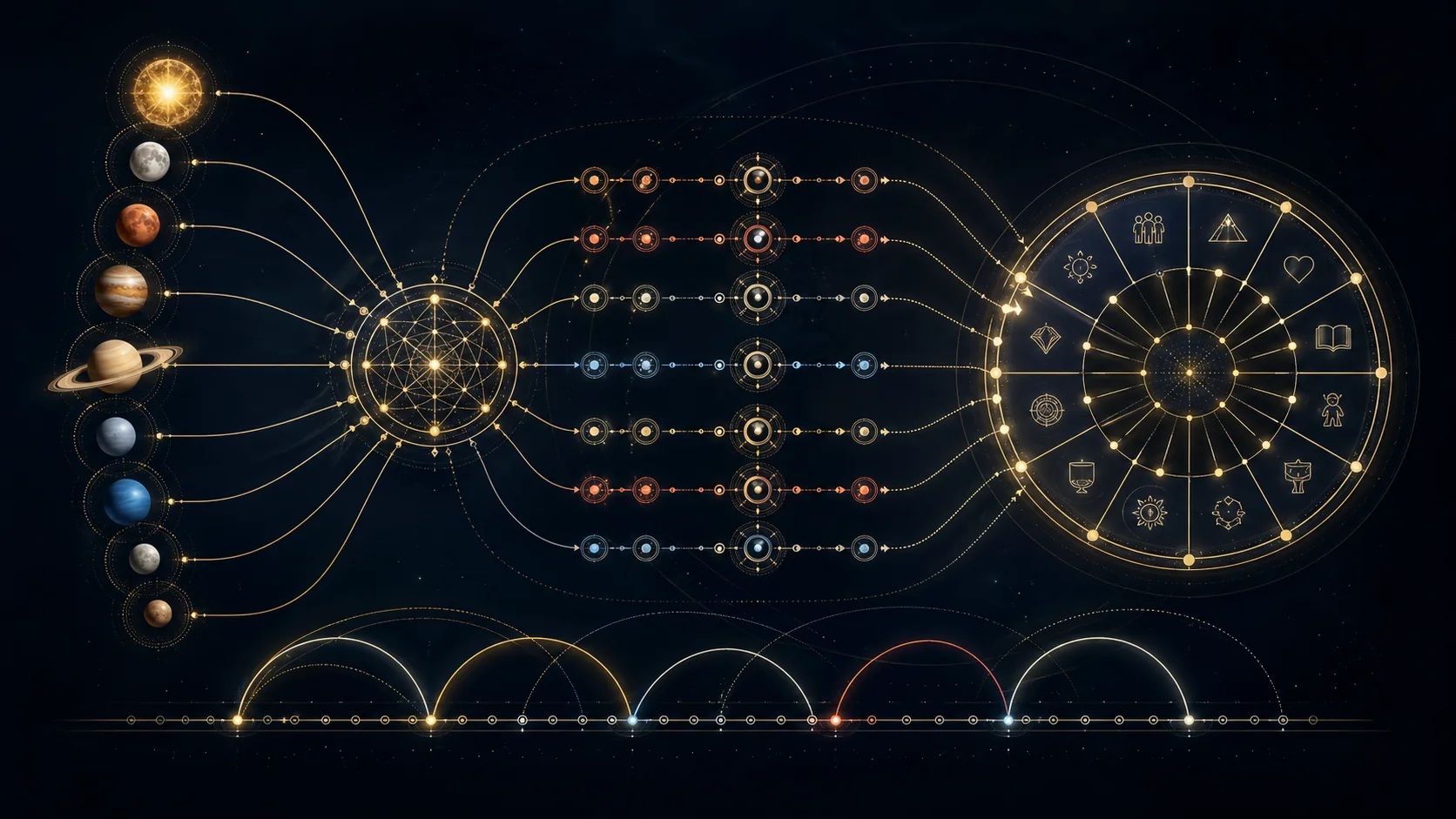
KP astrology uses a very specific sequence. First, the astrologer studies the ruling planets at the moment the work begins. These ruling planets are treated as a live indicator of the chart being examined. In practice, they help the astrologer check whether the direction of the rectification is moving in harmony with the native’s chart. The method is also why some practitioners pay close attention to Ruling Planets tools, because the starting moment is considered meaningful in the working process.
Next, the astrologer studies the Ascendant sign, star, and sub-lord. In KP, the sub-lord matters greatly because it refines the result much more than a sign-only reading does. A chart may appear to have a favorable house placement at one level, but the sub-lord can change the actual outcome. This is where KP rectification becomes detailed. Instead of asking only “Which sign was rising?”, the astrologer asks “Which exact degree was rising, and how does that degree behave through star and sub-lord connections?”
Then comes the event matching stage. Suppose a native reports a marriage in 2016, a child in 2019, and a major job shift in 2022. The rectified time has to explain all three events, not just one. If one time fits marriage but fails on childbirth and job change, it is not enough. Another time may align better with all three. In real-life practice, this is often the stage where the answer becomes clearer. The astrologer may try multiple candidate times within the birth window until the cuspal results and event timing line up more convincingly.
A useful way to think about it is like calibrating a machine. If a camera is slightly out of focus, a face may still be recognizable, but small details will be blurred. Rectification aims to sharpen the chart so the predictive work becomes dependable. The difference may be only a few minutes on the clock, but in astrological terms it can mean a different star, a different sub-lord, and a different house result.
One practical example is a person born in a family where records were not prioritized. The mother remembers the delivery was before dawn, the father says it was after the first tea of the day, and the paperwork says 5:30 AM because that was the time the nurse filled in later. The person later notices that one chart version explains a career in education and another suggests frequent movement and foreign travel. Instead of choosing based on intuition, KP rectification checks which version matches events such as when the person started college, shifted to another city, entered employment, or received a promotion. The chart that matches the event pattern is the one taken seriously.
That is why the method is considered rigorous. It is not about giving the astrologer room to make a flattering guess. It is about cross-checking actual life events against a precise framework. If done carefully, rectification can narrow a broad time range into a much more useful one. In some cases, it may even reduce ambiguity to a point where predictions become much more confident than they were before.
What Makes Birth Time Rectification Accurate?
Accuracy in KP rectification depends on several conditions working together. First, the birth time window must be realistic. If the native has only a rough family memory, the astrologer has less to work with. If there is a hospital record, a family note, or a near-exact recollection, the starting point is stronger. Second, the event list must be reliable. If the native is unsure whether a marriage happened in May or June, that uncertainty weakens the matching process.
Third, the astrologer must use a disciplined method rather than rushing toward a preferred answer. In a real consultation, there is often pressure to “get the answer quickly,” but rectification is strongest when the process is slow enough to test and retest the time against several life milestones. A single lucky hit is not enough. What matters is consistent alignment across multiple events.
Fourth, the interpretation must respect the system’s logic. KP does not treat every event the same way. For example, marriage, childbirth, and job change are not interchangeable. Each event connects to different houses and different significators. A time that works for career success may not explain a marriage date. This is why experienced practitioners ask for a broad event history rather than a single incident.
Fifth, the rectified time must remain stable when the astrologer reviews it against the overall chart. A good rectification should not only satisfy one event on a narrow technical basis. It should also make the chart feel internally coherent. If the adjusted time creates contradictions everywhere else, the result needs more testing.
In real cases, the difference between a good rectification and a weak one often comes down to the quality of information. A client who shares exact dates, honest history, and a clear birth window gives the astrologer a much better chance to arrive at an accurate result. A client who offers half-remembered events and a vague birth time is asking the method to do more than it can reasonably do.
Still, when the inputs are good, KP rectification can be impressive. A client may come in believing they were born at 9:15 AM, but the event sequence may fit better at 9:07 AM. Another may assume the time was 6:40 PM, but after matching key life events, 6:44 PM may produce a stronger correspondence. These are small shifts in clock time, but large shifts in chart behavior.
What Accuracy Looks Like in Real Life
Many people imagine rectification as a dramatic moment where the astrologer announces the exact second of birth and everything becomes instantly clear. In practice, accuracy is more modest and more useful than that. The best rectifications usually produce a time that behaves consistently across important events and gives the astrologer a reliable base for prediction. That is a real achievement, even if it does not feel cinematic.
Consider a person who wants to know about marriage timing. If the original birth time is off, the 7th house cusp may shift enough to change whether marriage is seen as likely in one period or another. The person may have already experienced delays or a broken engagement, and the corrected time may explain why the earlier prediction failed. Another client may come for career guidance after several job changes. A slightly different birth time may make the job sequence line up with the chart’s promise more clearly.
One realistic example is a student whose family says they were born “late at night,” but the exact time is unclear. Years later, the student notices that some chart versions suggest a strong educational path while others indicate interruptions and frequent changes. The rectification process checks when school changed, when college began, whether there was a gap year, and when the first job started. If one candidate time fits the pattern of stable study and gradual career development, it becomes more believable than another time that suggests a completely different story.
Another example is a person who relocates multiple times. A small birth time difference can alter how relocation and foreign travel are read. If the native moved to another country after a specific professional event, the rectified chart should explain that move in a way that fits the rest of the life story. This is why rectification is often more useful when the native has several memorable events spread over many years. The more event points available, the easier it is to confirm or reject a candidate time.
Accurate rectification also becomes easier when the astrologer and client work together carefully. The astrologer asks precise questions, and the client answers with precision. Instead of saying “I think it happened around 2014,” the client may check records and confirm “the wedding registration was on 19 August 2014.” Instead of “I had a big health issue once,” the client may provide the month and year of the event. That attention to detail can make a big difference.
The stronger the event data, the stronger the rectification.
Why Small Time Differences Matter So Much
People new to astrology often underestimate how sensitive a chart can be to a few minutes. In KP, this sensitivity is central. The birth time does not just tell the chart what sign is rising. It also determines the cusps and their sub-lords, which shape the chart’s practical reading. A shift of 4 minutes can alter the cusp position enough to affect the judgment of an event.
This is why two siblings born in the same hospital on the same day may still need separate rectifications. Even if their birth times are close, each person has a distinct chart. It is also why a time rounded to the nearest half hour is rarely good enough for advanced prediction. A person may say, “I was born around 7 PM,” but that is simply a starting clue, not a dependable birth time for fine-tuned analysis.
Think of it like two train departures on the same route. One leaves at 7:00 and another at 7:04. If you arrive at the station at the right moment, the difference may feel tiny. But if you miss the first one by a minute, your journey changes. In the same way, chart behavior can change when the time changes. The point of rectification is to reduce that uncertainty as much as possible.
The same logic is why KP practitioners do not rely on broad statements alone. “You will marry” is too general. “Marriage may occur during this period” is better, but still incomplete without the right birth time. A rectified chart can make the timing more precise, and precision is exactly what clients usually want when they come for serious consultation.
It is also worth noting that accurate birth time helps in many kinds of astrological work beyond one-time predictions. It can support better analysis of education, family events, relocation, profession, and relationship patterns. For people who want to build apps, services, or client workflows around astrology, this is one reason birth time rectification API for astrology products can be so valuable: the underlying data quality directly affects the usefulness of the service.
The Limits of Rectification
Even though KP rectification can be highly useful, it is not magic. It cannot create certainty where the source information is too weak. If a person does not know their birth window and cannot recall any exact life events, the astrologer has little to test. If records are missing and family memory is inconsistent, the result may remain approximate rather than exact.
There are also cases where two candidate times appear close, and the difference between them may not be obvious immediately. In such situations, the astrologer may need additional event data. Sometimes a single event is not enough to settle the question. A second or third event can break the tie. This is normal and should not be treated as failure. It simply reflects the fact that careful work takes enough evidence.
Another limit is human interpretation. A skilled astrologer may still differ from another skilled astrologer on a borderline case. That is why clients should think of rectification as a disciplined process, not as an automatic machine output. Even when the method is technical, the quality of judgment still matters.
There is also an important practical expectation to keep in mind: rectification improves the base for prediction, but it does not guarantee that every future reading will be perfect. Astrology remains interpretive. The value of a rectified time is that it removes a major source of error and allows the astrologer to work from a much better foundation.
For this reason, a responsible practitioner will usually present the rectified time along with the reasoning behind it. The client should be able to see which events were used, what time window was tested, and why one result was chosen over another. Transparency increases trust and helps the native understand that the answer was not pulled from thin air.
How to Prepare for a Rectification Session
If you want the best possible result, preparation matters. Start by collecting any available birth information: hospital slip, family note, birth certificate, or a memory of the approximate time. Then prepare a list of major life events with exact dates whenever possible. Focus on events that are easy to verify, not just emotionally important but date-specific.
- Marriage or engagement date
- Childbirth date
- First job date
- Job promotion or major role change
- Relocation to another city or country
- Accident, surgery, or major illness date
- Death of a parent or close family member
- Admission to college or graduation date
It also helps to note which events were most impactful in your life. A move that changed your career path is more useful than a minor house shift. A date that can be confirmed from records is better than a date based only on memory. If you are unsure of a date, say so clearly. Guessing can confuse the process.
Before the session, it may also be helpful to review educational content on the purpose and mechanics of rectification. A good starting point is the course preview on Purpose of Birth Time Rectification, which explains why the process matters, and Initial Matching Process, which shows how the first comparison is made. These previews can help you understand what the astrologer is looking for and how to organize your own information.
If you are trying to compare methodologies, you may also find it helpful to read about KP Astrology vs Vedic Astrology accuracy predictions. The comparison can clarify why KP emphasizes exact time, cusp analysis, and event matching so strongly.
When Rectification Feels Most Reliable
Rectification tends to feel most reliable when several things are true at the same time: the birth window is narrow, the event list is strong, and the chart’s pattern remains consistent after testing. This does not mean every case will produce a dramatic “perfect” answer. It means the final time should be usable in a meaningful way.
Clients often feel satisfied when the rectified time explains their history in a coherent manner. For example, they may notice that the revised chart accounts for the timing of marriage, the beginning of a major career phase, and a relocation event. That kind of coherence gives the native confidence that the chart is grounded in real life.
In practice, a good rectification often feels less like a revelation and more like a correction. Things that once looked contradictory start to make sense. Past predictions that seemed off may suddenly appear understandable because they were made from a weak base. Future predictions become more relevant because the chart now reflects the actual life timeline more closely.
That is why KP astrologers and serious students invest time in learning the process properly. It is also why tool-based support, consultation, and structured learning can be so helpful. A calculator may assist with early checks, a consultation can review life events in detail, and a well-taught course can show how to think through the matching logic carefully. Used together, these resources help make rectification more practical and less intimidating.
Final Perspective
So, how accurate is birth time rectification using KP astrology? The honest answer is that it can be very accurate when the inputs are good, the method is applied carefully, and the event data is strong. It is especially valuable because even a few minutes can change the chart enough to affect important judgments. At the same time, it is not a casual guessing exercise and not every case can be resolved with complete certainty.
The strength of KP rectification lies in its discipline. It uses a birth window, ruling planets, cuspal analysis, and event verification to bring the chart closer to reality. When done well, it can transform a vague or doubtful birth time into a far more usable one. For people who want practical astrology, that difference is enormous.
If you have an uncertain birth time, the best next step is to gather exact event dates and approach rectification as a serious data-based process. The more precise your information, the stronger the result can be. And if you are learning the method yourself, reviewing examples, tools, and course previews will help you understand how and why the process works.
In the end, KP birth time rectification is accurate to the extent that it respects real life. It asks the chart to prove itself against events, not against assumptions. That is why many people trust it as the starting point for dependable astrological analysis.
Explore More from KP Astro Academy
Related Tools & Features
- Childbirth Selection Tool
- Birth Time Rectification Tool
- Ruling Planets Calculator
- Marriage Matchmaking Calculator
- Career & Education Finder
- Transit Search & Prediction
- Planetary Remedies Finder
- Free KP Kundli
- Daily Panchang Calculator
- Vedic Ephemeris Calculator
- Hora Chart Calculator
- Ashtak Varga Calculator
- KP Event Finder
- Personal Muhurat Finder
- Cusp Promise Calculator
- Bhav & Dasa Phal Predictions
- Dasha Promise Calculator
- KP Astrology Consultation
Further Reading
- Childbirth in KP Astrology: Promise, Delay, Denial, and Hope
- Saturn Transit Effects on Each House: A KP Astrology Perspective
- How to Identify Gender, Virginity, or Death Through Astrology?
- Loan, Debt, and EMI Pressure: What KP Actually Checks
- Why You Can't Meditate (And How to Fix It): Psychological Blocks and Astrological Remedies
- Avoid Western Bias In Ai Astrology Platforms
- Education, Skill, and Why Your Degree May Not Become Your Career in KP Astrology
- How and Why Science Finally Agrees with KP Astrology!
- Approximate Birth Time Intake For Astrology Apps
- Vastu Shastra and KP Astrology: Using Geographic North for Building Orientation (Diya Drishti Method)
- Dasha Timing Api For Indian Astrology Apps
- The Secret of Day Lord (Vara Lord) and its Weight in KP Signification
Loading article...