Dasha Timing Api For Indian Astrology Apps
Dasha Timing Api For Indian Astrology Apps
Welcome to KP Astro Academy. In this article, we explore the deep insights of Krishnamurti Padhdhati, commonly known as KP astrology, and how its logic can be applied to dasha timing api for indian astrology apps in a clear, structured, and useful way.
When people search for astrological timing, they are often looking for a simple answer to a very practical question: when will something happen? Will an interview succeed? Will a marriage proposal move forward? Will a transfer, travel, business deal, or new phase of life begin on time? These questions are not abstract. They come from real life, and that is why timing matters so much in astrology applications built for Indian users.
KP astrology provides a highly organized, rule-based approach to predictions using the sub-lord theory and ruling planets. By evaluating the stellar and sub-level significations, astrologers can work with a more precise framework for timing events related to a topic. That precision is one reason KP has become especially attractive for digital astrology tools and APIs, where users expect fast, repeatable, and explainable output.
In an app context, a dasha timing API is not just a backend feature. It is the bridge between astrology logic and user experience. The API takes chart data, applies timing principles, and returns the periods or windows in which an event is more likely to manifest. For app builders, this creates a powerful layer of automation. For students of astrology, it becomes a chance to understand how a system like KP can be translated into a modern, structured format without losing its core method.
Before going deeper, it is useful to remember that the strength of KP astrology lies in its discipline. It does not encourage vague interpretation. It asks a series of questions in sequence: What house signifies the matter? Which planet is the ruler? What is the star lord showing? What does the sub lord confirm? Are the ruling planets supportive at the moment of judgment? This layered approach is exactly what makes KP timing suitable for an API-based application, because each layer can be represented as a rule or evaluation step.
For example, suppose an app is being used by someone who wants to know about career change timing. A conventional user interface may show a list of planetary periods, but a KP-based timing engine can go further. It can evaluate whether the relevant houses, significators, and sub lords support career movement. It can then present a filtered timing response that is closer to the user's specific query. This is especially useful when the app needs to serve many people with different questions while staying consistent in method.
Another reason this topic matters is that users increasingly expect astrology to feel personalized rather than generic. They do not want only a broad dashā label. They want a meaningful answer connected to the exact subject they asked about. That is where KP-style thinking becomes valuable. The method is not based on one isolated factor. It combines the house, the planet, the nakshatra, the sub, and the running period, then checks whether all of them are aligned enough to support the event.
In practical terms, a dasha timing API can be designed to output different layers of information. It may return the current running dasha, the antardasha, the more sensitive sub-periods, and a judgment about whether the requested event is likely to materialize during that sequence. If the app is built responsibly, it can also explain the basis of the answer in user-friendly language, so the response is not just a yes or no. It becomes an interpretation that users can understand and trust more easily.
This article focuses on the conceptual side of that process. We will look at the key principles behind KP timing, how those ideas translate into an application logic flow, why ruling planets are important, and how learners can strengthen their understanding through practical resources. You will also see why timing is not only about identifying a dasha period, but about confirming whether the planet periods actually connect to the topic in question.
Why Dasha Timing Matters In Astrology Apps
Astrology apps have changed the way people access predictions. Instead of waiting for a personal consultation every time they have a question, users can open an app and request insight instantly. That convenience is powerful, but it also creates a challenge. If the app is not built on a solid method, the answers can feel repetitive, vague, or disconnected from the actual question. That is why a dasha timing API needs more than simple calculations. It needs interpretive logic.
In Indian astrology apps, the dasha is often the backbone of prediction because it shows the major period influencing a person’s life. But timing is not just about being in a certain dasha. Many people have experienced this in real life. A person may be running a period that appears supportive for marriage, yet nothing happens until a much later sub-period. Another person may feel that a job opportunity came suddenly, even though the broad dashā had been running for years. These situations remind us that timing depends on layers, not labels.
KP astrology is especially useful here because it emphasizes that the star lord indicates the results while the sub lord confirms or denies them. That is a simple statement, but it has deep implications for app design. If an app only checks the major period, it may miss the finer timing that actually matters. If it checks the sub level, it can become much more sensitive to real-world results. This is one reason users often perceive KP-based timing as more specific and practical.
Consider a user asking whether they will receive a promotion in the next few months. The app should not just identify a favorable dasha and stop there. It should investigate whether the relevant houses connected to profession, authority, recognition, and advancement are promised by the running periods. If the same period also activates obstacles or delay signatures, the app should reflect that with caution. This layered approach produces a more believable and grounded answer.
Apps also benefit from dasha timing because it makes the experience dynamic. A user can return to the app at different times and see how the periods shift. Instead of a static horoscope, they receive an evolving analysis. This creates engagement, but more importantly, it reflects the core astrological principle that time is moving and life events unfold in sequence.
There is also a practical business reason behind this. People are more likely to trust an astrology app when the app can explain why a prediction is made. KP-style logic provides a structure that can be translated into readable output. The app can mention the current dasha, the connected significators, and the support from ruling planets at the moment of judgment. That type of response feels informed, not random.
For developers, the appeal is similar. A rule-based approach is easier to test and improve than an entirely free-form interpretive model. If the logic says that the star lord indicates a certain area and the sub lord confirms it, those conditions can be encoded into a decision tree or scoring system. The result is not just astrologically meaningful; it is also technically maintainable.
Understanding KP Timing In A Simple Way
To understand how a dasha timing API should behave, it helps to begin with the simplest possible explanation of KP timing. Every event in life is linked to specific houses and significations. A house represents a domain of experience. A planet signifies things connected to that domain. A star lord and sub lord narrow the results further. When all these elements point in the same direction, the probability of the event increases.
Imagine someone asking about marriage timing. In a KP framework, the app would look at the relevant houses connected to marriage and partnership, then check the planetary significations and the running periods. If the current dasha links clearly to those houses and the sub lord confirms the promise, the timing becomes stronger. If the sub lord denies the matter or points to unrelated outcomes, the result becomes weaker or delayed.
This layered logic can be especially helpful in app design because it mirrors how a skilled astrologer thinks. A human astrologer does not usually stop at one factor. They compare, cross-check, and confirm. A good API should do the same. It should not claim certainty from a single signal. It should build a conclusion from multiple supporting signals.
A useful way to think about it is like checking a route before a journey. The major dasha is like the main highway. The sub-period is like the exact exit you take. The star and sub-lord are like the road signs telling you whether the route is open, blocked, or leading in the right direction. Even if the highway looks promising, a blocked exit changes the outcome. This is why fine timing matters.
In many real-life scenarios, the outcome is not only about whether something is promised, but when it becomes activated. A person may have the promise of travel in the chart, but the actual trip happens only during a period that strongly activates travel houses. A person may have promise of meeting a partner, but the meeting occurs only when supportive periods align. This activation principle is exactly what dasha timing API logic must capture.
KP astrology also helps by reducing ambiguity. When the rules are followed carefully, the answer becomes more specific. The app can say that the period supports the matter, does not support it, or supports it partially with delay. This is much more useful than broad language. Users often appreciate honesty when a system says the timing is not yet strong enough. That is often better than giving an overconfident answer that later proves weak.
There is a common mistake in astrology app development: making the system look advanced without making it logically sound. Beautiful charts and colorful outputs are useful for presentation, but users return when the timing feels correct. KP principles help keep the emphasis on method rather than decoration. In other words, the quality of interpretation matters more than the style of display.
Core KP Elements That Support Timing
Any dasha timing API inspired by KP astrology should pay attention to a few key elements. The first is the stellar level. The star lord indicates the general result and shows the broad direction of the planet’s promise. The second is the sub level. The sub lord confirms whether the result can actually manifest. These two layers together create the backbone of timing analysis.
The next important element is the ruling planets framework. Ruling planets are especially valuable at the moment of judgment because they help the astrologer or system check whether the query time aligns with the chart’s promise. The ruling planets resource can help users and learners understand this concept more clearly. In an app, ruling planets can be used as one of the confirmation layers before finalizing a response.
Another important concept is the matching of significations. A planet does not merely represent one thing all the time. It can signify multiple houses and results depending on its position, star connection, and sub connection. A timing API should therefore avoid oversimplification. It should assess whether the running period activates the houses relevant to the user’s question. If it does, the result is more likely to appear. If it does not, the result is either weak or absent.
Here is where thoughtful app design becomes important. The user may ask a question in simple language, but the engine behind the app should map that question to the appropriate astrological houses. For example, a question about education should not be handled the same way as a question about marriage. A question about business growth should not be judged with the same house set as a question about relocation. The API needs a clear internal mapping so the prediction logic remains consistent.
Some developers imagine that astrology timing is just about finding a favorable planet and returning a positive result. In reality, the process is more nuanced. The star lord may show one thing, but the sub lord may refine or reverse it. The ruling planets may support the judgment, or they may not. A strong API should preserve that nuance rather than flattening it into generic output.
It is also useful to think about how the same period can produce different experiences for different questions. One dasha may support career movement but not marriage. Another may support property matters but not travel. This is not a contradiction. It is the natural result of house-specific significations. A well-designed app should therefore treat each query as a separate judgment problem instead of assuming one period answers everything.
From Astrology Logic To App Logic
Turning KP astrology into an app feature requires translation. Astrology logic must become application logic, but without losing meaning. This means the system should begin with structured input, such as birth data and the nature of the question, then process that data through a sequence of evaluative steps. The app should not jump directly to a conclusion. It should first determine what is being asked, then what houses are involved, then which periods are running, and finally whether the result is supported.
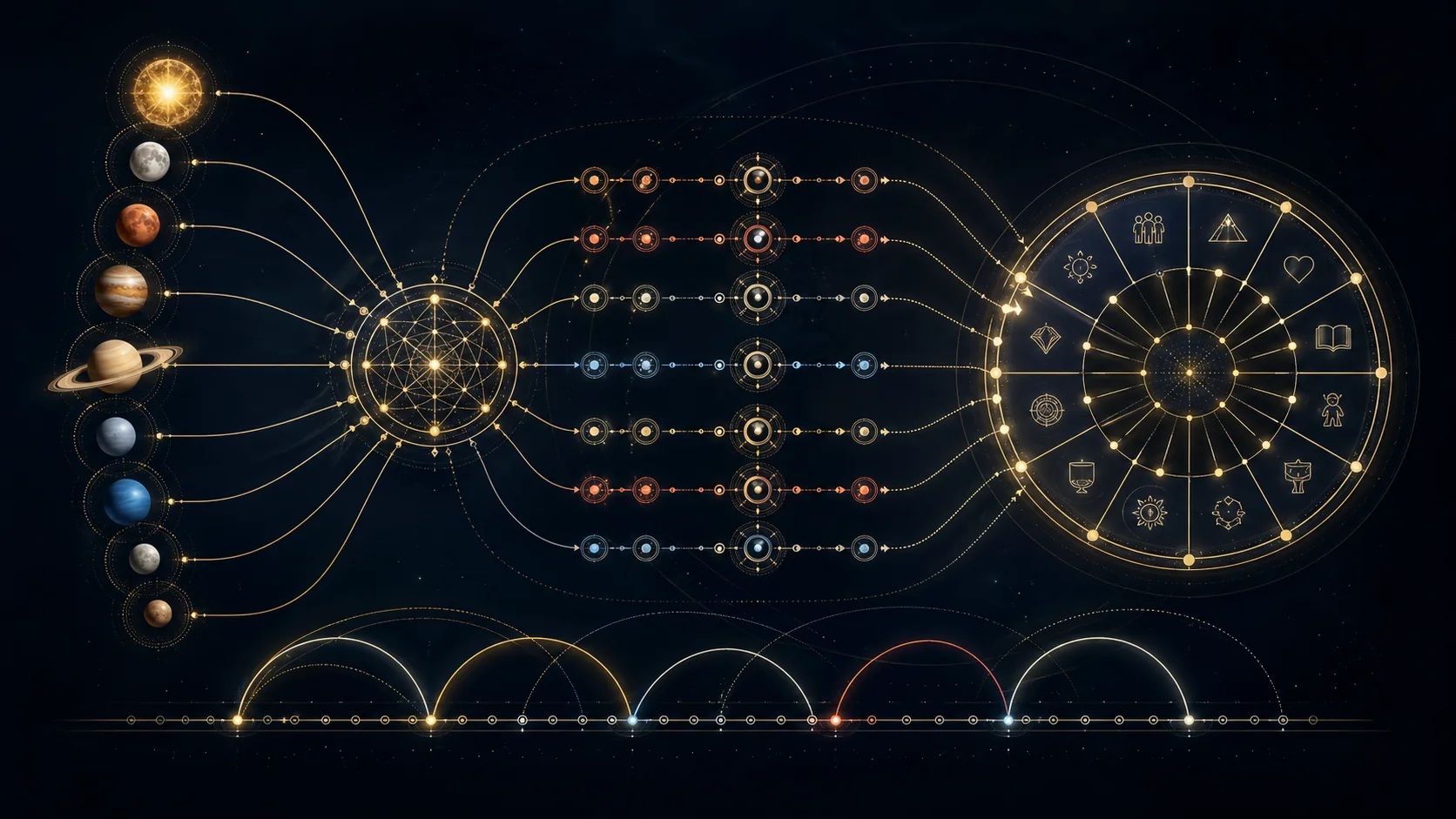
One practical approach is to think of the API in layers. The first layer identifies the relevant event category. The second layer maps that category to houses and significations. The third layer checks the current dasha and sub-period. The fourth layer compares the star and sub-lord logic. The fifth layer may use ruling planets as a real-time confirmation mechanism. Each layer narrows the outcome and improves consistency.
For example, suppose a user asks about starting a new business. The app could map that to houses related to profession, initiative, resources, and expansion. It then checks whether the running periods signify those themes. If the current period is strongly connected to those houses, the API may return a favorable timing window. If the sub lord indicates caution or delay, the app can advise patience or a later phase.
In a real-world product, this kind of structure helps both users and developers. Users receive answers that seem personalized. Developers receive a system that is easier to maintain because the logic is modular. If later the team wants to improve how a particular question type is handled, they can update that module without changing the entire engine.
The challenge, of course, is that astrology is not a mechanical checklist alone. It is interpretive, and interpretation requires context. That is why KP is so useful for an API. It offers a disciplined way to combine structure with interpretation. The app can still provide nuanced text, but the underlying decision should be based on explicit rules and confirmations.
Think of a user who asks, after many months of uncertainty, whether a pending interview will lead to an offer. If the app simply says the dasha is favorable, the answer may feel incomplete. If it says the current period supports the profession but not the final acceptance, the user gets more meaningful guidance. If the sub period activates success, then the app can indicate a stronger window. That kind of layered answer is exactly what people expect from a serious timing tool.
In this sense, the API becomes a modern reflection of the astrologer’s process. It does not replace judgment; it organizes it. It gives users access to a systematic reading of timing in a form that is fast, repeatable, and easier to integrate into digital products.
Why Sub-Lord Confirmation Is So Important
The sub lord is one of the most important reasons KP astrology is valued for timing. A star may indicate the broad promise, but the sub decides whether that promise becomes concrete. This is crucial in app outputs because users are usually not satisfied with broad tendencies. They want to know whether the matter will materialize.
Suppose two people have a similar dasha running. One person gets the result quickly, while the other waits much longer. The difference often lies in finer-level confirmations. The sub lord can show support, denial, partial support, or delay. This is why the sub layer should never be ignored in a dasha timing API. It is not a decorative detail. It is a core part of judgment.
Users may not always understand the technical terms, so the app should translate them carefully. Instead of saying only that the sub lord is favorable, the app might explain that the current timing supports manifestation of the requested event. If the sub lord does not support it, the app can state that the promise is weak or not active now. That simple language helps bridge astrology and user experience.
One illustrative example is travel. A person may feel restless and expect a trip simply because the major period looks active. But unless the sub lord also aligns with travel significations, the trip may not happen when expected. Another person might have a quiet-looking major period, yet a strong sub-period can trigger sudden movement. These are the kinds of differences that make KP timing practical.
For app builders, this means the output cannot be built from one chart factor alone. The API should be able to compare the main period with the sub period and evaluate how each contributes. If the two layers agree, the confidence can rise. If they disagree, the response should become cautious. This creates a more realistic and trustworthy product.
It is also worth noting that users often remember the moments when astrology felt accurate. More often than not, those are the moments when the timing was specific, not broad. The sub lord helps achieve that specificity. In a modern app, specificity is one of the biggest drivers of satisfaction and retention.
How Ruling Planets Support Judgment
Ruling planets are often used as a confirmation tool at the time of judgment. They help an astrologer check whether the query moment resonates with the chart and the question being asked. In a digital system, this can be built into the API as a supportive layer rather than the only decision-maker.
The value of ruling planets is that they add immediacy. A user is not asking in a vacuum. They are asking now, at a specific moment, with a specific concern. If the ruling planets align with the house significations and the running period, the timing feels more complete. The ruling planets calculator can help learners see how this principle works in a practical format.
In app design, ruling planets can be used to answer questions such as: Is the present moment suitable for judgment? Does the current query time support the theme of the chart? Do the live indicators agree with the running dasha? These questions are particularly valuable when the app is intended for instant consultations or self-service predictions.
For example, a user may open the app late at night and ask about business expansion. The app can check not only the natal timing, but also whether the ruling planets at that moment support the issue. If they do, the response may carry more confidence. If they do not, the app may suggest that the query should be reconsidered at another time or that the active period is not yet ripe.
This kind of real-time confirmation gives the app a more consultative feel. It makes the experience closer to a live astrologer’s review, even if the response is automated. It also reinforces the KPI of accuracy, because the system is not relying on one static output. It is checking the timing in context.
Examples Of Event Timing In An App Setting
To make the logic more concrete, let us imagine a few common situations that an Indian astrology app may handle.
Marriage timing: A user asks when marriage is likely. The app identifies the relevant houses, checks the current dasha and sub-period, and evaluates whether the sub lord supports partnership and union. If the indicators align, the app can present a favorable window. If they do not, the app can indicate that the matter may be delayed or require a later period.
Career change: Another user wants to know if they should expect a job switch. The app maps the question to profession-related houses and reviews whether the running periods show movement, opportunity, or transition. A supportive period may indicate interviews, offers, or a change in role. A weak period may suggest waiting rather than forcing the move.
Travel: Someone planning a trip asks whether the next few months will be suitable. The app checks travel-related significations and the timing layers. If the sub lord and ruling planets support movement, the period can be presented as favorable. If not, the app may note uncertainty or delay.
Property matters: A user asks about buying or selling a house. The app needs to evaluate property-related houses and the relevant dasha-subdasha combination. If the planets indicate support, the app can suggest a good window. If the timing is weak, the app should avoid overstating the result.
These examples show why a dasha timing API must be specific to the question. A generic answer can never match the clarity of a targeted one. KP astrology gives the structure needed to make those targeted judgments.
Building Trust Through Clear Explanations
One of the most overlooked parts of an astrology app is explanation. Users may accept a prediction more easily if they understand the logic behind it. A dasha timing API should therefore not only output a result, but also explain it in a way that reflects the method without overwhelming the user.
For instance, instead of simply saying “Yes, marriage will happen,” the app could say that the current dasha supports partnership themes and the sub period confirms the activation of the matter. That kind of explanation feels more credible. It also educates users, which can increase long-term trust in the platform.
When explanations are too vague, users often feel disconnected. But when they are too technical, users may become confused. The best approach is balanced language. The app can mention stellar and sub-level logic, the role of ruling planets, and the relevant timing window, while still keeping the response readable.
This is another reason KP astrology fits well in an app format. The system can be explained in modular pieces. The user does not need to see every calculation. They need enough transparency to feel that the result came from a disciplined process. That transparency is what turns an ordinary astrology app into a more serious and trusted tool.
An app that consistently explains its answers also creates a learning effect. Users begin to notice patterns. They see how the major period sets the stage and how the sub period triggers the event. Over time, they become more engaged with the system and more confident in its structure. That is a valuable outcome for both education and product adoption.
Learning KP Astrology For Better App Design
If you are building or evaluating a dasha timing API, learning the underlying astrology is essential. A developer can implement basic logic, but without understanding the method, the output may be shallow. KP astrology requires a genuine grasp of house significations, sub-lord judgment, and ruling planet confirmation.
That is why structured learning is so important. The more clearly you understand how the astrological logic works, the better you can translate it into software. The same applies to users who want deeper insights. A thoughtful learner can use an app more effectively when they know what the output really means.
Our courses are designed to help learners move from surface-level astrology to practical judgment. This is particularly useful if you want to understand not just what a timing system says, but why it says it. When the learning path is strong, the app design becomes stronger too, because the logic behind the product is clearer.
For many students, the moment of understanding comes when abstract concepts suddenly connect to real events. They may remember a friend’s marriage, a delayed transfer, or a sudden job offer and realize how the timing layers fit together. Those moments make KP astrology feel alive, not theoretical. In app development, that same awareness helps ensure the product mirrors real decision-making rather than only displaying calculations.
If you want to go deeper into this subject, it helps to study examples, review case patterns, and practice with actual chart-based questions. The more you work with timing logic, the easier it becomes to see how a system could be encoded in an application. This is where astrology education and product design meet.
A Practical Way To Think About The API Workflow
A useful way to imagine the workflow is as a sequence of questions the API asks itself. First, what is the user asking about? Second, which houses and significations are involved? Third, what is the running dasha and sub period? Fourth, do the star and sub lord support the matter? Fifth, do the ruling planets confirm the judgment at the moment of inquiry? Only after these steps should the app present a result.
This workflow helps prevent rushed conclusions. It also makes the system easier to debug and improve. If the output seems off, the team can inspect which layer produced the mismatch. Was the event category mapped incorrectly? Was the sub lord interpreted too broadly? Did the ruling planets not support the query time? Each of these questions can be reviewed systematically.
For users, this structure means the app feels organized. It does not jump randomly between optimistic and pessimistic answers. It follows a recognizable path. That consistency matters a lot in astrology, where trust depends on the sense that the method is stable.
In a well-designed app, the response may also vary depending on the confidence level. A stronger alignment of indicators could produce a firmer answer. A partial alignment could produce a tentative or conditional answer. A weak alignment could produce a message that the timing is not yet active. This approach respects the logic of KP astrology while keeping the user informed.
Final Thoughts On Dasha Timing In Indian Astrology Apps
Dasha timing is one of the most important features in any serious astrology application because it connects the chart to real-life events in time. In KP astrology, this becomes even more refined through the star lord and sub lord framework, along with the support of ruling planets. When these principles are translated carefully into an app, users receive responses that are more focused, more practical, and more meaningful.
The key lesson is simple: timing is not just about periods, but about confirmation. The star lord shows the direction, the sub lord confirms the result, and the ruling planets can support the judgment at the moment of inquiry. A dasha timing API should reflect that layered reasoning rather than reducing it to a single label.
For Indian astrology apps, this creates an opportunity to offer a better user experience. Instead of broad and generic forecasts, the app can provide specific, question-based timing. Instead of one-dimensional output, it can show a carefully reasoned answer. And instead of asking users to accept a prediction blindly, it can explain the method behind the response.
That is the real value of KP astrology in a digital setting. It gives structure to timing, clarity to interpretation, and discipline to prediction. When applied well, it can help an astrology app move from being merely informative to genuinely useful.
Related Course Videos
Learn KP Astrology
Enroll in our comprehensive Bootcamp to master these techniques yourself.
Enroll in BootcampExplore More from KP Astro Academy
Related Tools & Features
- Childbirth Selection Tool
- Birth Time Rectification Tool
- Ruling Planets Calculator
- Marriage Matchmaking Calculator
- Career & Education Finder
- Transit Search & Prediction
- Planetary Remedies Finder
- Free KP Kundli
- Daily Panchang Calculator
- Vedic Ephemeris Calculator
- Hora Chart Calculator
- Ashtak Varga Calculator
- KP Event Finder
- Personal Muhurat Finder
- Cusp Promise Calculator
- Bhav & Dasa Phal Predictions
- Dasha Promise Calculator
- KP Astrology Consultation
Further Reading
- Childbirth in KP Astrology: Promise, Delay, Denial, and Hope
- Gemstone Remedy Ecommerce Integration
- Marital Discord: How Relationship Karma Really Plays Out?
- KP Astrology vs Western Astrology: The Role of Geographic Precision in Chart Casting
- KP Astrology vs Vedic Astrology: Which System is More Accurate for Predictions?
- 🔮 The ₹500 vs ₹5,000 vs ₹50,000 Astrologer: What You’re Really Paying For
- Marriage Timing in KP Astrology
- Ai Astrology Assistant For Marketplaces And Apps
- Fast Kp Astrology Chart Api For Saas Products
- When Will I Get Married? Accurate Marriage Timing with KP Astrology
- Education Mismatch: Why Your Degree May Not Define Your Career
- KP Astrology Remedies: Do Gemstones and Mantras Really Work?
Loading article...