Education Mismatch: Why Your Degree May Not Define Your Career
Many students and professionals assume that the subject they study will become the subject they work in. In real life, that does happen for some people, but many others find themselves in a very different role after graduation. An engineering student may end up in sales. A commerce graduate may build a career in content creation. A science student may move into operations, analytics, or even entrepreneurship. This does not automatically mean the degree was useless. It often means the person’s education and professional path are not tightly connected.
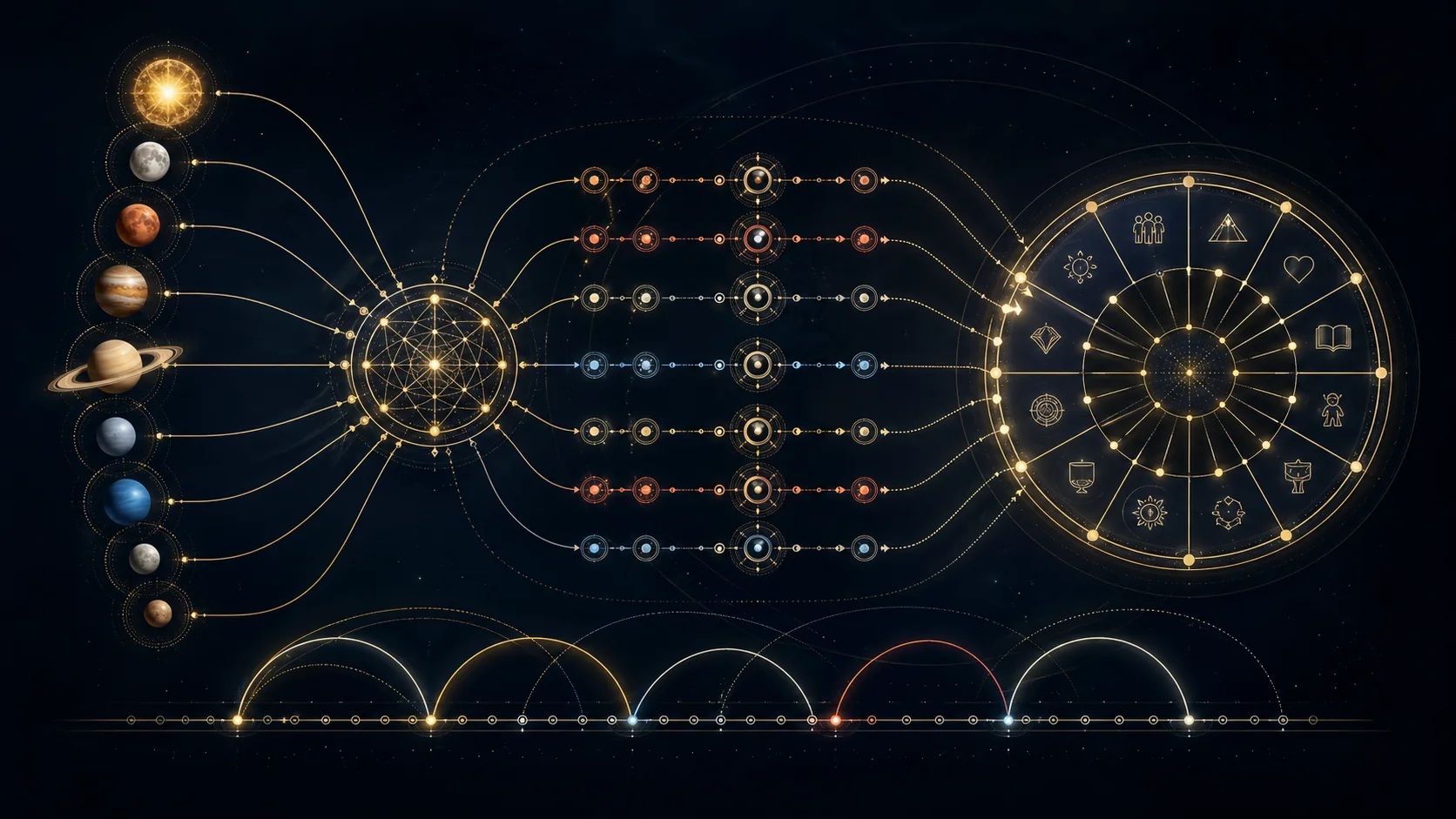
KP Astrology explains this pattern through clear cuspal linkages. The relationship between education and professional success becomes easier to understand when the 4th cusp, 9th cusp, and 10th cusp are examined together. The 4th cusp shows primary education and foundational learning. The 9th cusp indicates higher studies, specialization, and advanced training. The 10th cusp shows profession, work environment, and the actual source of income. When these points connect well, a person is more likely to use what they studied in their career. When they do not connect, a mismatch can appear.
This is one reason so many people ask why a degree does not always define a career. The answer is often hidden in the chart, not in the report card. A student may do well academically, but if the career significations do not support that field, the final professional path may move in another direction. Understanding this early can help a student choose subjects, courses, and training more wisely instead of discovering the mismatch only after several expensive years.
Why education and career do not always move together
Education and career are related, but they are not the same thing. Education is what you learn. Career is what you repeatedly do for income and long-term direction. A person may study one field because of family expectations, social pressure, curiosity, or available college options, but later choose a different profession because that path suits their talents, timing, or opportunities better.
For example, consider a student who completes a degree in mechanical engineering. During college, the student may enjoy the technical subjects, but after graduation, the available job openings may be mostly in customer support, operations, or business roles. Over time, the person may start working in a field that uses communication and coordination skills more than engineering concepts. Another student may complete a degree in biology and later become a teacher, writer, laboratory administrator, or medical representative. The degree still matters because it shaped thinking and discipline, but it may not become the direct profession.
KP Astrology treats this as a meaningful distinction. The 4th house and 9th house describe learning, while the 10th house describes career output. If the chart strongly supports education but weakly supports the corresponding profession, the student may remain academically capable yet professionally diverted. If the 10th house is linked to different domains than the education houses, the person may naturally earn through another line of work.
This is also why some people feel they are “doing something else” after education. They may not be failing. They may simply be following the stronger professional promise shown in the chart. In practice, that can be a relief when explained properly, because it removes the unnecessary feeling that a change in career means wasted years.
The role of the 4th, 9th, and 10th cusps
To understand education-career mismatch, it helps to keep the role of each cusp clear.
- 4th cusp: Schooling, basic education, academic foundations, formal learning during the early phase.
- 9th cusp: Higher studies, advanced courses, research, specialization, and long-distance or refined knowledge.
- 10th cusp: Profession, job role, public standing, work responsibility, and the way income is earned.
The 4th cusp tells us what the person learns at a foundational level. The 9th cusp shows whether higher education becomes necessary or beneficial. The 10th cusp reveals the actual occupation. If the education houses and career house support one another, the person may remain in the same broad domain from study to job. If they do not, then education may become a stepping stone rather than a direct route.
Many students are surprised by this because they imagine the degree itself creates the career. In reality, a degree is one factor among many. Skills, timing, market demand, family situation, confidence, and personal preference all matter. KP Astrology adds another layer by showing whether the chart supports continuity between study and work or encourages a shift.
For example, a student may complete an MBA and still work in a family business, a start-up, a training role, or a field unrelated to business administration. Another person may complete a degree in literature and become a recruiter, trainer, or marketing executive. These paths may look unexpected from the outside, but they are common when the chart’s 10th cusp has stronger connection with other significations than with the original education track.
How KP Astrology checks the connection
In KP Astrology, the first question is not simply, “What did the person study?” The question is, “What do the cuspal linkages show?” To judge whether education translates into career, the 4th cusp and 9th cusp are examined for their connections with the 10th cusp.
A useful example is this: if the sub-lord of the 4th cusp signifies the 10th house, the person’s education is more likely to be usable in profession. Similarly, if the 10th cusp sub-lord is placed in the star of a planet signifying the 4th house, the profession may reflect the educational background. In simple terms, the chart is showing a bridge between learning and earning.
If that bridge is strong, the person may feel their studies are paying off in the exact field they wanted. They may study accounting and become an accountant, study engineering and become an engineer, study law and work in legal services, or study medicine and enter a related healthcare role. If the bridge is weak or absent, the degree may still improve general capability, but the final job may move elsewhere.
This does not always mean the person fails in the studied field. Sometimes the person has enough skill to earn in a different area more quickly. A student trained in science may discover a stronger career in data operations because the job market rewards analysis and precision. A graduate in commerce may find that teaching, administration, or client handling suits them better than pure finance. These are not random accidents. In many cases, they are visible in the chart as a lack of direct linkage between the education houses and the career house.
What a strong linkage can look like in real life
Imagine a student who completes a degree in computer science and later becomes a software developer. The degree and the job align clearly. Such a person may have taken internships, attended technical workshops, and built a steady path toward the same field. Even if the job title changes over time, the career remains close to the original education.
Now imagine another student who studies computer science but discovers a strong interest in product management. The person may use technical understanding in meetings, but the day-to-day work involves coordination, planning, writing user stories, and communicating with teams. The education still helps, but the profession is no longer a direct continuation of the degree. In chart terms, the 10th cusp may be connected to communication, leadership, or business significations more than the exact technical subject.
A third student may study commerce and join a bank, which seems related at first glance, but later move into sales management or client relationship work. The commerce degree helped build a foundation, yet the career direction is shaped by a different set of strengths. This kind of movement is common and often healthy when the person’s chart and natural aptitude support it.
What a weak linkage can look like in real life
When there is no meaningful connection between the 4th or 9th cusp and the 10th cusp, the career path may drift away from the original subject. This often happens gradually. A student may complete a degree because it was expected, then start preparing for government exams, then accept a different kind of job for immediate income, and finally settle into a role that has very little to do with the original qualification.
Take the case of a graduate who studied electrical engineering but enters digital marketing. At first, the switch may feel temporary. The person may think, “I will do this until I find an engineering role.” But if the marketing role offers better stability, satisfaction, or growth, the individual may remain there long term. The chart may have indicated that the 10th cusp resonates more with communication, creativity, or business than with the studied subject.
Another common example is a student who studies biotechnology but later works in operations at a hospital, a laboratory support team, or a service company. The original field helped build discipline and technical understanding, but the profession develops in a different direction. This is exactly the kind of deviation that KP Astrology discusses when education and career houses are not connected strongly enough.
Why deviation happens after college
Career deviation from college degrees is not unusual. In many families, the student chooses a subject because it is available, affordable, recommended, or considered respectable. Later, when real work begins, the person may notice that another field suits their nature better. They may be more comfortable speaking with clients than calculating formulas, or more effective organizing people than doing technical tasks. As a result, the final job may not reflect the degree title.
There are practical reasons too. Job markets change. Some degrees open fewer immediate positions than others. Internship access may be uneven. Location matters. Financial pressure matters. And sometimes the student simply grows into a different interest after graduation. KP Astrology does not deny these realities. Instead, it offers a framework for seeing why certain paths become easier than others.
When the 4th and 9th houses are strong for learning but disconnected from the 10th, education may build knowledge without directly shaping profession. This can be frustrating if a student expected a straight line from college to career. But it can also be useful because it explains why someone can be successful in a field that was never their degree subject.
For instance, a graduate in electronics may later run a retail business. At first glance this may look unrelated. Yet the degree may have helped the person become analytical, organized, and comfortable with systems. Those qualities are still valuable in business. In a similar way, a literature graduate may become a communications specialist because reading, writing, and interpretation are exactly the skills needed in that environment.
How students can use this understanding early
One of the biggest benefits of checking education-career linkages early is better decision-making. If a student knows that the chart supports a career close to the field of study, they can invest more confidently in that track. They can choose internships, certifications, and projects that strengthen the same direction.
If the chart suggests a mismatch, that does not mean the degree should be abandoned. It simply means the student may need to think more broadly about future roles. A person who studies a subject with weak direct career linkage may still succeed through related fields, cross-functional roles, or skill combinations. For example:
- An engineering student may prepare for data analytics, operations, technical sales, or project coordination.
- A commerce student may explore accounting, banking, business development, teaching, or administration.
- A science student may consider research support, healthcare services, training, or regulatory work.
- An arts student may build careers in content, media, design support, public relations, or recruitment.
This practical approach reduces disappointment. Instead of assuming one degree must lead to one fixed job, the student can map possible options earlier and avoid panic after graduation. In many cases, the chart is not saying “No career.” It is saying, “Your career may come through a different route than the one you expected.”
Parents and mentors also benefit from this understanding. They often pressure students to choose what looks prestigious rather than what fits the long-term career picture. When the education and profession houses are examined properly, it becomes easier to advise realistically. The focus shifts from the label of the degree to the actual likely outcome.
A realistic example of a mismatch turning into success
Consider a student from a middle-class family who completes a degree in mechanical engineering. The family expects a technical job, and the student initially tries for such roles. But the opportunities are limited, and the student is not finding satisfaction in repeated technical interviews. Meanwhile, the same student begins helping a relative with business presentations and customer communication. That part feels easier and more natural.
After a short while, the student joins a company in business development. Over time, the engineering background becomes a plus because it helps with product understanding, but the daily work is sales, negotiation, and client interaction. From the family’s perspective, this may look like a deviation. From a professional perspective, it is a successful adaptation. The person is earning well and using strengths effectively, even though the degree and job do not match perfectly.
Another example could be a commerce graduate who takes up a role in content strategy. The person may not have planned this path at all. Yet a strong ability to understand business terms, write clearly, and explain ideas simply makes the transition smooth. The degree helped, but not in a direct textbook way. The 10th cusp may have connected more strongly to communication or creative expression than to strict commerce jobs.
These stories are common because career development is rarely linear. KP Astrology helps interpret that non-linear pattern with more clarity, showing when the mismatch is part of the design rather than a personal failure.
When the degree does define the career
Not every chart shows mismatch. Many people do work in the exact area they studied, especially when the 4th cusp, 9th cusp, and 10th cusp are well linked. In such cases, the person may move from school to higher studies to profession in a smooth line. A medical student may continue into healthcare. A law student may enter legal services. A finance student may remain in accounting or banking. The educational pathway becomes the professional pathway.
This often creates a sense of stability. The person may feel that every stage builds naturally on the previous one. Internships, certifications, and work experience all reinforce the same direction. In chart terms, the education houses support the career house strongly enough to keep the profession aligned with the degree.
However, even in such cases, the final work role may still involve variation. A person who studied law may work in compliance rather than courtroom practice. A person who studied medicine may move into hospital administration or healthcare operations. The field remains connected, but the exact job shape can still vary. That is why the question is not only whether the degree matches the career, but how closely and in what form.
Why this matters for tuition, training, and timing
Education is a major investment of time, money, and energy. Families often spend years supporting one course with the hope that it will lead directly to a livelihood. When the result is a different profession, the emotional reaction can be strong. That is why this subject matters. It helps people understand the difference between learning for knowledge and learning for occupation.
When a mismatch is likely, it may be wiser to choose courses that offer transferability. A course in communication, analytics, business software, digital tools, or operations can support many careers. A student can still honor the main degree while building adaptable skills. This is especially useful when the chart shows that the 10th house is more likely to express itself through another domain.
Timing also matters. Sometimes the right career does not appear immediately after graduation. A person may need one or two job changes before the final profession emerges. The first job may simply be a bridge. Understanding the chart can make that transition feel less discouraging. Instead of assuming failure, the student can see the process as a gradual unfolding.
Practical takeaways for students and professionals
If you are a student, ask yourself whether your current subject is something you want to study, something you want to work in, or both. If those answers are different, plan accordingly. Choose internships, certifications, and projects that fit your likely career direction, not just your degree title.
If you are already working in a different field from your education, do not assume your degree has no value. It may still be supporting your thinking, communication, discipline, or problem-solving. The mismatch may simply mean your professional significations are broader than your academic ones.
If you are advising a child or a younger relative, avoid forcing a single outcome based only on the course name. A person can succeed in many ways, and the chart may show that the original subject was always meant to be a stepping stone rather than the destination.
Most importantly, look at education and career as two connected but distinct stages. The first builds knowledge. The second expresses that knowledge in the world. When those stages align, life feels straightforward. When they do not, the person may still build a strong and rewarding career, only through a different route.
KP Astrology gives a structured way to read that route. By checking whether the 4th cusp, 9th cusp, and 10th cusp support one another, it becomes easier to understand why some people work exactly in their studied field while others discover success elsewhere. That clarity can save time, reduce confusion, and help students make wiser choices before the mismatch becomes expensive.
For readers comparing predictive approaches, the method also becomes more meaningful when contrasted with broader systems such as KP Astrology vs Vedic Astrology. The practical value lies in clear house-based analysis, especially when career decisions are involved.
When the educational path and professional path differ, the question is not whether one of them was wrong. The better question is: what does the chart say about the path that actually becomes sustainable? Once that is understood, the person can make choices with more confidence and less regret.
Explore More from KP Astro Academy
Explore More from KP Astro Academy
Related Tools & Features
- Childbirth Selection Tool
- Birth Time Rectification Tool
- Ruling Planets Calculator
- Marriage Matchmaking Calculator
- Career & Education Finder
- Transit Search & Prediction
- Planetary Remedies Finder
- Free KP Kundli
- Daily Panchang Calculator
- Vedic Ephemeris Calculator
- Hora Chart Calculator
- Ashtak Varga Calculator
- KP Event Finder
- Personal Muhurat Finder
- Cusp Promise Calculator
- Bhav & Dasa Phal Predictions
- Dasha Promise Calculator
- KP Astrology Consultation
Further Reading
- Childbirth in KP Astrology: Promise, Delay, Denial, and Hope
- Education, Skill, and Why Your Degree May Not Become Your Career in KP Astrology
- Dasha Timing Api For Indian Astrology Apps
- How to Rectify Birth Time Using KP Astrology: A Step-by-Step Guide
- Cusp Promise Api For Advanced Astrologers
- Education and Professional Success: The Role of 4th and 10th Houses in KP Astrology
- What to Expect in a Professional KP Astrology Reading
- Live Ruling Planets vs Birth Chart Ruling Planets: A KP Astrologer's Guide
- Ashtakvarga System: Measuring Planetary Strength in Your Kundli
- Career Business Astrology Report Api
- Safe Gemstone Recommendations For Consultants
- From Chaos to Calm: The Immediate and Long-Term Benefits of Daily Meditation