Ashtakvarga System: Measuring Planetary Strength in Your Kundli

Understanding Ashtakvarga Points
Ashtakvarga is a mathematical system that calculates the collective strength of planets across the 12 houses of your Kundli. Instead of relying only on broad sign-based interpretations, it breaks the chart into a practical scoring method that shows where planetary support is naturally stronger and where it is weaker. That makes it especially useful when you want to understand why one part of life seems to flow more easily than another, even when the same planet is involved.
- Points Range from 0 to 8: Representing the strength of a specific planet in a particular house.
- 28+ Points Indicate a Strong House: Houses with high scores can absorb transits and yield positive results.
- Useful for Fast Transit Evaluation: Helps identify which transiting planets will bring maximum benefits.
Ashtakvarga points act as a shield or amplifier for planetary transits in your natal chart. A house with stronger support often handles pressure more gracefully, while a house with fewer points may feel more sensitive when a planet passes through. This does not mean that a low score automatically brings difficulty; rather, it shows where patience, planning, and careful timing may matter more. In practical terms, Ashtakvarga gives you a way to compare houses side by side and notice which areas of life are naturally buffered and which areas require more deliberate effort.
Many people first encounter astrology through sign placements, house placements, or planetary aspects. Ashtakvarga adds another layer by asking a very simple but powerful question: how much support is available here? That question matters because two charts can look similar on the surface, yet produce very different experiences during transits. One person may find a Jupiter transit uplifting and productive, while another may feel only a mild change. Ashtakvarga helps explain why. The score gives context to transit results, especially when you want to move beyond general statements and understand the relative strength of each house.
The Fundamentals of the Ashtakvarga System
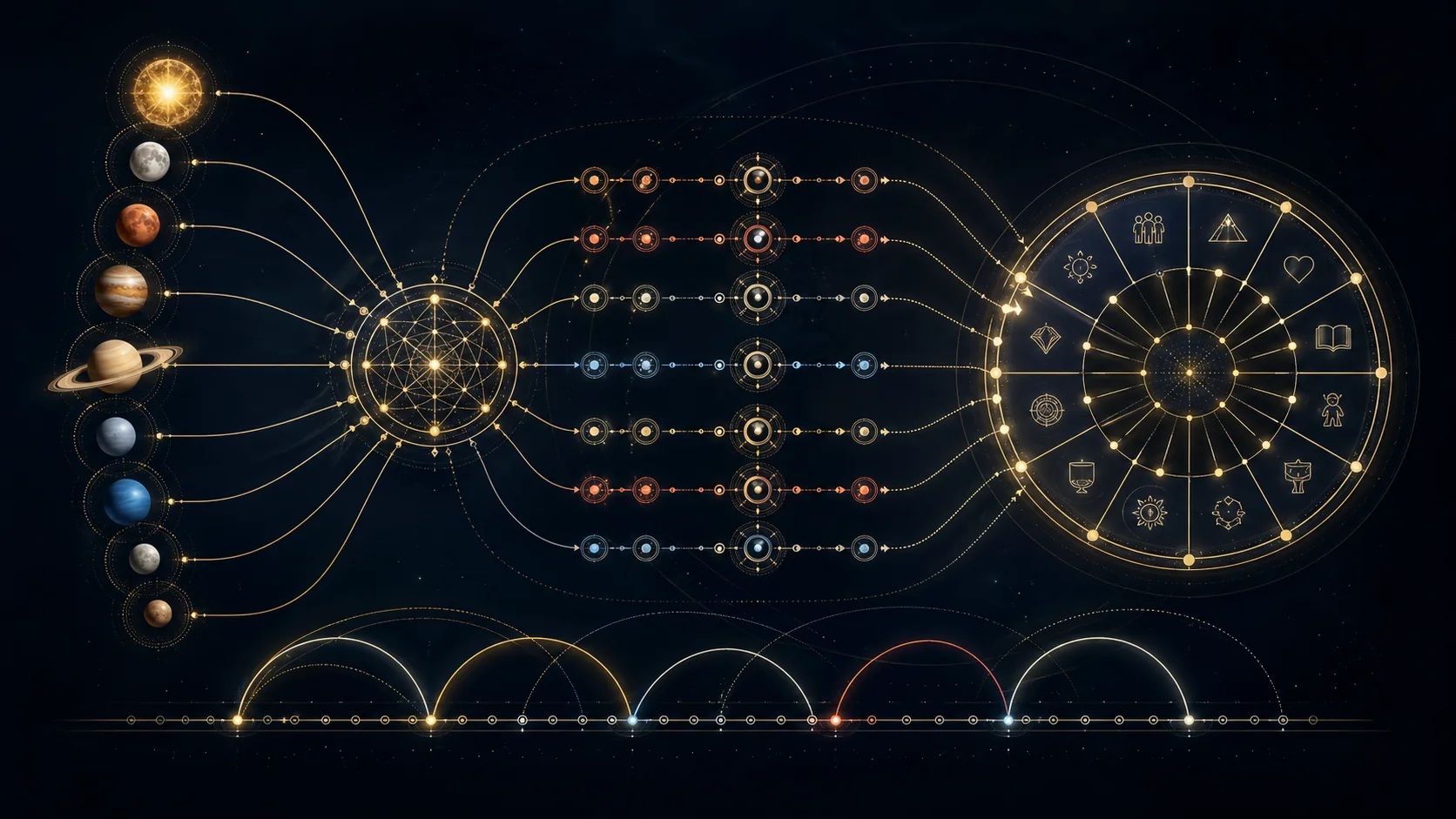
Ashtakvarga (meaning "Eight-fold division") assigns points (Bindus) to houses based on the positions of the Sun, Moon, Mars, Mercury, Jupiter, Venus, Saturn, and the Ascendant. It simplifies chart reading by converting planetary relationships into numerical scores. Rather than treating every house as equally responsive to a transit, the system recognizes that different houses have different levels of inherent support. Some houses seem ready to produce results as soon as a planet activates them, while others need more time, more favorable conditions, or stronger complementary influences.
The word "Bindu" literally refers to a point or dot, but in practice it functions as a unit of strength. When a house receives more Bindus, that house tends to have greater capacity to carry the results of a transit. When it receives fewer Bindus, the results may be less pronounced or may need additional triggers before they become visible. This is one reason Ashtakvarga is so valued for predictive work: it helps differentiate between houses that are merely activated and houses that are primed to deliver tangible outcomes.
It is also useful to remember that Ashtakvarga is not limited to one planet. The system considers the combined contribution of multiple factors. That makes it a collective measure rather than a single-planet opinion. In a real-life chart, that collective approach can feel more realistic because life events rarely come from one isolated influence. A career opportunity, for example, may depend on timing, confidence, external support, and the ability to act when conditions are favorable. Ashtakvarga helps you see whether the timing itself is offering enough momentum.
A simple way to think about the system is to imagine each house as a room and each Bindu as a lamp. A room with several lamps is easier to navigate and feels more active. A room with fewer lamps may still be usable, but it needs more intentional movement. Likewise, a house with higher Ashtakvarga points is usually more responsive to planetary traffic. This is why the system is so often used to judge transits, especially fast-changing ones like the Moon and other quicker-moving planets.
People sometimes assume that numerical astrology is mechanical or rigid, but Ashtakvarga is best understood as a guide to relative strength. It does not flatten the chart into a single score and it does not replace the broader interpretation of the Kundli. Instead, it adds a layer of precision. If your chart already suggests potential in a certain area, Ashtakvarga can show whether that potential has strong support at the time a transit arrives. If the house score is weak, the same transit may still matter, but its expression may be quieter, delayed, or less obvious.
Evaluating Bindus for Individual Planets
Each planet generates a Bhinnashtakvarga chart. If transiting Jupiter enters a house where it has 6 Bindus in its Bhinnashtakvarga, it will bring immense success. If it enters a house with only 2 Bindus, its positive transit effects will be muted. This is one of the most practical uses of the system because it lets you inspect not just the transit planet, but the destination house from the perspective of that planet’s own scoring pattern.
Bhinnashtakvarga can be especially revealing because it shows how each planet behaves differently across the chart. Jupiter may be supportive in one house and less supportive in another, while Venus or Saturn may show the opposite pattern. That means you cannot treat all transits as identical, even if the same planet is moving through a similar part of the zodiac. The score gives a more individualized reading. In everyday terms, it is like comparing how comfortable different guests feel in different rooms of the same house. Some guests settle in easily, while others need the right conditions to feel at home.
For example, imagine someone who is waiting for a job change. A Jupiter transit may bring more opportunities if it passes through a house with a higher score in Jupiter’s Bhinnashtakvarga. The person may receive a useful introduction, a positive reply, or a chance meeting that opens the door. But if the same transit occurs in a lower-scoring house, the person may still notice movement, yet the result may be smaller, slower, or dependent on additional support. The difference is not simply luck; it is the chart’s readiness to respond.
This is where Ashtakvarga becomes more than a technical chart. It begins to act like a timing assistant. If you are planning a conversation, a purchase, an academic submission, or an important practical step, it can be useful to know when the relevant house is better supported. A stronger score may not guarantee success, but it can indicate better reception. A weaker score may not stop progress, but it can suggest that the path may require more persistence or a more careful approach.
The same logic applies to the Moon’s everyday movement. Because the Moon moves quickly, it can trigger temporary shifts in mood, focus, attention, and activity. If the Moon transits a well-supported house, the day may feel more productive or emotionally settled. If it passes through a weaker house, the day may feel slightly more scattered or less aligned with your plans. This is why people who use Ashtakvarga for day-to-day judgment often watch the Moon closely. The Moon can indicate which days are better suited for action and which days are better for review, rest, or preparation.
It is helpful to approach Bindus as a measure of readiness. A house with high points is like soil that has already been prepared for planting. A house with low points may still grow something valuable, but it might need more careful watering, more time, and more attention to conditions. That image often makes the system easier to understand because it avoids the mistaken idea that a lower score means a permanently negative outcome. Instead, it shows varying levels of preparedness for planetary influence.
Another practical way to think about Bhinnashtakvarga is to compare it with a weather forecast. A transit may bring rain, but whether that rain nourishes the crop or creates disruption depends on the ground beneath it. A house with strong points absorbs and uses the transit more effectively. A house with fewer points may still feel the rain, but the experience can be uneven. The chart, in other words, tells you about receptivity, not just motion.
Understanding Sarvashtakvarga and House Totals
While Bhinnashtakvarga focuses on the score of individual planets, the combined total across all planets is called Sarvashtakvarga. This total is often especially important when evaluating the strength of a house as a whole. If a house reaches a high aggregate score, it is generally considered better equipped to generate positive results during transits. That is why many astrology readers pay close attention to the total number of points in each house rather than looking only at one planet at a time.
In everyday chart reading, the house total can function like a summary score. It tells you whether a life area has broad support. For instance, if a house connected to career, health routines, relationships, or finances shows a strong Sarvashtakvarga total, then transits through that house may be more noticeable and constructive. If the total is lower, the same transit may need a more careful interpretation. It may not deny opportunity, but it can suggest that timing and effort must work together more closely.
One reason house totals are so useful is that they help answer a familiar question: why does one period of life feel smoother than another? Sometimes the answer is not in a single major transit. It is in the overall support structure of the house receiving the transit. A strong total acts like a stable foundation. A weaker total can still hold important events, but the results may feel less sustained or more sensitive to surrounding conditions.
For example, a person may notice that professional matters move forward more easily during certain months, even though no dramatic planet change seems obvious. When that happens, the house total can offer an explanation. A favorable house score may be helping daily transits produce more visible results. On the other hand, if a person experiences repeated delays in the same area, the house total may reveal that the chart is asking for more patience, more planning, or more realistic scheduling.
The strength of Sarvashtakvarga is that it gives a broader map. It shows which houses are generally more fertile ground and which houses may need extra encouragement. That broader map is especially valuable when a reader wants to compare several life areas at once. A person may have strong support in one area of life and moderate support in another. Instead of viewing the chart as uniformly good or bad, Sarvashtakvarga encourages a more balanced understanding: some parts of life are naturally easier to activate, while others ask for more conscious work.
It can also help explain why the same transit affects different people so differently. If two people experience the same planetary movement, but one has a much stronger house total in the relevant area, their experiences can diverge significantly. One may feel momentum and opportunity; the other may feel only a subtle nudge. That difference is not random. It reflects the chart’s internal distribution of support.
In this way, Sarvashtakvarga acts as an overview, while Bhinnashtakvarga offers detail. Together they create a layered system. The overview tells you which areas of life are fundamentally strong, and the detail tells you which planet is likely to activate those areas more effectively. When used together, they can make transit interpretation much more precise and much more grounded in actual chart behavior.
Why Ashtakvarga Matters in Predictive Astrology
One of the main reasons people turn to Ashtakvarga is that it makes transit analysis more concrete. Instead of saying only that a planet is passing through a certain house, it asks whether that house is prepared to deliver results. This is especially helpful when a transit looks important in theory, but the lived experience is surprisingly mild or mixed. Ashtakvarga helps explain that gap by showing the underlying strength of the house receiving the transit.
Consider a person who is waiting for progress in a personal project. A planetary transit may suggest activation, yet the project does not move quickly. If the relevant house has a low score, the delay may make sense. The transit may be present, but the chart is not strongly amplifying it. Another person with a stronger score in the same area may experience visible progress, support from others, or a quicker outcome. This is why Ashtakvarga has a reputation for practical predictive value. It helps identify not just when something is active, but how strongly it may manifest.
The system is also useful because it respects variation. Astrology is not one-size-fits-all, and Ashtakvarga acknowledges that by design. A strong transit in one chart may be a minor transit in another. A smaller transit may become meaningful if it lands in a highly supportive house. This is one of the reasons experienced students often appreciate Ashtakvarga after they have already learned the basics of chart interpretation. It fills in the nuances that broad descriptions can miss.
Another benefit is that Ashtakvarga can help reduce overreaction. If someone sees a difficult-looking transit, the house score may show that the area is better supported than expected. That can temper anxiety and encourage a more measured response. Likewise, if a pleasant transit enters a low-scoring house, the person can avoid unrealistic expectations and plan more carefully. In both cases, the system encourages balance. It does not tell you what to hope for blindly; it tells you how to evaluate the conditions around that hope.
This balanced approach matters in real life because timing often shapes results as much as intention does. A person may be ready for a major step, but the environment may not yet be supportive. Another person may feel uncertain, yet the timing may be unusually favorable. Ashtakvarga helps bridge that mismatch by offering a house-level view of timing strength. That can make decision-making more grounded, especially when paired with the broader reading of the Kundli.
In many cases, readers use Ashtakvarga as a second check after assessing the main horoscope. If the chart suggests a possibility, Ashtakvarga shows whether the timing is conducive. If the chart suggests caution, Ashtakvarga may show whether the current transit is likely to intensify that caution or soften it. The result is a more layered interpretation that avoids relying on a single indicator. That makes the system especially useful for people who want practical, day-to-day relevance rather than abstract symbolism alone.
How Houses Respond to Transit Pressure
Every house in a Kundli represents a different life area, and each one responds differently when planets move through it. Some houses feel like busy intersections, quickly drawing attention whenever a transit arrives. Others are quieter and need stronger activation before their themes become noticeable. Ashtakvarga helps identify that difference in advance. It shows which houses can take on transit pressure smoothly and which houses may react more sensitively.
When a house has a higher score, it often behaves like a well-supported structure. Transit energy enters and is handled with relative ease. The results may appear as opportunities, clarity, coordination, or a sense that things are finally moving. When a house has a lower score, transit energy may still arrive, but the expression can be more erratic. There may be stops and starts, smaller gains, or a feeling that progress requires extra effort. Neither situation is inherently "good" or "bad" in a simplistic sense. They simply indicate different kinds of responsiveness.
For example, imagine a house related to learning or communication. If it holds a strong score, a Mercury transit may coincide with quick understanding, smoother conversations, or the ability to complete tasks efficiently. If the score is lower, the same transit may still bring mental activity, but the person may need to review details more carefully or avoid rushing. The house score does not change the transit, but it changes the environment into which the transit arrives.
This can be particularly helpful when evaluating repeated patterns. Some people notice that certain life areas consistently respond better than others. They may not know why one domain seems more stable, while another feels unpredictable. Ashtakvarga offers one possible explanation: the house totals are simply more supportive in the stronger area. Over time, this can show up as recurring ease, repeated delays, or varying degrees of success depending on which house is being activated.
In practical terms, this knowledge can improve planning. If a house score is strong, you may choose that period for initiating something important in that area. If the score is lower, you may still move forward, but with a more cautious strategy. For instance, you might spend more time preparing documents, testing options, or seeking feedback before committing. That is one of the best features of Ashtakvarga: it turns an abstract transit into a usable timing tool.
People often appreciate that Ashtakvarga does not demand dramatic conclusions. A house can be strong without guaranteeing immediate success. A house can be weak without guaranteeing failure. Instead, the system helps you understand the size and ease of the response. That subtlety is what gives it lasting value in predictive work.
Using Ashtakvarga for Daily Predictions
By checking the daily transit of the Moon against the Ashtakvarga points of your natal chart, you can identify auspicious days for meetings, investments, and starting new projects. It serves as an excellent tool for real-time decision making. Because the Moon moves quickly, it acts almost like a daily messenger, briefly activating different parts of the chart and revealing where the day may feel more supportive.
This makes Ashtakvarga especially appealing for people who want astrology to be useful in everyday life. A person preparing for a conversation, a test, a financial decision, or a travel plan may benefit from knowing whether the relevant house is well-supported that day. The Moon’s transit can create a subtle shift in tone. When it passes through a stronger house, the atmosphere may feel easier, more cooperative, or more focused. When it passes through a weaker house, the person may still accomplish something important, but they may need more patience or flexibility.
Consider a student who wants to submit an application. On one day, the Moon may transit a house with strong support for documentation or communication, and the student may find the process smooth and efficient. On another day, the Moon may activate a weaker house, and small issues may appear: confusion over details, a missing attachment, or delays in response. The difference may be subtle, but in time-sensitive situations, subtle differences matter. Ashtakvarga helps identify those windows more clearly.
Similarly, someone planning a business meeting may use the Moon’s transit as a practical check. If the Moon is moving through a well-supported house linked with professional exchange or visibility, the meeting may feel more productive. If it is moving through a lower-scoring house, the discussion may still be worthwhile, but the person may want to keep expectations realistic and avoid forcing decisions. This kind of daily timing is where Ashtakvarga often proves most relatable.
The value of this approach is not that it turns life into a rigid calendar. Instead, it helps you notice rhythm. Some days are naturally more responsive, while others are better used for preparation, observation, or maintenance. People who work with the system over time often develop a better sense of when to act quickly and when to allow more space. That can reduce frustration and improve confidence in day-to-day choices.
An important point to keep in mind is that daily prediction works best when seen as a guide, not a guarantee. The Moon can indicate a favorable atmosphere, but your own readiness, circumstances, and effort still matter. Ashtakvarga does not replace judgment; it supports it. That is why many people find it useful as a timing aid rather than as a final answer. It offers a practical snapshot of the chart’s current receptivity.
If you have ever noticed that some days seem naturally productive while others feel oddly resistant, this system offers a way to study that pattern with more structure. Over time, observing Moon transits against house scores can help you see recurring trends. That may be especially helpful when choosing dates for routine tasks, important discussions, or the start of a new initiative. In short, the system gives the daily astrologer a sharper lens.
Interpreting Strong and Weak Scores Responsibly
One of the most important habits in Ashtakvarga interpretation is avoiding extremes. A strong score should not lead to overconfidence, and a weak score should not lead to discouragement. The system is best used as a measure of support, not as a verdict. When interpreted responsibly, it encourages balanced planning and clearer expectations.
A strong house score can be exciting because it suggests that transits are more likely to produce visible results. But the result still depends on the broader chart and the nature of the planet involved. A supportive house may bring growth, yet the form of that growth may not always match what a person expects. For example, a transit may produce an opportunity that requires learning, restructuring, or adaptation before it becomes fully rewarding. In that sense, a strong score indicates capacity, not an identical outcome for everyone.
Likewise, a weak house score should not be treated as a warning to avoid all action. It simply suggests that the area may need more care. Sometimes the best use of a weaker period is to prepare, simplify, or wait for a better opening. Other times, a person may still need to move forward because the situation requires it. In those cases, the score can help shape strategy rather than determine whether action is possible at all.
One useful mindset is to treat Ashtakvarga like a planning companion. If the score is strong, you may proceed with more confidence. If it is moderate, you may proceed with a balanced approach. If it is low, you may focus on groundwork, patience, and attention to detail. This allows the system to become a tool for intelligent timing rather than a source of unnecessary fear or exaggerated optimism.
That balanced perspective also helps when comparing different houses. A person may discover that one area of life is well supported while another is not. Instead of assuming that the weaker area is doomed, the reader can look for ways to work with the timing. Perhaps the more favorable period is best used for preparation, while the less favorable period is better for correction and review. In this way, the chart becomes a living map rather than a fixed script.
The most practical readers of Ashtakvarga often rely on it as one piece of a larger interpretation. They combine the house score with planetary dignity, house ownership, transit condition, and the context of the person’s current life stage. That layered method produces far more useful guidance than any single indicator alone. Ashtakvarga shines when it is used as part of that broader, thoughtful analysis.
Examples That Make the System Easier to Picture
Imagine two people experiencing the same Jupiter transit. Both are waiting for progress related to education. The first person’s relevant house has a high score, so the transit may coincide with a favorable result: a scholarship response, a helpful mentor, or a clearer direction. The second person’s house has a lower score, so the same transit may still encourage growth, but the path may involve more delays, revisions, or administrative hurdles. The transit is similar, but the house strength changes the outcome’s ease.
Or consider someone dealing with a long-term household decision. If the transit moves through a house with strong support, family discussions may become more productive and practical solutions may emerge sooner. If the house support is weaker, the same discussion may need more patience, more compromise, or more time before consensus appears. Ashtakvarga helps you understand why one conversation feels smooth while another feels like work.
A third example involves a person planning to begin a fitness routine. If the relevant house is well-supported when the Moon or another useful planet transits through it, the person may find it easier to establish habits, stay disciplined, and feel motivated. If the house score is lower, motivation may come in waves, and the person may need a gentler plan. The point is not to predict success or failure in a simplistic way, but to adjust expectations to the timing.
These examples matter because they show how the system works outside theory. Ashtakvarga becomes more meaningful when you can connect the score to lived experience. Most people do not need an abstract lecture about bindus; they want to know whether a phase will support action, rest, planning, or change. The system answers that question in a structured way.
It is also worth noting that different life areas can be strong at different times. A person may have excellent support for finances but weaker support for travel, or strong support for communication but less support for emotional ease. This variation is normal. Ashtakvarga does not promise uniformity, and that is precisely why it can feel so practical. It reflects the uneven but patterned way life unfolds.
Why the System Remains Popular Among Serious Students
Ashtakvarga continues to attract interest because it provides a bridge between symbolic astrology and measurable strength. Many students appreciate tools that help them test interpretations against structure, and this system does exactly that. It gives a number to compare, a pattern to observe, and a practical method for transit judgment. For those who like clarity, that combination can be very appealing.
Another reason for its popularity is that it rewards observation. As you compare house scores with actual events, you begin to notice patterns that deepen your understanding of the chart. A strong score may repeatedly coincide with smoother outcomes, while a weaker score may repeatedly show slower results or the need for extra effort. That feedback loop helps build confidence in interpretation because it ties the system to lived experience.
Students also value Ashtakvarga because it is adaptable. It can be used for broad house evaluation, planet-specific transit judgment, or daily timing. It works in short-term and longer-term contexts. That flexibility makes it useful for many kinds of questions, from everyday scheduling to more significant periods of life planning. In that sense, it is both simple and rich: simple in its scoring method, rich in its interpretive possibilities.
Just as importantly, the system encourages disciplined thinking. It asks the reader to look at conditions rather than assumptions. That can be refreshing in astrology, where vague statements sometimes sound more certain than they are. Ashtakvarga pushes the reading toward structure. It asks: what is the house strength, how much support is available, and which transit is most likely to produce a meaningful result? Those are practical questions with practical value.
For a student trying to become more accurate, that discipline matters. It helps reduce guesswork and encourages comparison. Instead of relying only on impressions, the reader can study patterns, notice thresholds, and refine judgment over time. That is one reason the system remains a staple in serious predictive work. It does not ask you to believe in a claim blindly; it invites you to observe a pattern carefully.
Bringing It All Together
At its core, Ashtakvarga is a method for measuring how strongly different parts of the chart can respond to planetary movement. It translates planetary relationships into Bindus, summarizes those Bindus into useful house scores, and gives astrologers a practical way to judge transits. Whether you are studying Bhinnashtakvarga for individual planets or Sarvashtakvarga for overall house strength, the principle remains the same: some areas are more prepared to receive results than others.
That is what makes the system so useful. It does not replace the rest of the horoscope; it refines it. It does not predict life in a rigid way; it clarifies timing. It does not turn astrology into a scorecard for good or bad fortune; it reveals where support is naturally stronger. For anyone trying to understand why one transit feels powerful and another barely registers, Ashtakvarga offers a grounded answer.
The more you work with it, the more you may notice that astrology becomes less about generic statements and more about specific conditions. That shift can be incredibly helpful. Instead of asking only whether a planet is moving through a house, you begin to ask whether the house is ready to respond. That is a more practical, more nuanced, and often more accurate way to read the chart.
When used thoughtfully, Ashtakvarga can improve decision-making, strengthen timing judgments, and deepen your sense of how the Kundli behaves in real life. It is especially valuable for transit evaluation, because transits are where astrology often becomes most immediate and actionable. If you want to move from broad interpretation to finer timing, this system is one of the most useful tools to explore.
Ashtakvarga helps you see not just where a planet is moving, but how much support is waiting there. That simple shift in perspective can make transit reading more precise, more balanced, and more useful in daily life.
Explore more: Use the Ashtakvarga calculator to check house strength and compare planetary support across your chart. You can also revisit the main article on Ashtakvarga System: Measuring Planetary Strength in Your Kundli for a broader overview of the concept.
Explore More from KP Astro Academy
Explore More from KP Astro Academy
Related Tools & Features
- Childbirth Selection Tool
- Birth Time Rectification Tool
- Ruling Planets Calculator
- Marriage Matchmaking Calculator
- Career & Education Finder
- Transit Search & Prediction
- Planetary Remedies Finder
- Free KP Kundli
- Daily Panchang Calculator
- Vedic Ephemeris Calculator
- Hora Chart Calculator
- Ashtak Varga Calculator
- KP Event Finder
- Personal Muhurat Finder
- Cusp Promise Calculator
- Bhav & Dasa Phal Predictions
- Dasha Promise Calculator
- KP Astrology Consultation
Further Reading
- Childbirth in KP Astrology: Promise, Delay, Denial, and Hope
- Gemstone Remedy Ecommerce Integration
- KP Astrology Marriage Matchmaking: Beyond Gun Milan to Sub-Lord Compatibility
- Āyakalai 64: Tamil Traditions of Holistic Skill-Building
- Stop Asking “If” and “When?”
- Astrologer Knowledge Base For Ai Astrology Products
- The Science of KP Sub Lords in Baby Birth Time Selection: Longevity, Career, and Health
- Astrological Remedies: Scientific Principles Behind Mantra and Yantra
- 💰 Why Billionaires Turn to Astrology: A Maslow’s Hierarchy Perspective
- The Importance of Transit Rules in Timing Kundli Events
- Health and Disease in KP Astrology
- 🌕 The Navagraha Temples of Kumbakonam