KP Astrology Remedies: Do Gemstones and Mantras Really Work?
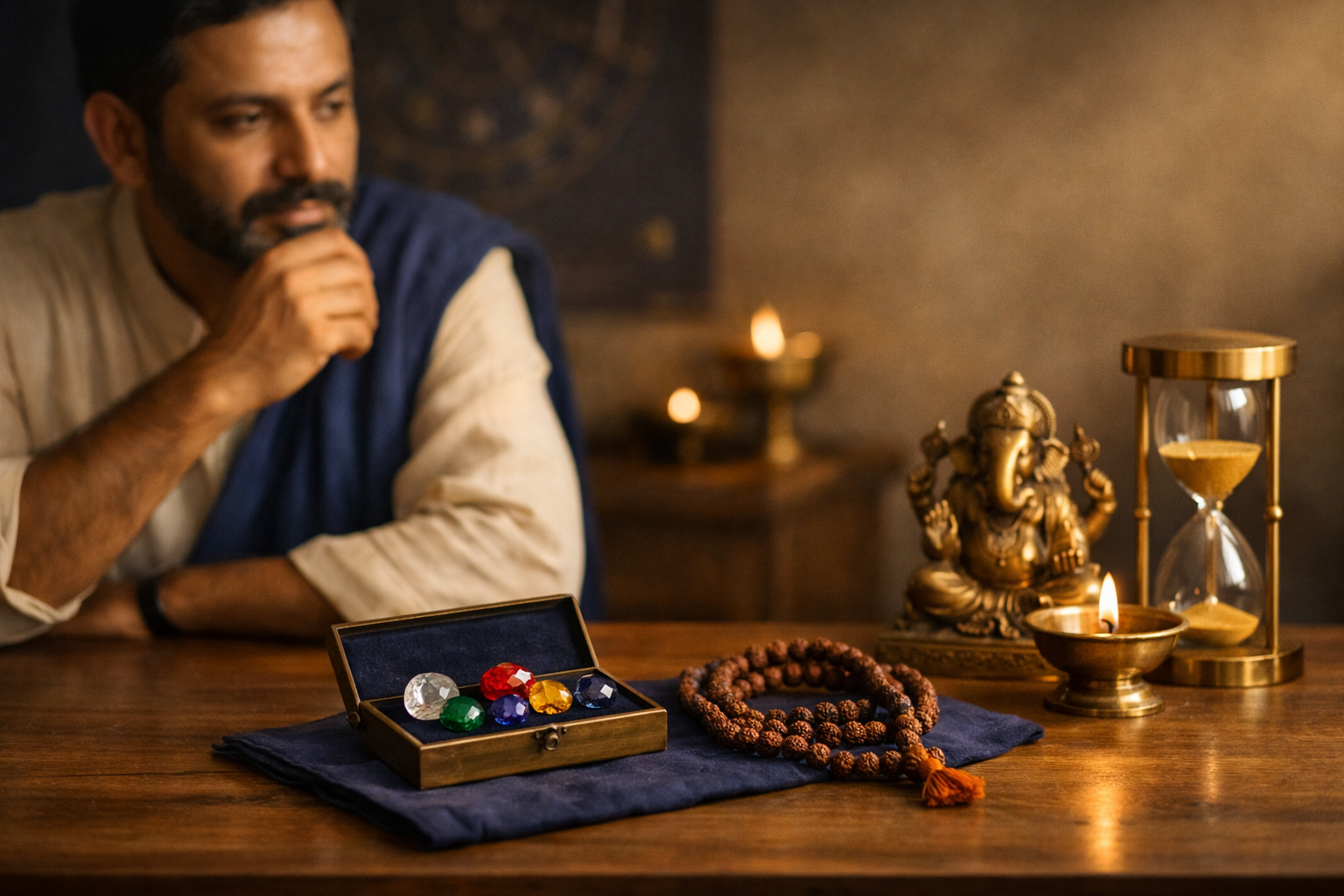
KP Astrology has always been known for one central promise: it helps you understand what is likely to happen, when it may happen, and why. That is why the topic of remedies often creates confusion. Many people come to astrology looking for relief from fear, uncertainty, or disappointment, and they naturally ask whether gemstones, mantras, or rituals can change the picture. In KP practice, the honest answer is more nuanced than a simple yes or no. Remedies may offer psychological support, but they are not treated as a way to override the chart.
That distinction matters because KP is built on precision. It is not a system that depends on vague suggestions, and it does not encourage the idea that every problem can be solved by a prescribed object or chant. Instead, it asks you to read the chart carefully, especially the sub-lord of a cusp, and to understand the real promise of the horoscope. Once that promise is clear, the role of any remedy becomes easier to evaluate without exaggeration.
Many astrology discussions mix together very different traditions. In some approaches, remedies are presented as a major part of the process: wear a stone, perform a ritual, donate on a specific day, repeat a mantra, and the outcome will change. KP Astrology does not operate that way. The method is primarily predictive. It focuses on the natal promise, the running dasha and bhukti, sub-periods, and the transit triggers that activate results. If the chart does not promise an event, a remedy is not considered a substitute for that promise.
At the same time, it would also be unfair to say that remedies have no value at all. Human beings do not live only in logic. They live with stress, hope, expectation, and habit. A simple practice such as chanting a mantra, wearing a stone that reminds someone to stay confident, or doing service work during a difficult period can support discipline and calm. That support may not alter the horoscope, but it can alter how a person responds to life. In real life, that difference is not trivial.
This article takes a rational view of KP astrology remedies. It explains what Prof. K. S. Krishnamurti’s approach suggests, where remedies may offer practical or emotional support, where they become misleading, and why timing is often more valuable than a promise of correction. If you are trying to understand whether gemstones and mantras really work, the answer depends on what you mean by “work.” If you mean changing the sub-lord significations of a cusp, KP does not support that idea. If you mean helping a native stay centered, disciplined, and hopeful during a difficult phase, then some remedies may indeed have a place.
What Prof. Krishnamurti Said About Remedies
Prof. K. S. Krishnamurti developed KP Astrology as a structured predictive system that could give more specific answers than broad sign-based reading. The method relies on the logic of cusps, sub-lords, star lords, and house significations. Because the approach is so focused on accurate judgment, it does not place remedies at the center of the system. The chart is read first. The life event is judged first. The timing is calculated first. Only then does any discussion of practical support begin.
That is one of the reasons KP users often speak differently about remedies than people in other branches of astrology. In some traditions, a problem is immediately followed by a remedial prescription. In KP, the first question is usually, is the event promised at all? If the promise is absent, then no amount of ritual is expected to manufacture it. If the promise exists, then timing and circumstances matter more than a symbolic correction.
Prof. Krishnamurti’s emphasis was not on ritual intervention but on judgment. A native may want marriage, but if the 7th cusp sub-lord does not signify the relevant houses, the chart may not support it in the desired period. A native may want a promotion, but if the 10th cusp sub-lord does not connect with career houses in a supportive way, the outcome is not indicated simply because a remedy was performed. That is the logic that keeps KP grounded.
It is also important to avoid a common misunderstanding. Saying that KP does not use remedies does not mean KP is hostile to faith, discipline, or spiritual practice. It simply means those practices are not treated as technical substitutes for the astrological promise. A mantra may help a person feel calmer. A charity practice may improve generosity and reduce obsessive worry. But none of those are presented as tools that can rewrite the significations of the chart.
For example, imagine a person who is anxious about a long job search. They are told to wear a gemstone and recite a mantra ten thousand times. They may feel more hopeful for a while, especially if the suggestion gives structure to their day. But if the chart indicates that the current dasha is not supportive of stable employment, the remedy is not changing the cosmic condition. At best, it is helping the native stay disciplined while waiting for a more favorable period. That is a meaningful difference.
KP Astrology therefore asks a practical question: what can be known clearly from the chart, and what can be done practically in response? That is a stronger foundation than making large claims about spiritual fixes. It also prevents emotional exploitation, because people under pressure are often vulnerable to expensive promises.
Why People Turn to Remedies in the First Place
To understand why gemstone and mantra discussions remain so popular, it helps to remember what people are actually seeking. Most people do not ask for remedies because they enjoy rituals for their own sake. They ask because they feel stuck. They want relief from repeated failures, relationship strain, career uncertainty, family pressure, or fear about the future. When life feels out of control, remedies offer something immediate to hold on to.
This emotional need is real. A person who has just lost a job may not be ready for a technical explanation of dasha periods. A student worried about exams may want an action they can take tonight. A parent concerned about a child’s future may prefer a tangible suggestion over a complex astrological analysis. Remedies can meet that psychological need because they provide an activity, a routine, and a sense of participation.
That is why many people find mantras comforting. Repetition creates rhythm. Rhythm reduces mental noise. A person who chants with sincerity often feels less scattered, even if the external situation has not changed. The same is true for other forms of spiritual discipline. Fasting, prayer, meditation, and service can all create a feeling of direction when life otherwise feels uncertain.
Gemstones have a different kind of appeal. They are physical, visible, and easy to understand. People like the idea that they can wear something and receive protection, support, or enhancement. The appeal is obvious: the remedy becomes part of daily life. Every glance at the ring or pendant can reinforce hope. For some individuals, that visible reminder is enough to improve focus and confidence.
But the popularity of remedies also has a downside. Because the desire for certainty is so strong, people can become easy targets for exaggerated claims. An astrologer may suggest a costly stone, multiple pujas, or repeated consultations with the promise that results will improve. In reality, the native may simply be paying for reassurance. Sometimes reassurance is valuable, but it should not be confused with technical correction.
One useful way to think about remedies is to compare them with ordinary life habits. A person preparing for an interview may sleep well, rehearse answers, and wear clothes that make them feel confident. None of those habits can guarantee the job. Yet they can improve readiness. Some astrology remedies function in a similar way. They are not the cause of success, but they can shape the condition in which a person meets the event.
When Remedies Help: Psychological Support and Discipline
In a KP context, the safest and most realistic value of remedies is psychological. They can create calm, discipline, and a sense of structure during periods that otherwise feel unstable. That is a real benefit, especially when the native is going through stress.
Mantras are a good example. Many people report that regular chanting helps them feel focused. The repetition gives the mind an anchor. Someone who wakes up anxious may find that a short morning mantra practice helps them begin the day with steadiness. This does not mean the mantra has altered the chart. It means the person’s mental state has improved enough to make better decisions.
Gemstones can work in a similar psychological way. Suppose a student feels shy and uncertain. Wearing a stone recommended by an astrologer may make the student feel protected or encouraged. That confidence might help during presentations or interviews. However, the stone is not creating skill where none exists. It is helping the student access existing effort more effectively.
Charity and service may also be meaningful. Donating time or resources often shifts attention away from fear and toward contribution. A person who is obsessed with their own problem may become more balanced when they engage in service. The practical effect is often emotional clarity, not magical change.
Fasting and discipline can also support a difficult period, provided they are approached sensibly and safely. A simple routine can help a person feel more in control. It can also reduce impulsive behavior. In that sense, disciplined practice may improve the way a native moves through a tough Dasha period.
Here is a realistic example. A woman in her thirties is going through repeated career uncertainty. Each time she starts to panic, she changes jobs too quickly or sends rushed applications. An astrologer suggests a mantra practice and a simple weekly charity routine, not as a cure but as a stabilizing discipline. Over time, she becomes less reactive. She still has to face the actual market conditions, but she handles them better, applies more consistently, and interviews more calmly. In such a case, the remedy has helped her behavior, not rewritten the chart.
Another example: a young man is worried about a family dispute. He feels angry, distracted, and unable to sleep. A routine of prayer, meditation, or even a simple spiritual practice can reduce the intensity of his reaction. He may not get the outcome he wanted immediately, but he becomes more capable of handling the situation without making it worse. Again, the value is real, but it is human and psychological.
That is the useful middle ground in KP remedies. They can support the mind, strengthen routine, and reduce panic. They can make a person more patient while waiting for favorable periods. They can provide a sense of participation in one’s own life. What they do not do is override the chart’s indication.
Why Gemstones Are Often Overstated
Gemstones are probably the most commercially attractive of all astrological remedies because they are tangible and expensive. People often assume that a costly object must be powerful. That assumption is understandable, but it can be misleading. In KP Astrology, the question is not whether a gemstone is rare or beautiful. The question is whether the chart supports the effect the native is hoping for.
Many people wear gemstones after hearing broad advice such as “wear this for career” or “wear that for marriage.” But KP judgment does not work on that level of simplicity. A chart must be analyzed carefully. If the promise is weak or absent, a gemstone cannot create the needed result. If the promise exists, then the timing matters more than the ornament.
There is also a practical problem with gemstone advice: people often treat the remedy as if it were a universal shortcut. They may skip effort, planning, or personal responsibility because they believe the stone will do the work. This can be damaging. A student who avoids studying because of a gemstone, or a business owner who ignores market realities because they have been “protected,” may end up more disappointed than before.
Consider a common scenario. A professional feels stagnant in a job and seeks astrology. They are told to wear a particular stone for growth. For a few weeks, they feel hopeful. They begin acting with more confidence. That confidence may itself produce useful results: they network more, speak up in meetings, and present ideas more clearly. But if the workplace itself is not offering growth, the stone cannot create a promotion out of thin air. The result, if it comes, will still depend on the chart, timing, effort, and external conditions.
This is why expensive gemstone prescriptions deserve caution. The higher the price, the more likely people are to assume the remedy is powerful. Yet in reality, high cost often increases emotional attachment, not astrological certainty. If someone sells a costly gem with grand claims that it will reverse a difficult marriage pattern or guarantee financial success, the buyer should pause.
KP Astrology encourages a more restrained attitude. If a remedy is recommended, it should be understood as support, not salvation. It should never replace honest chart reading. It should never be used to avoid hard truths. And it should never be sold as if it can change the fundamental promise of the horoscope.
Mantras: Helpful Practice, Not Chart Correction
Mantras occupy a special place because they are less material than gemstones and often feel more accessible. A person can chant without buying anything. The practice can be private, devotional, and low-cost. For that reason, mantras are often seen as safer and more respectable than commercial remedies. Even so, the same caution applies: the effect should be understood realistically.
People usually respond to mantra practice in one of three ways. Some feel emotionally soothed. Some feel spiritually connected. Some become more disciplined because repeated chanting creates a daily routine. These are genuine experiences, and no one should dismiss them. But they are not the same as saying the mantra has altered the cusp sub-lord or transformed a negative house promise into a positive one.
Imagine a native dealing with fear before an important interview. A short mantra practice each morning may reduce nervousness. The person may then perform better because they are calmer, sleep better, and prepare more consistently. That is a practical benefit. But if the chart does not support the desired job outcome during that period, the mantra is still not changing the underlying indication.
There is another issue with mantras: people sometimes misunderstand them as mechanical formulas. They repeat a phrase many times and expect an automatic result. But in real life, repetition without understanding often becomes empty habit. The practice may still calm the mind, but it should not be treated like a transaction. In a rational KP framework, the role of a mantra is closer to training the mind than controlling fate.
A well-chosen mantra practice may be valuable for someone who needs consistency. For example, a person with irregular sleep, scattered focus, or emotional reactivity may benefit from a steady routine that includes chanting, prayer, or meditation. The benefit comes from regularity, self-observation, and intentional living. Those are human benefits, not astrological overrides.
For someone seeking spiritual connection, mantras may also provide meaning during hardship. That meaning can help a native endure a difficult period with grace. Endurance matters. Patience matters. But it is still important to separate endurance from outcome. A person can remain dignified and calm even when the event itself is not changed.
When Remedies Become Misleading or Harmful
The danger begins when remedies are sold as guarantees. This is where honest astrology becomes blurred by fear-based marketing. If an astrologer says that a gemstone will definitely bring marriage, or a mantra will definitely eliminate financial loss, the promise goes beyond what KP supports. The result may be disappointment, dependency, or unnecessary spending.
Misleading remedies often follow a pattern. First, the native is told that a severe problem exists. Then they are told that only a specific remedy can solve it. Then they are asked to act quickly, before “the chance is lost.” This pressure creates urgency. Urgency creates compliance. The native may spend money or follow rituals without a clear understanding of whether the chart even supports the claimed result.
There is also the issue of emotional harm. A person in pain may blame themselves when a remedy does not work. They may think they were not pure enough, not disciplined enough, or not faithful enough. That can be deeply unfair. If the chart did not promise the result in the first place, the failure is not a moral failure of the native. It is simply a mismatch between expectation and indication.
Here is a realistic example. A couple struggling with fertility-related disappointment is told that a specific ritual will “solve” the matter. They invest hope, money, and time. If the outcome does not change, the emotional crash can be severe. In such sensitive areas, it is especially important not to present remedies as if they replace proper guidance, reality, or responsible decision-making. KP Astrology should not be used to exploit vulnerability.
Another common problem is overdependence. A person may begin to consult for remedies every time they feel uncomfortable. Instead of developing judgment, resilience, and practical planning, they rely on external fixes. This can weaken confidence over time. In contrast, a KP reading that clarifies timing can help a native take ownership of their choices.
That is why skepticism is healthy. Not cynicism, but skepticism. It is reasonable to ask: what exactly is being claimed? Is the claim about emotional support, or is it about changing the horoscope? Is the astrologer offering a symbolic practice, or promising a guaranteed event? If the promise is too grand, it is probably not in line with KP thinking.
The Real Strength of KP Astrology: Timing and Strategy
If remedies are limited, what does KP offer instead? The answer is one of its greatest strengths: strategic timing. A clear reading of periods and transits can help a native make better decisions without relying on magical correction. This is often more useful than a remedy because it is actionable.
For example, if a chart shows a favorable period for career movement, that is the time to apply, interview, negotiate, or launch. If the chart shows a difficult financial period, that is the time to be cautious, reduce risk, and avoid impulsive commitments. In other words, astrology becomes a planning tool.
This approach also respects free will in a practical sense. A chart may not allow a person to choose every outcome, but it does not leave them powerless. A native can choose when to act, how to prepare, where to focus energy, and which battles to avoid. That is a far more grounded use of astrology than waiting for a remedy to do the work.
Let us look at a concrete example. A person wants to change jobs. A broad astrological approach might say, “Wear this stone and the path will open.” A KP approach asks a different set of questions. Is the period supportive of change? Is the 10th cusp signifying career movement? Is the 6th house involved in service transitions? Is the 11th house showing gain? If the answer is yes, then the native can plan a move. If the answer is no, then patience may be wiser than ritual.
Another example: someone wants marriage. In KP, the analysis would focus on the 7th house, relevant significations, and the timing that activates them. If the period is weak, then a remedy may offer hope, but hope is not the same as indication. The native may use the time to improve readiness, relationships, and clarity rather than expecting a gemstone to produce a spouse.
This is why timing can be more empowering than remedies. Timing tells you when effort is likely to bear fruit. It helps you avoid unnecessary frustration. It also prevents wasted action during unfavorable periods. A person who understands timing can plan travel, education, business launches, or relationship commitments more intelligently.
In many cases, once a native understands the timing, the need for dramatic remedies weakens naturally. They no longer feel that life is random or hostile. They see patterns. They understand why some efforts stall and others move. That clarity itself is a kind of relief.
A Balanced Way to View Remedies in KP
The most sensible view is neither blind belief nor absolute dismissal. A balanced KP attitude says: remedies may support the mind and discipline, but they do not replace the chart. That single sentence can prevent many mistakes.
If a practice helps a person feel calmer, more focused, or more hopeful, it may be worth doing. If a ritual builds discipline or encourages service, it may have practical value. If a gemstone acts as a personal reminder to stay confident, that is fine too, as long as the native does not mistake symbolism for certainty.
The same standard should apply to anyone offering remedies. A responsible astrologer should not inflate the promise. They should explain the chart honestly, identify the likely timing, and keep the remedy discussion secondary. They should never use fear to sell dependency. They should never suggest that a costly object can erase a clear chart indication.
Think of it this way: if the chart is the map, remedies are at best supportive gear. They may make the journey more comfortable. They may help you travel with greater calm. But they are not the road itself. They do not redraw the landscape.
That metaphor matters because people often confuse comfort with correction. Just because a remedy makes someone feel hopeful does not mean the horoscope has changed. Just because a ritual gives temporary peace does not mean the promised event is now guaranteed. Realistic expectations protect both money and emotional wellbeing.
For people who like spiritual routine, there is nothing wrong with keeping a mantra practice, prayer habit, or charitable discipline. These can enrich life. They can also coexist with a KP reading. The key is to keep the roles separate. Astrology shows the pattern. The practice supports the person.
How to Use a KP Reading Responsibly
If you are exploring KP Astrology because you want clarity, start with the chart, not the remedy. Ask for a proper assessment of the promise, timing, and likely event. Once that is known, you can decide what practical support, if any, is useful.
A responsible process often looks like this:
- Understand the actual question you are asking about your life.
- Check whether the chart supports that event or outcome.
- Study the running dasha and bhukti for timing.
- Consider transits and triggers carefully.
- Use remedies only as optional support, not as the main solution.
This approach reduces confusion. It also protects against the tendency to overbuy remedies when what you really need is timing, preparation, and a clear life decision. Many people do not need more ritual. They need better understanding.
For instance, a native deciding whether to start a business may be tempted to ask only, “What remedy should I do?” A more useful question is, “Is this the right time according to my chart, and what practical steps should I take if I proceed?” That shift in thinking can save time, money, and emotional stress.
Similarly, a student worried about results may ask for a stone, when what they really need is a realistic view of the exam period, stronger study habits, and better stress management. A supportive mantra practice may help concentration, but it is not a substitute for study. KP Astrology works best when it encourages this kind of grounded thinking.
Where to Go From Here
If you want to understand your chart more clearly, it helps to start with reliable analysis rather than assumptions. A structured reading can show which periods are active, what kinds of events are supported, and where patience may be wiser than action. If you are curious about remedial ideas, they should be seen in that context: as support, not replacement.
You can also explore practical tools that help you think more clearly about your situation. Our Remedies Calculator can help you understand which planets may need support in your chart and explore practical approaches. For strategic life planning based on your Dasha timeline, consult I Navin.
At a deeper level, the lesson of KP Astrology is simple. Life is not always easy, but it can be understood. Not every difficulty needs a ritual. Not every delay needs a gemstone. Not every fear needs a grand promise. Often, what a person needs most is clarity, timing, and the discipline to act at the right moment.
If a mantra helps you stay calm, use it. If a gemstone helps you feel more confident, keep the expectation realistic. If charity or service helps you live with more balance, that is valuable. But if you want the truth of the chart, trust the method that was built for prediction. In KP Astrology, understanding usually matters more than attempting to control.
That is why the best answer to the question “Do gemstones and mantras really work?” is this: they may work as human supports, but not as astrological corrections. They can comfort, stabilize, and strengthen. They should not be sold as tools that rewrite destiny.
Explore More from KP Astro Academy
Related Tools & Features
- Childbirth Selection Tool
- Birth Time Rectification Tool
- Ruling Planets Calculator
- Marriage Matchmaking Calculator
- Career & Education Finder
- Transit Search & Prediction
- Planetary Remedies Finder
- Free KP Kundli
- Daily Panchang Calculator
- Vedic Ephemeris Calculator
- Hora Chart Calculator
- Ashtak Varga Calculator
- KP Event Finder
- Personal Muhurat Finder
- Cusp Promise Calculator
- Bhav & Dasa Phal Predictions
- Dasha Promise Calculator
- KP Astrology Consultation
Further Reading
- Structured Kp Api Response Format For Developers
- Childbirth in KP Astrology: Promise, Delay, Denial, and Hope
- Birth Time Rectification Api For Astrology Products
- Gemstone Remedy Ecommerce Integration
- Saturn Transit Effects on Each House: A KP Astrology Perspective
- 🔍 Ten Lessons from a Viral Post: What the ₹500 vs ₹5000 vs ₹50000 Debate Really Taught Me
- Complete Guide to House Significations in KP
- Dasha Timing Api For Indian Astrology Apps
- Closed Source Astrologer Workspace For Client Consulting
- The Secret of Day Lord (Vara Lord) and its Weight in KP Signification
- How to Check Marriage Compatibility Using KP Sub-Lord Method
- Why Money Comes, Stops, or Leaks in a KP Chart
Loading article...