Structured Kp Api Response Format For Developers

Structured Kp Api Response Format For Developers
Welcome to KP Astro Academy. In this article, we explore the deep insights of Krishnamurti Padhdhati (KP) astrology regarding structured kp api response format for developers. The title may sound technical, but the idea behind it is simple: when you build a response format for a KP astrology API, the structure should be as clear, layered, and dependable as the method itself. Developers often ask for a practical way to organize the output of an astrology system so that applications, dashboards, and client tools can read it without confusion. In the KP context, that means presenting data in a way that respects the system’s core logic while remaining friendly to software usage.
KP astrology provides a highly accurate, rule-based approach to predictions using the sub-lord theory and ruling planets. By evaluating the stellar and sub-level significations, we can precisely time events related to this topic. When a developer looks at such information, the challenge is not only collecting the right astrological details, but also returning them in a format that is consistent across requests. A stable response format helps users compare charts, store predictions, display timing results, and build interactive tools around a common structure.
To understand why structure matters, imagine two different approaches. In the first, an API returns a long paragraph with mixed meanings, scattered labels, and no clear separation between chart data and interpretation. A developer can still read it, but a machine must work harder to parse it, and the user interface becomes messy. In the second, the response has clearly named sections such as input details, analyzed factors, significations, event timing, and notes. The second approach is more useful for a website, mobile app, or internal analytics engine because each part has a defined role. This is especially important in KP, where the quality of interpretation depends on the relationship between star lord, sub lord, and the result being asked about.
For developers building astrology applications, structure does not mean making the response cold or mechanical. It means organizing meaning so that it can be reused. A well-designed response can support a simple chart display for beginners, a detailed study panel for advanced learners, and a debugging log for technical teams. The same data may need to serve all three audiences. If the response is formatted thoughtfully, each audience can extract the level of detail it needs without losing the overall logic of the KP method.
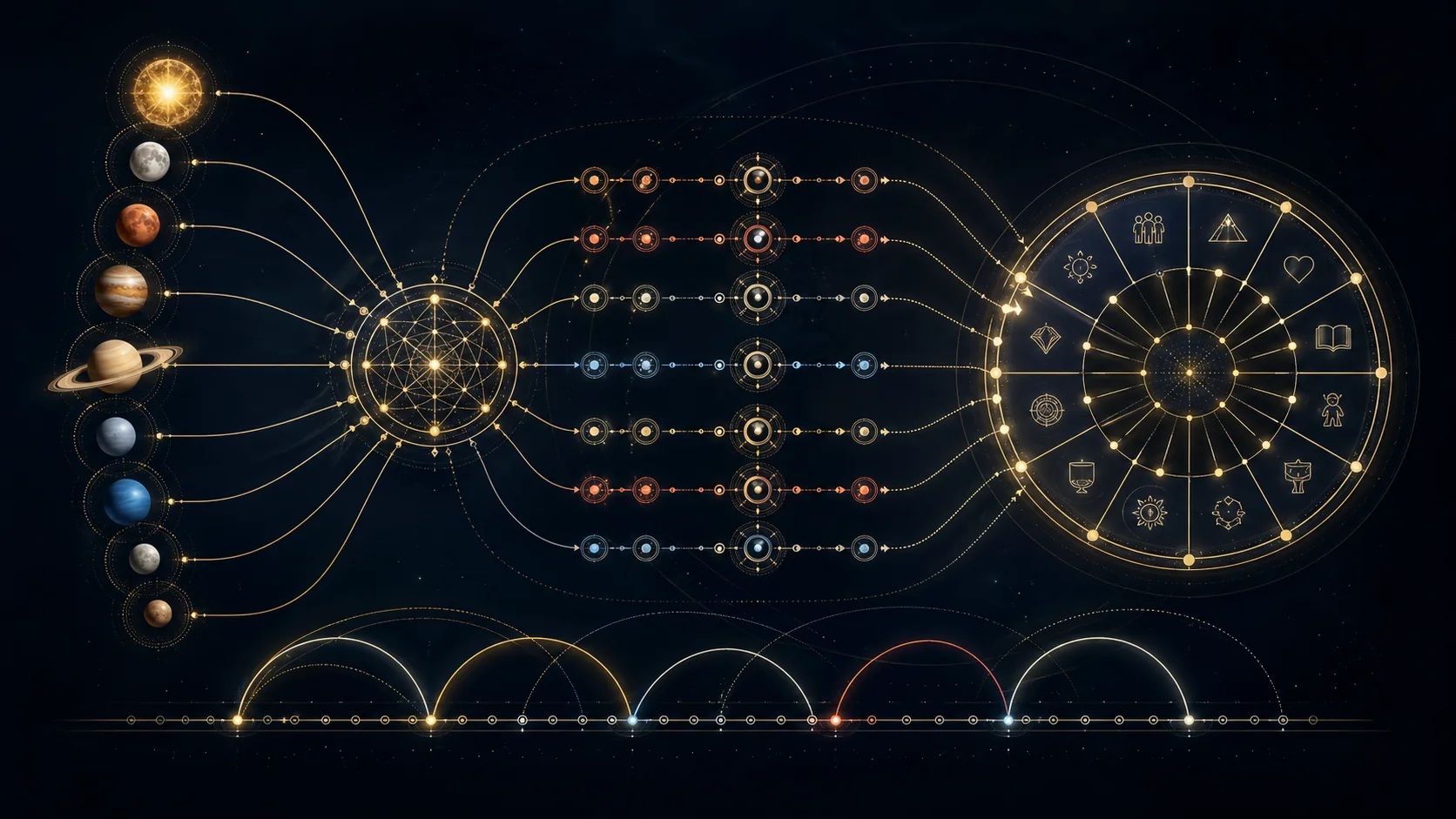
One useful way to think about a structured response is to treat it like a layered chart reading. The outer layer contains user-facing essentials: the name of the query, the time of analysis, and the summary result. The middle layer includes the significant astrological indicators: house, star, sub, and ruling factors. The inner layer provides reasoning and confidence notes, explaining why a result is supported or not supported according to the analyzed factors. This mirrors how a careful astrologer would explain a reading: first the conclusion, then the support, then the finer details.
Developers also benefit from predictable naming conventions. If a response uses one naming style for one endpoint and a different style for another, integration becomes harder. Consistency helps front-end teams render cards, badges, and timelines without constantly writing custom mapping logic. It also helps analytics systems compare one case with another. In practical terms, a structured format should make it easy to answer questions such as: what was asked, which chart was analyzed, which KP factors were considered, what conclusion was reached, and what follow-up action is suggested.
Another important reason for structure is traceability. Astrology applications often require a record of how a result was derived. Even when the final user only wants a short answer, the system may need to preserve the path used to reach it. That is where a clean response format becomes valuable. It allows the application to show a concise interpretation while still retaining the detailed data needed for review, support, or future comparison. For KP readers and developers working together, traceability supports clarity and trust.
At KP Astro Academy, we encourage a practical approach: keep the response easy to read, easy to validate, and easy to expand. The format should support both human understanding and software parsing. For example, a response can include a top-level summary, a list of judged significators, the ruling planets observed at the time of analysis, and an interpretation field that explains the conclusion in plain language. This allows the same output to be used in a web app, a report generator, or a consultation workflow.
It is also helpful to think about the user journey. A person may begin with curiosity, then move to chart inspection, and finally seek a consultation if the matter is important to them. A response format that reflects this journey can be more engaging. The first part should answer the immediate question. The next part should show the basis of the answer. The final part can guide the user to deeper exploration. This makes the experience feel coherent instead of fragmented.
Key Principles
- Stellar Level: The star lord indicates the results.
- Sub Level: The sub lord confirms or denies the results.
These two principles remain central even when we are discussing software output. A developer may not be performing manual astrological analysis, but the response should still reflect the same logic. If the star lord indicates a type of outcome and the sub lord confirms it, the API should present that relationship in a way that is unmistakable. If the sub lord does not support the outcome, the response should also make that clear instead of hiding uncertainty inside vague language.
To make this more concrete, consider a simple example. A user asks whether a particular event is likely to materialize within a given period. The API can return the question, the relevant chart context, the star-level indications, the sub-level confirmation, and an interpretation summary. If the result is positive, the summary should say so clearly. If the result is mixed or not supported, the summary should reflect that honestly. Developers should avoid vague phrasing such as “maybe” without explanation, because users often need to know whether the uncertainty comes from conflicting factors, insufficient data, or an inconclusive configuration.
A practical response format can also include a confidence-style note, not as a prediction of certainty in the absolute sense, but as a transparent signal about how strongly the analyzed factors support the interpretation. This is useful when building interfaces that present multiple chart results side by side. The user can then compare cases in an intuitive way, while the detailed notes preserve the underlying astrological reasoning.
Another useful design idea is to separate raw data from interpretation. Raw data might include the planetary positions, house assignments, and ruling planets at the time of analysis. Interpretation should be a distinct section that summarizes what those values imply in the context of the question. This separation keeps the output cleaner and helps developers decide whether they want to show only the raw facts, only the conclusion, or both. It also avoids a common problem in response design, where explanatory text is mixed into data fields and becomes difficult to parse later.
When people first build an astrology API, they often focus on what to include, but not how to include it. In practice, both matter equally. A response can have all the right information and still be hard to use if the nesting is awkward, the labels are unclear, or the fields are inconsistent. Good structure reduces friction. It makes test cases easier to write, it simplifies front-end rendering, and it lets content teams produce clearer user-facing explanations. In a subject like KP astrology, where timing and precision matter, structure is more than a coding preference; it is part of the communication itself.
Think of an app that helps a user track a specific life question over time. The app may call the API repeatedly as chart data is updated or as a new query is made. If the response format remains predictable, the app can store previous interpretations and compare them with new ones. This is valuable for learning and for user experience. Over time, users can see patterns in how different factors were evaluated, and developers can optimize the application without changing the meaning of the results.
There is also a presentation advantage. A structured response can be formatted into cards, accordions, tables, or timeline segments depending on the screen size and product style. A mobile interface may want a short answer and a few bullet points. A desktop dashboard may want a full explanatory panel. A structured output supports both without needing separate analytical logic for each display. That is one reason developers appreciate well-organized astrology APIs: the same response can power multiple experiences.
In KP astrology, the connection between the observed factors matters as much as the factors themselves. The response should therefore not only list data points, but also show relationships. For example, if a result is supported by star-level indicators and then reinforced by sub-level confirmation, the interpretation should reflect that chain. If the sub-level weakens the result, that should also be visible. When developers present the response this way, the user can follow the logic instead of merely seeing a conclusion detached from its basis.
Another point worth noting is that developers often work with different audiences, from astrology learners to business stakeholders. Learners want the logic explained. Business teams want reliability and consistent output. Power users want depth and flexibility. A structured KP API response can serve all three if it is designed with layered sections and concise labels. The response should read like an organized conversation: the system answers the question, explains the basis, and leaves room for more detail when requested.
Below is a practical way to think about the kinds of information that often belong in a structured response.
- Query details: what the user asked and when the analysis was performed.
- Chart context: relevant birth chart or event data used for the analysis.
- KP factors: star-level and sub-level indicators connected to the result.
- Ruling planets: the reference set used at the time of judgment.
- Interpretation: a plain-language explanation of the outcome.
- Notes: any important context, limitations, or follow-up guidance.
This list is not meant to force a single rigid design. Instead, it helps developers think clearly about how to separate meaning into sections. Some applications may need only a compact response, while others may need an extended structure. The main idea is that every field should have a purpose. If a field does not help a user, a developer, or a future audit, it may create noise instead of clarity.
Let us consider a common real-world scenario. A developer is building a dashboard for users who want astrological insights for different life topics. The dashboard includes a query box, a chart viewer, a results panel, and an archive of previous reads. If the API response is structured, the dashboard can highlight the main conclusion in the results panel, show the supporting KP indicators in a technical section, and store the response history without data loss. If the response is unstructured, each feature has to guess where the important information lives.
That difference becomes even more apparent when an application grows. At first, a short answer may be enough. Later, users may ask for explanations, comparisons, and historical records. A response format that was designed with structure can scale with these needs. Developers can add fields, preserve existing ones, and keep compatibility. This is particularly useful in astrology software, where users often return to the same chart or question over long periods and expect continuity in how results are presented.
A structured response also helps when integrating with AI-assisted tools, reporting engines, or data visualization libraries. These systems typically work best when input is stable and well-labeled. If the response clearly distinguishes between factual data and interpretation, downstream tools can transform it into charts, summaries, or reports with less custom logic. In other words, good structure reduces the effort required everywhere else in the product pipeline.
From a content perspective, clear formatting improves trust. Users are more likely to value an interpretation when they can see how it was assembled. In KP astrology, where the significance of star and sub levels plays a central role, transparency matters. A user does not need every technical detail in the main screen, but they do benefit from knowing that the conclusion was not produced randomly. A thoughtful response format makes that transparency natural.
There is also an educational benefit. Many KP learners do not want only a yes-or-no answer. They want to understand why a certain factor mattered and how the method led to the conclusion. A response that includes explanation fields can teach while it informs. This is especially helpful in academy-style platforms where the same content may serve both practical users and students of astrology. The API can then become not only a data source, but also a learning aid.
One of the most useful habits for developers is to test the response with edge cases. What happens if the query is incomplete? What if chart data is missing? What if the analysis is inconclusive? A strong format should still behave gracefully. It should return a clear status, a useful message, and any relevant partial data rather than failing silently or producing confusing output. This keeps the application resilient and helps users understand whether the issue is with the input, the data, or the interpretation.
In practice, the best response formats are often the ones that feel boring in the right way: predictable, readable, and easy to maintain. The excitement comes from the insights themselves, not from a chaotic data structure. Developers who work on astrology products know that elegant software often looks simple on the surface because the design work has already been done underneath. A structured KP response is a good example of that principle.
For users exploring this topic on KP Astro Academy, the next step may be to compare the output with actual chart data or to see how different questions are handled. The birth chart viewer can help with chart-related inspection, while the ruling planets calculator can support deeper context during analysis. These tools are helpful because they connect the conceptual discussion to practical usage. When a response is structured well, it becomes easier to align the API output with what these tools display.
Developers who want personalized discussion can also use the consultation path when a project or question needs human guidance. Sometimes the best way to validate an implementation is to review a real case with an experienced reader who understands both the astrological framework and the user experience implications. That is especially true when the goal is to present results responsibly and clearly.
Imagine a consultation scenario where a team is unsure whether to show a brief interpretation or a detailed breakdown by default. A structured format solves this elegantly: the API can return both a short summary and a richer explanation section, allowing the interface to choose what to display. The same response can serve a quick preview and a full report. This kind of flexibility is one of the strongest arguments for organizing data carefully from the start.
Another benefit appears when teams collaborate across roles. Astrologers can review the logic, developers can validate the schema, designers can shape the presentation, and support teams can answer user questions using the same source of truth. If the response is messy, each group invents its own interpretation. If it is clear, collaboration becomes smoother. This saves time and reduces misunderstandings, especially in applications where users care deeply about the accuracy and presentation of the reading.
It is worth remembering that the purpose of a structured response is not to overwhelm the user with technical detail. The purpose is to give the right amount of detail in the right place. A summary should feel concise. Supporting sections should feel purposeful. Notes should feel informative, not repetitive. A well-balanced response respects attention and makes the result easier to act upon or explore further.
In the wider context of KP astrology applications, structured outputs can support search, filtering, and comparison. For example, if every response stores similar fields, developers can later search for cases where a certain house, star, or sub pattern appeared. They can compare outcomes across similar queries and improve internal understanding of the system’s practical use. This turns the API from a one-time answer engine into a reusable knowledge layer.
There is also value in making the format readable even when viewed as plain text. Not every integration will render beautiful UI components. Sometimes a developer inspects the raw response in a log, a console, or a test file. If the structure is sensible there, it will also be easier to work with in production. Good formatting should travel well across contexts.
For developers new to astrology data, the most important mindset is patience. The structure does not need to be complicated to be effective. A clean separation between inputs, KP indicators, conclusions, and notes often goes a long way. Start with what the user needs most, then add detail in layers. Avoid overloading the response with unnecessary duplication. Keep the logic readable. Make sure the same result is represented consistently across similar requests.
As a final practical reminder, the strongest API responses are those that help a user move from question to understanding without friction. In KP astrology, that means reflecting the star level and sub level clearly, using ruling planets appropriately, and presenting the interpretation in a form that developers can reliably build upon. If the structure supports clarity, then the application can support trust, learning, and better decision-making around the topic being explored.
Stay tuned for a detailed breakdown and case studies on this specific topic. In the meantime, if you are building or reviewing an astrology product, think of the response format as part of the experience, not just a technical detail. A well-structured output is easier to test, easier to scale, and easier for users to understand. That combination is especially valuable when the subject is as nuanced as KP astrology.
Need personalized guidance?
Book a 1-on-1 Consultation to get specific answers based on your birth chart.
Book ConsultationExplore More from KP Astro Academy
Related Tools & Features
- Childbirth Selection Tool
- Birth Time Rectification Tool
- Ruling Planets Calculator
- Marriage Matchmaking Calculator
- Career & Education Finder
- Transit Search & Prediction
- Planetary Remedies Finder
- Free KP Kundli
- Daily Panchang Calculator
- Vedic Ephemeris Calculator
- Hora Chart Calculator
- Ashtak Varga Calculator
- KP Event Finder
- Personal Muhurat Finder
- Cusp Promise Calculator
- Bhav & Dasa Phal Predictions
- Dasha Promise Calculator
- KP Astrology Consultation
Further Reading
- Identifying Intercaste Marriage Combinations in KP
- Free Astrology Readings in KP Astrology (An Ethical Astrology Perspective by Navin)
- 💰 Why Billionaires Turn to Astrology: A Maslow’s Hierarchy Perspective
- Childbirth in KP Astrology: Promise, Delay, Denial, and Hope
- 🌿 Practical Remedies to Fix Any Trouble in Life: The KP Astrology Way
- Longevity and Health in KP Astrology Without Fear-Mongering
- Astrology and Meditation: Aligning Your Practice with Your KP Chart
- White Label Astrology Software For New Astrologers
- Career Business Astrology Report Api
- Should This Marriage Be Saved? KP Astrology Is Not Sentimental
- Understanding KP Hit Theory the Right Way
- Behavioral Remedies Api For Astrology Products
Loading article...