Astrologer Consulting Business Software

Astrologer Consulting Business Software
Welcome to KP Astro Academy. In this article, we explore the deep insights of Krishnamurti Padhdhati (KP) astrology regarding astrologer consulting business software. The topic may sound modern, but the core idea is timeless: every business activity has a pattern, and an astrologer’s consulting work is no exception. Whether the work happens through a phone call, an in-person appointment, a video consultation, a website booking form, or a simple message that turns into a paid session, the sequence of events can be understood through KP principles.
When we speak about astrologer consulting business software, we are not only referring to a digital tool that manages appointments or payments. We are also looking at the wider professional process behind consultation work: how clients discover the astrologer, how they decide to book, how the consultation is scheduled, how the session is delivered, and how the service continues through follow-up or repeat engagement. In many cases, the software becomes part of the business flow, but the astrological topic still concerns the broader consulting profession and the timing of its active use.
KP astrology provides a highly accurate, rule-based approach to predictions using the sub-lord theory and ruling planets. By evaluating the stellar and sub-level significations, we can precisely time events related to this topic. This is especially useful in consulting-based professions, because such work often depends on client response, scheduling availability, payment confirmation, and the smooth handling of an appointment. A consultation may look simple from the outside, but it often involves many small decisions and actions that together create the final result.
For example, an astrologer may notice that inquiries increase suddenly after a video goes viral, after a testimonial is shared, or after a previous client recommends the service to someone else. At another time, the same astrologer may observe a pause in new bookings even while marketing efforts continue. KP helps us study these patterns without relying on vague generalities. Instead, we can examine which planets signify the profession, how the star lord contributes results, how the sub lord confirms the actual outcome, and how ruling planets support the timing of the event.
It is useful to think of consulting business software as the operational layer of the service. One astrologer may use it simply to record names and timings. Another may rely on it to automate reminders, manage digital payments, or track follow-up sessions. In both cases, the software supports the consulting activity itself. If the astrological promise of consulting work is present, then the software becomes the practical expression of that promise. If the promise is weak or inactive at a certain time, the same software may remain underused despite being technically available.
In the consulting world, small details matter. A client may visit a website and decide within seconds whether to trust the service. Another client may open a booking page, read the description, and wait until the right date to schedule. Someone else may watch a short preview video and then ask for a consultation because the astrologer’s style feels clear and reliable. These stages are all part of business behavior, and KP astrology allows us to examine them with precision. Rather than treating a consulting business as one single event, KP encourages us to look at the chain of events that make the business active and meaningful.
Astrologer consulting business software can therefore be studied from several angles: as a technology tool, as a client management system, and as an indicator of ongoing professional activity. A software platform may help the astrologer deliver services efficiently, but the real question in astrology is whether the native’s chart supports such service-oriented work, especially in a consulting format. The answer depends on the relevant houses, significators, star placements, sub-lords, and the ruling planets at the moment of judgment or event.
Another practical point is that consulting work usually involves repeated interaction. A single consultation may lead to follow-up questions, an extension of the session, a second booking, or a later referral. In business software, this can appear as a client record, an invoice history, a reminder schedule, or a notes section. In astrological analysis, this repeated interaction may reflect the strength of the relevant significations for ongoing service, communication, and commercial continuity. The work is not just about one isolated meeting; it is about whether the consulting relationship can continue smoothly.
For a beginner, it is easy to focus only on the visible business layer: booking software, calendars, payments, and reminders. But KP astrology teaches us to ask deeper questions. Why does one astrologer experience a steady flow of clients while another has irregular bookings? Why does a consultation software system become actively used during one period and sit idle during another? Why do some astrologers grow through referrals while others depend entirely on ads or social media? These questions are useful because they reveal the underlying event structure that KP can analyze.
One simple way to understand this topic is to imagine a client journey. First, the client becomes aware of the astrologer’s service. Next, the client checks the profile, reviews the service options, and decides whether the consultation seems suitable. Then comes the booking step, which may happen through software or through direct communication. After that, the session is conducted, notes may be taken, and a follow-up may be scheduled. Every step is part of the consulting business process. In KP terms, each stage can be linked to the relevant significations and timed using ruling planets at the moment of the event.
This is why astrology and software should not be seen as separate in a consulting business context. Software does not create the consulting potential by itself; it organizes and supports it. Likewise, a strong astrological promise for consulting work may exist even before the software is introduced. The software simply becomes the instrument through which the service is delivered more efficiently. This is especially visible today, when many astrologers manage bookings online, share video previews, and offer remote sessions across locations and time zones.
In many businesses, software is adopted because the volume of work has increased. For an astrologer, this may mean more clients than can be handled manually. A simple spreadsheet may no longer be enough. Appointment reminders become important. Time slots must be tracked carefully. Payments may need to be recorded. Client history may need to be stored for future reference. In such situations, the consulting software becomes part of a larger expansion in business activity. If the chart supports growth, KP can help analyze the timing of that growth and the nature of the results.
At times, the consulting business itself may be the main profession. At other times, it may be a side activity supported by a broader spiritual, teaching, or content-based presence. This distinction matters because the software can serve different business models. One astrologer may use software to run daily paid consultations. Another may use it only for special sessions or premium clients. Another may use it to coordinate a team, assistants, or multiple service types. KP analysis remains relevant because the actual outcome depends on how the business manifests in the native’s life.
There are also interesting behavioral patterns in consulting work. Some clients prefer a direct voice call because they want immediate answers. Some prefer chat-based interaction because it feels private and flexible. Some want a recorded session or written summary. Others want quick clarification before making a larger decision. Each of these preferences affects how business software is used. From an astrological perspective, these preferences can be studied as part of the broader consulting environment, where communication, convenience, and trust all play important roles.
One useful example is the difference between an inquiry and a confirmed consultation. A person may ask for rates, duration, or availability, but may not complete the booking. Another person may confirm immediately and pay without delay. In business software, these are different stages. In astrology, these stages can be seen through the strength of the relevant significators and the support of the ruling planets. This is where the sub-lord becomes especially valuable, because it can help confirm whether the matter materializes or remains only a possibility.
KP astrology emphasizes precision, and that precision is particularly helpful in service businesses. Consulting work has measurable moments: first contact, scheduled time, session completion, payment collection, and follow-up. These moments are not abstract. They happen in sequence and can be tracked. Business software makes them visible in records and reports. Astrology makes them intelligible through significations and timing. Together, they provide a structured way to understand the business flow.
Consider an astrologer who receives many messages on a particular day but only a few actual bookings. The software may show a high number of inquiries but low conversion. In practical business terms, this suggests a gap between interest and commitment. In KP terms, one may examine whether the indicators support only attention and communication, or whether they also support firm action, payment, and actual service delivery. This kind of distinction is essential because not every positive signal leads to a completed event.
Similarly, an astrologer may find that some months are excellent for content promotion but not for direct consultation. A video may attract viewers, the profile may gain visibility, and the software may record more page visits, yet the actual number of sessions may remain limited. Such a situation reminds us that business activity has layers. Awareness, engagement, booking, and delivery are related but not identical. KP allows us to examine which layer is active at a given time and whether the final result is actually promised.
In real consulting practice, client trust is crucial. A software system may streamline operations, but trust is still built through clarity, consistency, and service quality. An astrologer who explains the process well, provides time slots clearly, and follows up properly is more likely to retain clients. From an astrological point of view, such service-oriented behavior is reflected in the relevant houses and significations associated with communication, professional service, and repeated interaction. Software becomes a practical extension of that service quality.
The same principle applies to referrals. A satisfied client may recommend the astrologer to a friend or family member. The new client may then book through the software or through direct contact. This chain of events is important because consulting businesses often grow through trust networks rather than only through advertising. KP analysis can help identify whether such referral-driven growth is supported in the chart and when it is most likely to become active.
It is also worth noting that the word “software” may include many different tools. Some are simple and manual; others are full-featured platforms with automation, reminders, analytics, and integrated payments. In astrology, the tool itself is less important than the business function it serves. What matters is the consulting activity, the service delivery, and the timing of events. A basic system and an advanced system can both be part of the same business promise if the consulting work is active.
For students of KP astrology, the most useful approach is to observe actual business events carefully. When did the astrologer begin receiving paid consulting requests? Was it after creating an online profile? Did bookings increase after a website launch? Did software adoption happen when the number of clients grew? Did the astrologer begin offering packaged sessions, follow-up calls, or recurring consultations? These observations help connect the real business pattern with the astrological framework in a meaningful way.
At the same time, it is important not to force conclusions. Some charts may show excellent communication and public visibility but weaker conversion into paid consulting. Others may show fewer inquiries but strong confirmation once interest appears. This is why KP uses layers of analysis rather than superficial judgment. The star lord may show one type of activity, while the sub lord determines whether the result becomes concrete. Ruling planets help anchor the judgment in the actual moment.
In the context of astrologer consulting business software, timing can affect practical decisions. An astrologer may choose a date to launch a booking page, update the service structure, or start using a new management tool. Another astrologer may notice that clients respond better during a particular period, making it an ideal time to introduce new software or a more organized workflow. While business strategy is not astrology alone, KP can help identify supportive periods and reduce guesswork.
The consulting model is also highly personal. A client is not buying a generic product; the client is choosing a person, a method, and a relationship of trust. That means the software is never just a machine. It becomes part of the client’s experience of the astrologer’s service. Smooth scheduling, prompt reminders, clear notes, and simple payment handling all contribute to that experience. When these elements work well, the client feels that the consultation is professional and dependable.
Sometimes the software itself becomes a sign of growth. An astrologer who previously handled everything manually may decide to adopt a structured system after the number of consultations increases. This shift can be seen as an outcome of expanding service demand. In other cases, software is adopted in preparation for growth, creating a more organized business foundation before the client load rises. Either way, the consulting business and its software are linked through practical necessity.
If we look at the topic from a teaching perspective, it helps to separate three ideas clearly. First, astrologer consulting is the service activity. Second, business software is the management tool. Third, the astrological judgment is the method used to understand when and how the activity becomes active. This separation keeps the analysis clean and prevents confusion. A chart may show the promise of consulting, but the software merely supports how that promise is administered in the real world.
Another useful observation is that software often helps transform informal service into a repeatable business system. Without software, an astrologer may rely on memory, messages, and handwritten notes. With software, the same work can become more organized and scalable. This shift may be especially important when the astrologer handles different types of sessions, different durations, or different fee structures. The business then becomes easier to track, and the consulting service can be delivered in a more consistent manner.
KP astrology is well suited to such practical questions because it does not depend on broad, vague descriptions. It asks what exactly is happening, which significators are involved, whether the sub-level confirms the event, and whether the ruling planets support the moment. This makes it useful for understanding service businesses where details matter. In a consulting business, details are not minor; they are the business.
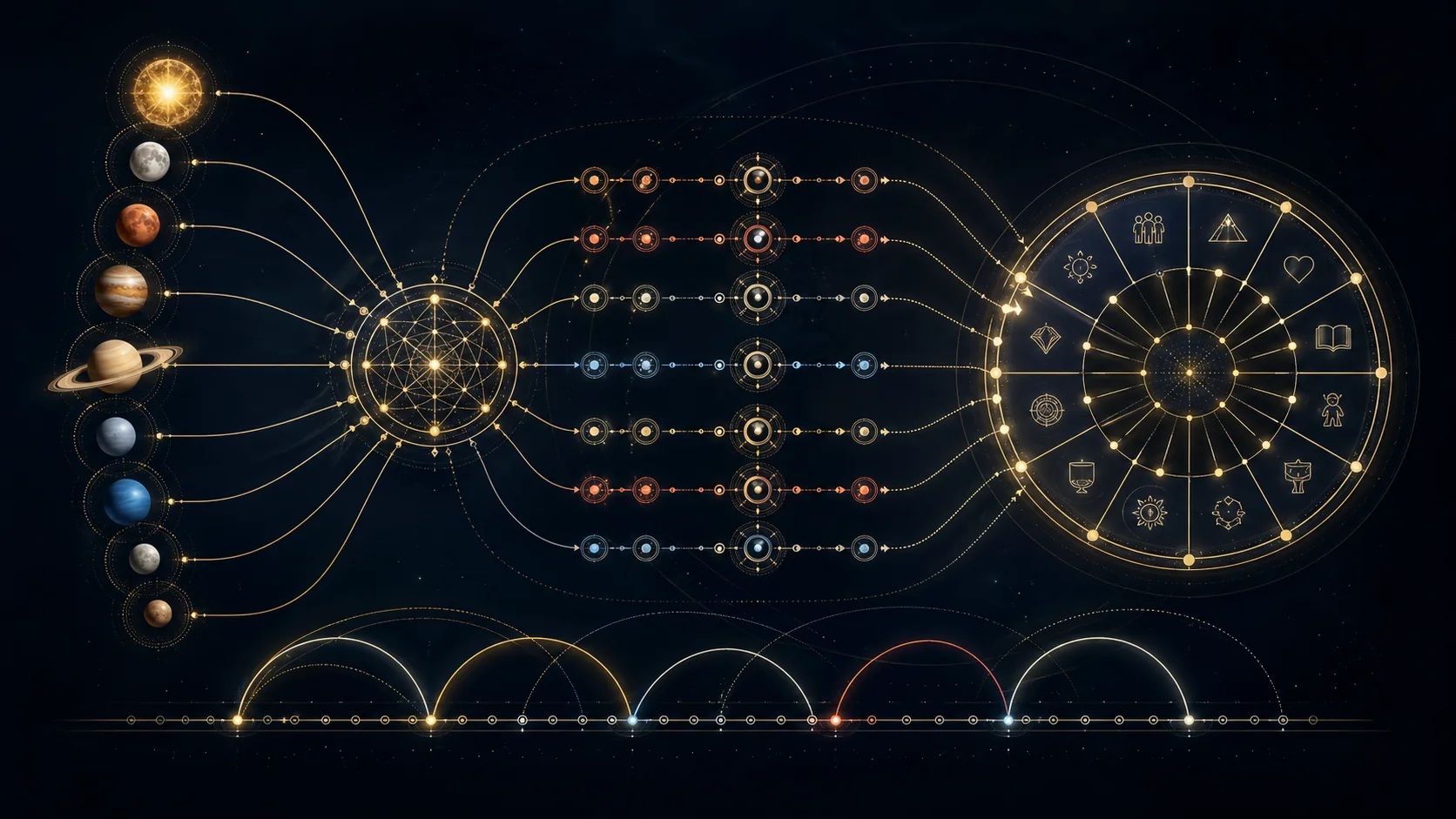
In simple terms: the star lord points toward the result, the sub lord decides whether the result becomes real, and the ruling planets help validate the timing. When these factors align with consulting activity, the astrologer may see meaningful business action through clients, bookings, software use, and repeat engagement. When they do not align, the business may remain slow, fragmented, or inconsistent even if the software is present.
Key Principles
- Stellar Level: The star lord indicates the results.
- Sub Level: The sub lord confirms or denies the results.
These two principles are the backbone of the judgment. In a consulting business context, the stellar level can show the direction of the matter, such as communication, professional service, public interaction, or business handling. The sub level then decides whether that direction becomes an actual event, such as a confirmed consultation, a completed payment, a successful follow-up, or a repeat client relationship. This distinction is especially important because business opportunities often begin as signals long before they become completed transactions.
Suppose an astrologer is exploring whether a new business software platform will be actively used for consulting. The stellar level may suggest that the native is entering a phase of more organized communication and more client-facing work. That is encouraging, but it is not enough on its own. The sub lord must show actual materialization. If the sub lord denies support, the astrologer may still talk about the software, compare features, or plan adoption, but the real usage may not happen immediately. This is one reason KP is so practical: it distinguishes intention from fulfillment.
Ruling planets add another layer of confidence. They help us relate the judgement to the moment of observation. When a client calls, when the software is opened, when a payment is made, or when a booking is confirmed, the ruling planets can be checked against the event. This is especially useful in consulting businesses because many outcomes happen at exact moments. A consultation is not vague; it begins at a specific time, ends at a specific time, and often leaves a trackable business record. The timing is therefore not merely theoretical but directly visible in practice.
An easy way to visualize this is through a small business story. An astrologer launches an appointment page on a quiet evening. For the first few days, there are no bookings. Then one morning, a former client shares the link with a colleague. By afternoon, two appointments are confirmed, and the software starts showing reminders and session notes. From a business viewpoint, this looks like normal growth. From a KP viewpoint, one would examine whether the relevant significators, star-lord support, sub-lord confirmation, and ruling planets all aligned when the actual event unfolded. The story is ordinary, but the astrological structure behind it may be quite precise.
Another example is a consultant who uses software for follow-up scheduling. Some clients want a second session after thinking through the first reading. The software makes it easy to reserve a slot and send reminders. Yet the real question is whether repeat consulting is promised in the chart at that time. A strong sign for service continuity may show more than one interaction, while weaker support may show only a one-time session. Again, the star lord may indicate the type of activity, but the sub lord decides whether the activity becomes repeatable and functional.
For many astrologers, the consulting business grows gradually. It may begin with a few inquiries from acquaintances, then expand through word of mouth, then move into an online format with software support. This gradual development is important because not every business begins with a full system. Sometimes the software appears after the consulting work has already proven itself. At other times, the software is introduced early to build structure. KP can be used in both cases to examine whether the expansion is supported by the chart and when it is likely to take shape.
Clients also play a major role in determining how software is used. A client who prefers a detailed booking process may appreciate forms, confirmation emails, and scheduled reminders. Another client may want a quick, direct process without extra steps. If the astrologer’s business model serves many types of clients, the software may become a central part of the service design. This practical variety is important because consulting is a human business. Even the best tool must fit the behavior of real clients. KP analysis helps us understand the conditions that make this fit successful.
It is equally helpful to think about the emotional side of consulting. People often seek astrologers when they want clarity, direction, reassurance, or a structured conversation about decisions. That means the consulting experience itself matters a great deal. Software that makes the process smooth can improve the client’s comfort. Faster booking, clearer time slots, organized records, and reminders can reduce friction. While astrology does not replace user experience, it can help us understand when such service improvements are likely to be implemented or appreciated.
When examining this topic, students should remember that business software is only one visible expression of a consulting promise. The deeper astrological question is whether the profession involves guidance, exchange, service, and repeated interaction. If those significations are active, then software may be a natural companion to the business. If they are weak, software may still exist as a tool but may not generate meaningful consulting activity. This is why the distinction between indication and confirmation matters so much.
Here is another practical observation: software often becomes necessary when a business reaches a threshold of complexity. An astrologer with a few regular clients may not need much more than a notebook and a messaging app. But once the volume increases, conflicts in timing, missed calls, duplicate bookings, or forgotten follow-ups can create inefficiency. Software helps solve these issues. In astrological terms, this may reflect a period when the consulting function is strong enough to require formal structure. The chart does not just show the profession; it can also show the point at which organization becomes essential.
Business software can also help an astrologer separate categories of service. For instance, one type of session may be short and introductory, another may be a deeper consultation, and a third may be a follow-up review. The software can keep these categories organized, but the chart may reveal whether the native is moving into a more specialized consulting approach. This is a valuable distinction because not all consultations are the same. Some are exploratory, some are decisive, and some are for continuity. KP analysis can track these patterns through significations and timing.
In practical use, the sub lord is often the most decisive factor for confirmation. This is because a consulting business can show many promising signs without actually producing a booking. A client may express interest, ask questions, or even discuss payment, yet not finalize the session. In such moments, the sub lord helps distinguish between possibility and event. The consultation becomes real only when the sub-level supports it. This makes the method especially relevant for service businesses where conversion is everything.
The ruling planets concept is also useful when checking live business moments. If an astrologer wants to know whether a call will turn into a booking, the moment of inquiry can be compared with the ruling planets. If the software is being implemented on a particular date, the same principle may help understand whether that timing is supported. This does not mean software choices are made by astrology alone. It means the timing of implementation can be evaluated within a structured astrological framework.
In many consulting businesses, the true measure of success is not only the number of first-time clients but also the quality of repeat engagement. A software platform may make this easier to observe through records, histories, and reminders. A satisfied client may return after some weeks or months. The astrologer may then see a familiar name, a new request, or a continuation of the earlier discussion. Such repeat activity is meaningful because it shows that consulting has become a continuing service rather than a one-time interaction. KP can help study whether this continuity is supported.
The topic also invites an important professional insight: not every astrologer wants the same business model. Some prefer one-to-one consulting with limited clients. Others want a larger consulting practice supported by software and automation. Others may blend teaching, content creation, and consultation. Each of these approaches uses software differently. The chart may show which approach is more natural. For a service-oriented native, software can amplify efficiency. For another native, the same software may only be a minor support tool. The astrological question is not the tool itself, but the style of profession it supports.
When all of this is put together, the value of KP becomes clear. The method allows us to study astrologer consulting business software not as a random modern topic, but as a structured professional event. We can ask when the business becomes active, what kind of client behavior appears, whether software adoption is supported, and how the consultation cycle unfolds. This approach is especially valuable for anyone who wants practical clarity rather than abstract speculation.
In summary: use the star lord to understand the direction of the result, use the sub lord to determine whether the result will manifest, and use ruling planets to check the timing of the event. In a consulting business, this gives a practical way to judge client interaction, booking flow, software usage, and repeat service.
As you continue studying this topic, it helps to observe real examples around you. Notice how consultation businesses are organized, how clients book, how software helps manage the process, and how the service grows over time. Then compare those observations with KP principles. This combination of practical observation and astrological structure is where deeper understanding develops.
Stay tuned for a detailed breakdown and case studies on this specific topic.
Related Course Videos
Explore More from KP Astro Academy
Related Tools & Features
- Childbirth Selection Tool
- Birth Time Rectification Tool
- Ruling Planets Calculator
- Marriage Matchmaking Calculator
- Career & Education Finder
- Transit Search & Prediction
- Planetary Remedies Finder
- Free KP Kundli
- Daily Panchang Calculator
- Vedic Ephemeris Calculator
- Hora Chart Calculator
- Ashtak Varga Calculator
- KP Event Finder
- Personal Muhurat Finder
- Cusp Promise Calculator
- Bhav & Dasa Phal Predictions
- Dasha Promise Calculator
- KP Astrology Consultation
Further Reading
- Childbirth in KP Astrology: Promise, Delay, Denial, and Hope
- How to Activate the 12 Houses: A Behaviour-First Framework for Real Astrology
- How to Read a KP Birth Chart: Planets, Houses, and Sub-Lords Explained
- KP Birth Time Rectification: Why Geographic Coordinates Are as Critical as the Time Itself
- The Secret of Day Lord (Vara Lord) and its Weight in KP Signification
- Career Prediction & Job Stability: When Will I Get a Promotion?
- Birth Time Confidence Scoring For Kp Reports
- Career Business Astrology Report Api
- A Parent’s Manual to Choosing Activities, Environments, and Schooling Using KP Astrology
- KP Horary Astrology (Prashna) and the Role of Geographic Location
- Astrology Pdf Report Generator Api
- How to Use Ruling Planets for Instant Predictions without a Natal Chart
Loading article...