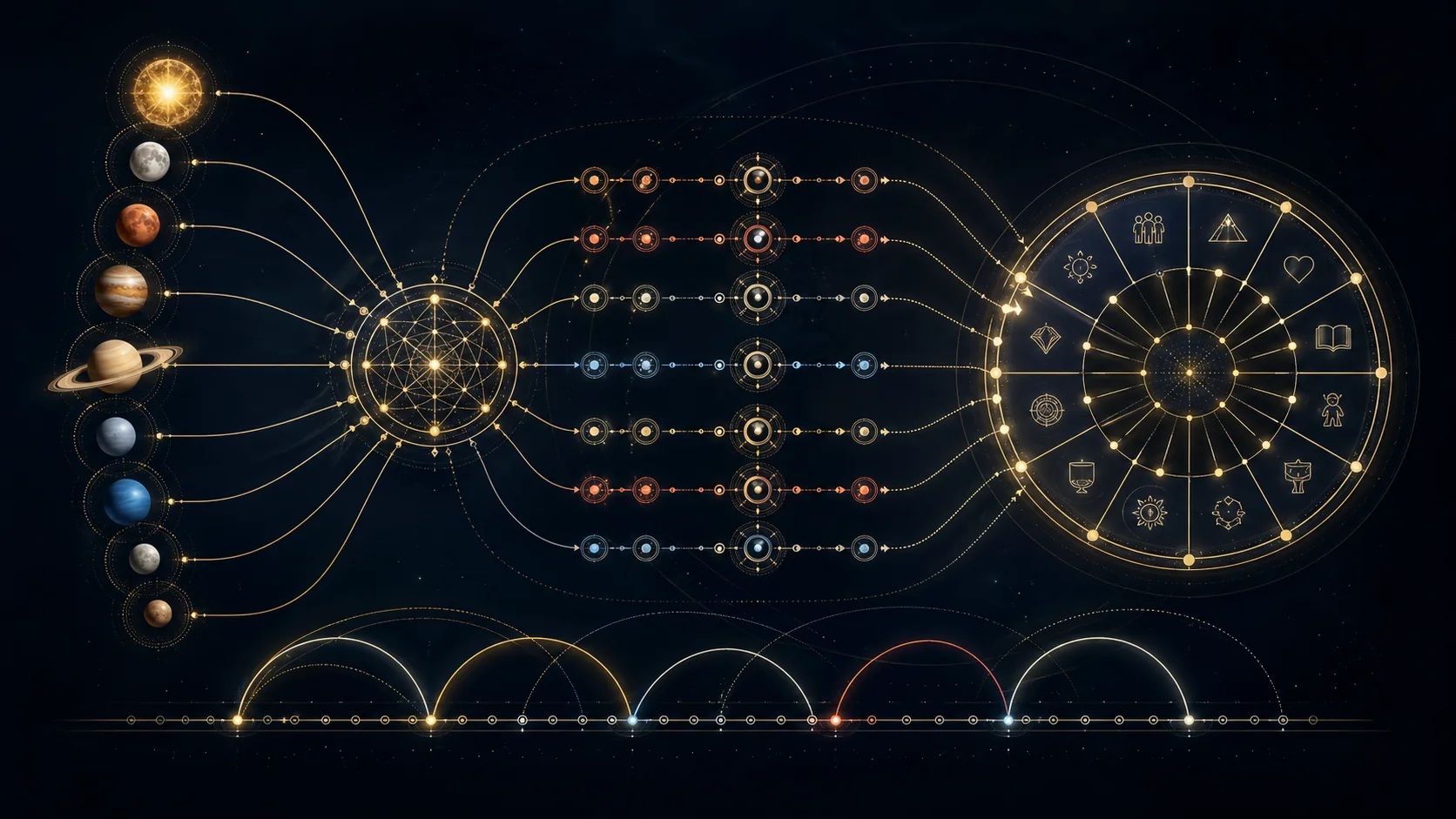
Understanding LSRD in KP Astrology: Lagna, Star, Rashi, and Dasha Lords

Understanding LSRD in KP Astrology
LSRD is one of the most practical decision-making tools in KP Astrology because it gives the astrologer a disciplined way to identify which planetary influences are active, relevant, and worth judging first. The letters stand for Lagna Lord, Star Lord, Rashi Lord, and Dasha Lord, and together they create a priority framework that helps narrow a chart reading from many possible indicators to the few that truly matter in the moment. This is especially useful when a chart seems crowded with possibilities, or when multiple planets appear to support different outcomes. Instead of guessing, the astrologer uses LSRD as a filter.
At a simple level, LSRD helps answer a very practical question: among all the planets in a chart, which ones are actually speaking loudly right now? That question matters in every type of KP analysis, whether the astrologer is studying a birth chart, checking a horary query, or comparing the promise of a planet with the timing shown by timing of events. A planet may be present in the chart, but if it is not functioning through the active ruling framework, it may not be the deciding factor for that specific judgment.
For students who first encounter this idea, the abbreviation can sound technical, but the logic is surprisingly intuitive. The Lagna Lord describes the body, the environment, and the immediate state of the native. The Star Lord shows the deeper drive and the channel through which promise is delivered. The Rashi Lord adds the emotional and mental texture of how the event is experienced. The Dasha Lord tells us when the event is ready to unfold. When these are read together, a chart becomes less abstract and more usable.
This approach is one of the reasons many learners turn to KP methods when they want more precision in prediction and rectification. If you are still building context, it may help to review what is birth time rectification in KP astrology and the broader comparison of KP Astrology vs Vedic Astrology. LSRD sits naturally inside that practical system because it is designed to reduce noise and focus the judgment.
The Components of LSRD
LSRD is a prioritized hierarchy of ruling planets used to analyze charts and make predictions. It stands for Lagna Lord, Star Lord, Rashi Lord, and Day or Dasha Lord. These are not four unrelated labels. They are four layers of a single decision process. In KP work, the point is not merely to list planetary rulers, but to see how they cooperate or conflict in showing results.
The hierarchy is especially important because in real charts there are often several planets involved in a topic. For example, a person may ask about a new job. One planet may connect to profession, another to income, another to interviews, and another to timing. If the astrologer does not sort these influences by priority, the reading can become vague. LSRD makes the analysis more disciplined.
- Lagna Lord (L): Governing the physical body, orientation, and present environment.
- Star Lord (S): Directing the subconscious focus and the core promise of events.
- Rashi Lord (R): Governing the emotional state and mental responses.
- Dasha Lord (D): Controlling the chronological activation and timing of events.
Each component contributes differently. The Lagna Lord is often the first place to begin because it describes the native’s immediate condition and the “entry point” into the chart. The Star Lord points to the star-based mechanism that carries the result. The Rashi Lord gives sign-based expression, often showing how the native receives or processes the matter. The Dasha Lord acts like a clock. Even if promise exists, the event does not arrive until timing opens the door.
In practice, the LSRD sequence keeps the astrologer from over-reading weaker indications. A beginner might see a planet linked to a topic and assume the event will happen. But KP astrology asks a stricter question: is that planet active in the ruling framework, and is it in a position to deliver? LSRD helps answer that with structure rather than intuition alone.
Why LSRD is Critical in KP Astrology
In KP Astrology, predictions are not based on random transits. Instead, the LSRD framework filters out inactive planets, focusing the astrologer’s attention on the planets that are mathematically designated to deliver results during a specific query or birth chart analysis. This is why LSRD matters so much. It prevents scattered interpretation. It also makes chart analysis faster, more repeatable, and easier to verify through experience.
Consider two people asking similar questions. One wants to know whether a job offer will come through. Another wants to know whether a delayed exam result will finally be released. On the surface, both questions involve waiting for an outcome. But the planets that matter, and the sequence in which they matter, can be different. LSRD helps the astrologer focus on the active rulers for each matter rather than leaning on broad generalizations.
It is also critical because a chart can contain many supportive combinations, yet only some will actually produce a visible result. A common learning mistake is to identify every possible sign of success or failure and treat them all as equally important. In KP, that can create confusion. LSRD cuts through this by giving a strict order of importance. A strong Dasha Lord without supporting promise may not deliver the expected result. A strong promise without timing may remain dormant. A responsive Lagna but an unrelated Star Lord may indicate activity without fruition. The framework keeps these possibilities in balance.
For students and practitioners, this is where the system becomes reliable in real-life work. The astrologer is no longer merely describing the chart. The astrologer is judging activation. That is a major shift. And because astrology is often used to answer highly practical questions about relationships, work, education, movement, and life events, a method that clarifies activation is extremely valuable.
A useful way to think about it is to compare it to a traffic signal system. The promise may exist on the road, but unless the signal turns green, the car does not move. LSRD is the signal-checking process. It tells you which route is open, which gate is closed, and which planetary current is actually moving the event forward. This is why KP learners repeatedly return to ruling planets and timing logic when they want accuracy.
The Hierarchy of LSRD Planets
Not all ruling planets are created equal. The Lagna Star Lord and Moon Star Lord carry the highest weight, followed by the Lagna Sign Lord, Moon Sign Lord, and the Day Lord. Understanding this hierarchy prevents confusion when different ruling planets point to conflicting outcomes. In an actual consultation, this hierarchy can make the difference between a clear answer and an uncertain one.
Why does hierarchy matter so much? Because charts often contain mixed signals. A planet may show promise for an event, yet another planet may indicate delay, distraction, or a different path. Without a ranking system, the astrologer may not know which signal to prioritize. The LSRD framework says: begin with the most relevant point of reference, examine the core ruling sequence, and then compare the rest against it.
The Lagna Star Lord and Moon Star Lord are often treated as especially significant because they reflect the core orientation of the person and the emotional lens through which life is experienced. The Lagna relates to the outer manifestation, while the Moon shows inner response. Together, they offer a very practical anchor. If both point toward similar themes, the matter tends to stand out more clearly. If they diverge, the astrologer knows there may be inner-external mismatch, delay, hesitation, or a need for more careful judgment.
Next come the Lagna Sign Lord and Moon Sign Lord, which add the sign-based layer of expression. These rulers often explain how the promise is shaped in practical life. A chart may show the promise of a relationship, for instance, but the sign-based rulers may indicate whether the person experiences it as smooth, complicated, public, private, quick, or emotionally intense.
The Day Lord is also important because it reflects the current weekday atmosphere at the moment of calculation. It is not the same thing as the life chapter shown by the Dasha. The Day Lord works more like the prevailing environmental tone. On a day when the Day Lord agrees with the chart factors, the astrologer may find stronger coherence in the query. On a day when it conflicts, the result may still be present, but it may not express as cleanly.
This hierarchy becomes very practical in consulting work. Imagine a client asks whether a transfer to another city is likely. One planet may support relocation, another may support professional movement, and another may show family resistance. If the astrologer does not rank the rulers properly, the interpretation may become a collection of possibilities rather than a judgment. The hierarchy keeps the reading grounded.
How the hierarchy works in real chart reading
In a real case, the astrologer might start with the Lagna Star Lord and Moon Star Lord to see whether the question is alive in the ruling pattern. Then the Lagna and Moon Sign Lords may be checked for contextual clarity. Finally, the Day Lord or Dasha Lord may determine whether the matter is operating now or simply exists as a future promise. This layered approach is one reason KP readings can feel specific and testable.
Suppose a person asks about clearing an interview. The astrologer may find that one ruling planet supports service, another supports communication, and the Dasha Lord supports the relevant period. But if the Lagna Star Lord does not connect to the event houses at all, the overall judgment may remain weak. The point is not to force a desired answer, but to see whether the relevant rulers cooperate.
Lagna Lord: The Immediate Self and Present Environment
The Lagna Lord is the ruler of the ascendant and is closely tied to the body, personal orientation, and the immediate conditions in which the native is functioning. In LSRD analysis, this planet is important because it shows how the person is entering the matter. It can reveal whether the native is open, resistant, active, confused, prepared, or under pressure.
In simple terms, the Lagna Lord shows the “vehicle” through which the native experiences life. If the car is the body and the current environment, then the Lagna Lord tells us how that vehicle is moving. This is why it is often one of the first points checked in a KP reading. A strong or well-placed Lagna Lord can indicate engagement and responsiveness, while a troubled one can show strain, fatigue, or difficulty in handling the issue.
For example, imagine a person worried about a pending visa decision. The Lagna Lord may show whether the native is able to act, follow up, prepare documents, or respond to delays. If the chart shows a strong prompt for the matter but the Lagna Lord is weak, the person may experience the matter as stressful or exhausting. If the Lagna Lord is aligned with the matter, there may be more personal control and steadiness.
The Lagna Lord is not the whole answer, however. It is one part of the LSRD picture. A chart can show a strong self-effort and still not produce the desired result if the star and dasha factors do not support the same outcome. Conversely, a weak or pressured Lagna Lord does not automatically deny success. It may simply describe the person’s condition as the event unfolds.
A practical story: choosing between two job paths
Imagine a candidate is choosing between a stable corporate role and a freelance opportunity. The candidate feels torn because both seem possible. In a KP reading, the Lagna Lord may show how the person is positioned emotionally and physically to handle each choice. One path may fit the present environment better, while the other may demand more flexibility than the person currently has.
If the Lagna Lord is tied to stability and consistency, the reading may suggest that the native prefers a structured setting. If it is linked to movement and adaptability, the person may be more capable of handling changing conditions. This does not replace the rest of the chart, but it gives a real-world sense of what the native is carrying into the situation.
Star Lord: The Core Promise and Hidden Direction
The Star Lord is often the most revealing layer in KP reasoning because it connects the planet to the nakshatra-based channel through which results are delivered. In the LSRD sequence, this is the layer that often shows the deeper promise of the event. It is not merely surface behavior. It points to the underlying route by which the matter becomes manifest.
This makes the Star Lord essential in prediction and query judgment. A planet may look important in sign-based terms, but if its star connection does not support the topic, the result may not materialize in the expected way. The Star Lord is where the astrologer checks whether the event has a real delivery channel.
For students, this can be one of the most powerful shifts in thinking. Instead of reading only sign placements, the astrologer begins to see that the star layer carries a strong part of the promise. That is why KP astrology often feels more exact to practitioners who test it carefully. It is not enough to say, “This planet is in a good sign.” The question becomes, “What does this planet deliver, and through which star-level route?”
In daily life, the Star Lord often helps explain why two people with similar external circumstances respond differently. For example, both may apply for the same university seat. One may get a quick confirmation, while the other faces repeated follow-up. The surface event is similar, but the delivery channel differs. The Star Lord can help account for such differences.
It also helps with topic differentiation. A planet may be connected to professional matters, but the star it occupies may pull the result toward a different house influence. That is why LSRD reading avoids simplistic judgments. The star layer is a reminder that the chart works in a linked, not isolated, way.
A practical story: a delayed admission result
Consider a student waiting for an admission result. The student is convinced the answer will come any day, but the days pass without clarity. In a KP-style analysis, the astrologer would look beyond hope and check the ruling sequence. If the Star Lord supports education and the relevant houses, the promise may exist. If the Dasha Lord is not yet active enough, the result may still be pending.
In such a case, the student may be relieved to know that delay is not denial. The star layer can show that the promise is present, while the timing factor explains why it has not yet arrived. This is where astrology becomes more useful than generic optimism or pessimism. It describes not only possibility, but activation sequence.
Rashi Lord: Emotional and Mental Expression
The Rashi Lord governs the emotional state and mental responses in the LSRD framework. It adds texture to the reading by showing how the native processes the matter internally. Even when the outer event is promised, the Rashi Lord can reveal whether the experience feels smooth, unsettling, hopeful, hesitant, or overwhelming.
This matters because astrology is not only about events happening. It is also about how those events are lived. Two people may receive the same kind of news and react very differently. One may feel relieved, while another may feel anxious. The Rashi Lord helps explain that response.
In practice, the Rashi Lord can also show where the native’s mind is focused. If the topic is career but the sign-based ruler suggests emotional distraction, the astrologer may advise the client to be patient and avoid jumping to conclusions. If the Rashi Lord is steady and aligned, the person may be mentally prepared to handle the matter more effectively.
For example, someone may ask about marriage prospects. The chart may show a promise of relationship activity, but the Rashi Lord might indicate anxiety, overthinking, or a tendency to interpret situations too quickly. In such cases, the matter may be real, but the emotional response may complicate the experience. That is valuable insight because it explains why people often feel uncertainty even when a chart contains clear promise.
Rashi-based reading also helps when the same event can unfold with different levels of comfort. A move to another city may be desired by one person and resisted by another. The Rashi Lord can indicate how the mind and emotions receive the change. The event may still occur, but the lived experience may differ greatly.
A practical story: relocation that looks good on paper
Imagine a professional is offered a transfer to a larger office in another city. On paper, it is a promotion. But emotionally, the person worries about leaving parents, losing routine, and adjusting to a new culture. In this situation, the Rashi Lord may reveal the tension between external promise and internal readiness.
This kind of example is common in real consultations. A client does not always want only “yes” or “no.” They want to know whether the event will feel manageable. The Rashi Lord adds that layer. It can show mental burden, emotional acceptance, hesitation, or readiness. This makes LSRD not just a prediction tool, but also a way to understand human response more carefully.
Dasha Lord: Timing and Activation
The Dasha Lord controls the chronological activation and timing of events. In KP astrology, this is the layer that says when a promise can become a visible event. Without timing, even a strong chart indication may remain inactive. This is why the Dasha Lord is indispensable. It is the clock of the system.
The key idea is simple but powerful: a planet may promise an event, but the event appears only when the timing allows it. The Dasha Lord shows whether the current period is capable of delivering the result. This is one of the main reasons astrologers combine promise with timing rather than treating them separately.
For example, a person may have an event promised in the chart for career change, but if the Dasha Lord does not support that theme yet, nothing visible may happen. The person might keep applying, waiting, or preparing, but the change will not fully unfold until the relevant period is active. When the Dasha aligns, the delay can suddenly resolve into action.
This is also where many practical consultations become precise. If a client asks whether something will happen soon, the Dasha Lord becomes central. If the promise exists but the Dasha is not ripe, the astrologer may indicate that the event is not immediate. If the Dasha has matured, the same promise can become urgent and visible.
The Dasha Lord should not be confused with the Day Lord. The Day Lord reflects the weekday at the moment of calculation, whereas the Dasha Lord reflects the life period in which the native is operating. Both matter, but in different ways. One is environmental; the other is temporal. Together they help the astrologer judge whether the query is just a thought or an active event.
How timing changes the meaning of the same promise
Think about a person who has a strong promise for marriage in the chart. If the Dasha Lord is not active, the person may still meet people, attend events, or receive proposals, but nothing settles. Later, when the Dasha becomes supportive, the same person may suddenly move toward commitment with less resistance. The promise did not change. The activation did.
This is why KP practitioners place so much emphasis on timing. It prevents false certainty. It also prevents unnecessary worry. A client who thinks something is “denied” may actually be in a waiting period. A client who assumes something is “guaranteed now” may be facing a period that has not yet opened. The Dasha Lord keeps the reading honest.
Day Lord vs Dasha Lord
The Day Lord represents the ruler of the weekday at the moment of calculation, which acts as a grounding force. The Dasha Lord represents the chronological ruler of the native's current life chapter. When both align, the promise of the chart manifests instantly. This distinction is important because the words can sound similar, yet they operate on different levels.
The Day Lord is useful when the astrologer is making a query judgment on a particular day. It reflects the tone of the day and often helps confirm whether the current question is aligned with the chart. It is immediate and situational. The Dasha Lord, by contrast, is period-based and developmental. It tells us what chapter of life is active.
In consultation, both can be used together. Suppose a client asks about a result expected this week. If the Dasha Lord supports the matter and the Day Lord also connects cleanly, the astrologer may feel more confidence that the outcome is near. If the Dasha supports the matter but the Day Lord is weak or conflicting, the result may still be possible but not immediate.
A practical way to understand this is to compare weather and season. The Day Lord is like the weather today. The Dasha Lord is like the season of the year. A warm day in winter does not mean summer has arrived, and a cold day in summer does not mean the season has changed. Similarly, a supportive day may not override an inactive period, but it can still improve the immediate atmosphere.
When both the Day Lord and Dasha Lord align with the relevant chart promise, the event often feels less blocked. This is particularly helpful in horary-style work or in time-sensitive questions. It explains why a client sometimes receives clarity very quickly on one day and much less so on another.
How LSRD Works as a Filter
LSRD is not simply a list. It is a filter for relevance. That difference is important. A list gives you data. A filter gives you judgment. KP astrology depends heavily on judgment because the chart often contains too much information to treat every factor equally.
When an astrologer checks LSRD, the process is usually aimed at asking three questions:
- Which rulers are active right now?
- Which rulers actually connect to the subject of the question?
- Which ruler is capable of delivering the result in time?
These questions are practical, not theoretical. They keep the reading focused on outcome rather than speculation. If a planet is not part of the ruling framework, it may be background noise. If it is part of the framework but not time-active, it may represent a future possibility. If it is both relevant and active, it may become the main indicator.
This is one reason LSRD is so helpful for students. It teaches discipline. Beginners often want to read every combination, every house, and every aspect all at once. LSRD trains the mind to prioritize. That priority discipline later improves confidence in prediction, especially when working with consultative questions.
In real practice, a chart reading can move from broad to specific very quickly through LSRD. First, the astrologer identifies the active ruling planets. Then the topic is judged through promise. Then timing is checked. Finally, the answer is framed in a way that reflects what is active rather than what is merely possible.
A Realistic Example: A Career Question
Imagine a professional asking, “Will I get the new role I interviewed for?” The chart may show several planets connected to work, authority, communication, and change. But not all of them matter equally. The Lagna Lord may show the person’s current confidence and condition. The Star Lord may show whether the interview line is genuinely promising. The Rashi Lord may reveal fear or optimism. The Dasha Lord may decide whether the timing is open.
If the LSRD framework is aligned, the astrologer might say the result is likely to be delivered in the active period. If the framework is mixed, the astrologer may see promise without immediate confirmation. The client then understands that silence from the employer does not always mean rejection. It may simply mean the period is not yet fully activated.
This sort of reading is more useful than a generic yes-or-no answer because it explains why the answer is what it is. It gives the client a meaningful timeline and a realistic emotional frame. LSRD is effective precisely because it does not force the chart to say more than it can support.
A Realistic Example: Relationship Clarity
Now consider someone asking about a relationship. Perhaps the person wants to know whether a long-distance connection will become serious. The Lagna Lord may show how ready the person is to participate. The Star Lord may show whether the connection has actual promise. The Rashi Lord may reveal emotional readiness or fear. The Dasha Lord may indicate whether the relationship is entering an active phase.
In a real consultation, the answer may be subtle. The chart might support the connection, but the Dasha might show that formal commitment is not yet ready. Or the person’s emotional state might be unstable, making them interpret every message as a sign. LSRD helps the astrologer separate the promise from the anxiety around the promise.
This is where the framework becomes especially human. A client does not want to hear only a technical statement. They want to understand whether the matter is alive, whether it is delayed, and whether they are emotionally overestimating or underestimating it. LSRD offers that structure without overpromising certainty.
Why Students Benefit from LSRD
Students often struggle not because they lack interest, but because they have too many tools and no clear order for using them. LSRD gives that order. It teaches the sequence of judgment, and that sequence is essential in KP work. Once a student understands the hierarchy, chart reading becomes much less chaotic.
It also improves consistency. Two different charts may look very different on the surface, yet the same LSRD method can be applied to both. That repeatability is valuable for learning. It allows students to test their judgments against real events and refine their understanding over time.
Another benefit is that LSRD encourages humility. Instead of assuming the chart should confirm a wish, the astrologer learns to check whether the active rulers actually support the matter. This helps avoid wishful reading. It also improves client communication because answers are framed in a grounded, testable way.
If you are studying KP seriously, it is worth exploring the practical tools and learning resources that support this style of analysis, including the ruling planets calculator and related study material on ruling planets and birth time rectification. These resources can help you observe how ruling patterns are identified and how they connect to actual judgments.
How to Think About LSRD During a Consultation
During a consultation, the most useful attitude is not to treat LSRD as a memorized formula, but as a live decision process. The astrologer begins by identifying the active rulers, then checks how each layer responds to the question. The body and environment are read through the Lagna Lord. The promise route is checked through the Star Lord. Emotional expression is assessed through the Rashi Lord. Timing is decided through the Dasha Lord.
This sequence creates a fuller picture than isolated sign readings can provide. It tells you not only what may happen, but how it may feel and when it may appear. That is what makes LSRD especially practical for consultation work. It respects the complexity of real life without becoming vague.
A good consultation often sounds like this: the event is promised, the current period is approaching activation, the native may feel anxious or uncertain, and the immediate environment supports one part of the matter more than another. That kind of answer is much more actionable than a simple yes or no. It allows the client to prepare, wait, or act with more awareness.
Common Mistakes to Avoid
One common mistake is treating every ruling planet as equally important. Another is assuming that one favorable factor cancels all the rest. In KP, context matters. The hierarchy exists for a reason. If the astrologer ignores the order, the reading may become inconsistent.
A second mistake is confusing promise with timing. A chart may promise an event, but the Dasha may not yet be ready. Or timing may be active, but the promise may be weak. Both are needed. This is why the Dasha Lord cannot be treated as a decorative detail. It is central to the outcome.
A third mistake is overlooking the emotional and environmental components. People often focus only on the “event,” but the Lagna Lord and Rashi Lord can explain how the person is positioned to receive it. That insight can be extremely useful, especially when the same event could be experienced differently depending on the native’s condition.
A final mistake is forcing certainty where the chart shows only partial support. KP is powerful because it is disciplined. The discipline should be preserved in interpretation. If the active rulers do not fully agree, it is better to say so clearly than to stretch the reading beyond what the framework supports.
Bringing the LSRD Framework Together
When LSRD is used properly, the chart becomes easier to read and the prediction becomes more grounded. The Lagna Lord shows how the native is entering the matter. The Star Lord shows the deeper promise and delivery channel. The Rashi Lord shows emotional response and mental processing. The Dasha Lord shows timing. Together, they make a compact but powerful hierarchy for decision-making.
That is why LSRD remains one of the most practical foundations in KP astrology. It does not replace chart study; it organizes it. It does not eliminate complexity; it makes complexity usable. And because it focuses on the planets that are truly active, it helps the astrologer avoid both overstatement and confusion.
For learners, the best way to understand LSRD is to keep observing how it behaves in real charts. Notice when the promise exists but timing is absent. Notice when the emotional response differs from the outer event. Notice when the immediate environment supports a matter but the deeper delivery route does not. Over time, these observations build confidence.
LSRD is ultimately about clarity. It is the KP way of asking: what is active, what is relevant, and what can be delivered now? Once that question is answered well, the rest of the chart becomes much easier to interpret. That practical clarity is what makes the system so valuable for prediction, rectification, and consultation work.
Explore More from KP Astro Academy
Explore More from KP Astro Academy
Related Tools & Features
- Childbirth Selection Tool
- Birth Time Rectification Tool
- Ruling Planets Calculator
- Marriage Matchmaking Calculator
- Career & Education Finder
- Transit Search & Prediction
- Planetary Remedies Finder
- Free KP Kundli
- Daily Panchang Calculator
- Vedic Ephemeris Calculator
- Hora Chart Calculator
- Ashtak Varga Calculator
- KP Event Finder
- Personal Muhurat Finder
- Cusp Promise Calculator
- Bhav & Dasa Phal Predictions
- Dasha Promise Calculator
- KP Astrology Consultation
Further Reading
- Childbirth in KP Astrology: Promise, Delay, Denial, and Hope
- Gemstone Remedy Ecommerce Integration
- Foreign Settlement or Just Foreign Desire? KP Separates the Two
- When Will I Get Married? Using KP Astrology Dasha and Sub-Lord Analysis
- Astrology and Meditation: Aligning Your Practice with Your KP Chart
- White Label Astrology Software For New Astrologers
- Approximate Birth Time Intake For Astrology Apps
- Free KP Kundli (Birth Chart) Generator: Understanding Your Horoscope
- Astrology Crm For Consultation Businesses
- Astrology Api Pricing Low Cost Indian Platforms
- Predicting Unexpected Events: When Dasha and Transit Align for Sudden Shifts
- Can KP Horary (Prashna) Answer Yes/No Questions?