The Golden Rule of KP Astrology Predictions

There is one ultimate, unbreakable rule in KP Astrology that separates it from many other astrological approaches. It is the Golden Rule of Prediction. Every serious KP student eventually comes back to this principle again and again, because without it, the chart may be read beautifully, yet the prediction may still fail. In simple terms, KP does not ask only what planet is connected to what house; it asks which planet is delivering the result, through which star, and whether the sub lord finally approves that result or denies it. This layered logic is what gives KP its practical sharpness.
Many beginners are initially attracted to the confidence of a quick answer. They want to know whether a marriage will happen, whether a job will come, whether a transfer is likely, or whether a business will grow. KP respects that desire for clarity, but it also insists on discipline. A chart is not read by guesswork, by vague symbolism, or by hoping that a planet will “somehow” give a result. The method is structured. First identify the planet. Then examine the star lord. Finally, confirm the sub lord. If these three do not agree, the prediction becomes uncertain. If they align, the judgment becomes far more dependable.
This is why KP students are often encouraged to slow down and think in terms of causation rather than isolated meanings. A planet may be sitting in a house, but that alone is not the full story. In KP, a planet acts like a messenger, the star lord shapes the area of life involved, and the sub lord acts like the final gatekeeper. If the gate is closed, the result may not materialize in the way expected. If the gate is open, the outcome is more likely to unfold. That is the spirit of the Golden Rule.
When this rule is understood properly, astrology becomes more practical. Instead of sounding poetic, it becomes more testable. Instead of saying that a placement “looks good,” a KP astrologer asks: good for which matter, and approved by which sub lord? This is not merely theoretical. It is the reason why KP is often preferred when the question is specific and the answer needs to be grounded in actual event promise. In this article, the core idea will be kept simple, but the explanation will be expanded carefully so the logic becomes clear enough to use in real-life chart reading.
Planet, Star Lord, and Sub Lord
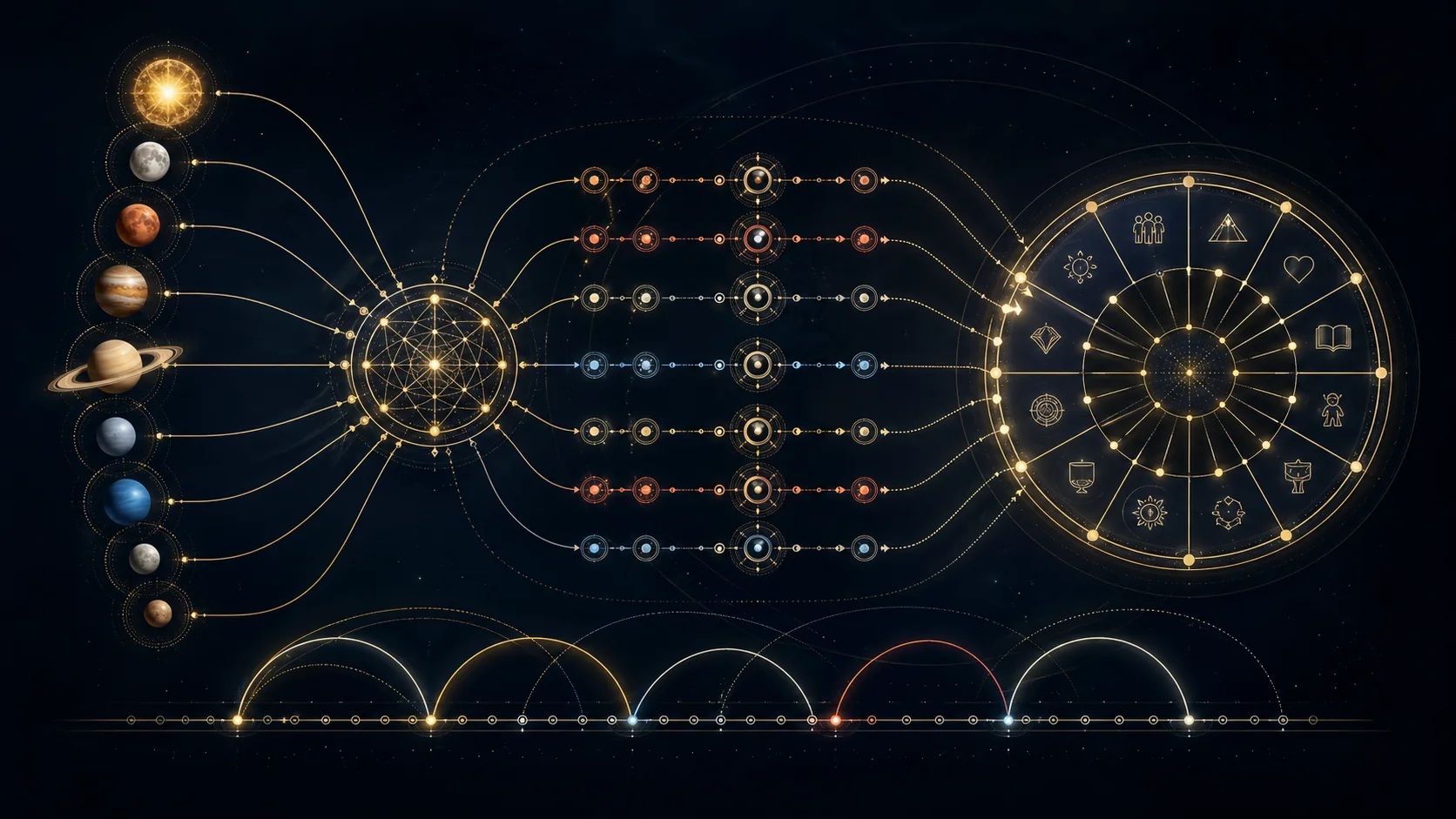
The Golden Rule rests on three levels of judgment. Each level has a distinct role, and each one matters. If any level is ignored, the reading becomes incomplete. This is one of the main reasons beginners sometimes feel that KP is difficult at first. It is not because the system is chaotic; rather, it is because the system is precise. Precision always demands more attention than broad interpretation.
- The Planet is the source of the results. It indicates what is acting.
- The Star Lord (Nakshatra Lord) dictates the actual results and the houses that will be activated.
- The Sub Lord is the final judge. It decides whether the results given by the Star Lord will be favorable (success) or unfavorable (failure).
To understand this better, imagine a company decision. The planet is like the person who initiates action. The star lord is like the department that gives the work direction. The sub lord is like the senior authority who approves or rejects the final file. Even if the action starts, it does not complete unless the final approval is granted. KP prediction works in a similar layered way. The chart may show potential, but the final result depends on the sub lord’s testimony.
Another useful way to understand the relationship is to think of the planet as the delivery vehicle, the star lord as the route, and the sub lord as the traffic checkpoint. A vehicle can be ready, and the route can be clear, but if the checkpoint blocks it, the journey changes. In practical terms, this means that the chart’s promise must be checked from all three angles before a conclusion is drawn. A single favorable factor is not enough.
This three-step structure explains why two people can have similar-looking placements and yet experience very different outcomes. One chart may support marriage because the relevant planet, star, and sub all agree. Another chart may show a relationship opportunity, but the sub lord may deny formalization. On the surface, both may seem to be about partnership, but the final event outcome can differ sharply. That difference is not accidental; it is exactly what the Golden Rule is designed to catch.
It is also important to notice that KP is not only concerned with whether a planet is “strong” or “weak” in a general sense. Strength alone does not decide the event. A strong planet can still give an unfavorable result for a particular question if its star lord or sub lord points to denial, delay, separation, loss, or mismatch for that matter. Likewise, a seemingly ordinary planet may produce a surprisingly good result if the relevant star and sub support the desired outcome. This is one reason KP prediction can feel very concrete once the logic clicks.
Why the Golden Rule Matters in Prediction
The Golden Rule matters because prediction is about outcomes, not just descriptions. A chart reading becomes useful only when it can answer a real question with enough reliability. Many astrology discussions remain at the level of tendencies: emotional nature, career interests, family background, and personality patterns. KP certainly can observe these things, but its most distinctive strength is event-based judgment. It is used to assess whether a matter is likely to happen, when it may happen, and whether the result is supportive or obstructive.
Suppose someone asks about marriage. In a general reading, many placements might be mentioned: the 7th house, Venus, Jupiter, or relevant combinations. But in KP, the real question becomes: does the significator chain support marriage, or does it point to breakup, delay, or non-fulfillment? The sub lord becomes decisive because it tells you whether the house promise can manifest in a usable way. If the 7th house is activated but the sub lord carries denial indications, the astrologer should not simply assume that marriage will happen smoothly. The same is true for job, education, travel, childbirth, property, or any other specific matter.
It helps to think of the Golden Rule as a quality-control process. A factory may produce many items, but only the final inspection determines which items are accepted. In KP, the final inspection belongs to the sub lord. This does not mean the planet and star lord are unimportant. Without them, there would be no pathway of manifestation. But the sub lord is the last word on whether the result is ultimately usable, successful, or denied.
For students, this is often the point at which their predictions become more disciplined. Before learning the rule, they may jump from one indicator to another and form an answer too quickly. After learning the rule, they begin to ask more exact questions. Is the planet relevant to the matter? Which star lord is it connected to? Which houses does that star lord signify? And finally, does the sub lord support the desired outcome or oppose it? These questions create a method instead of a hunch.
There is another reason the rule is essential: it helps prevent overconfidence. An astrologer may be tempted to say, “This placement looks excellent, so success is guaranteed.” KP teaches caution. A good-looking placement is only part of the story. If the sub lord signifies obstacles, the success may be partial, delayed, or denied in the specific area being examined. This is not pessimism; it is accuracy. In prediction work, humility is often the sign of competence.
How the Three Levels Work Together
The simplest way to understand the Golden Rule is to see the three levels as a sequence of decision-making. The planet shows the actor, the star lord shows the field of operation, and the sub lord confirms the final outcome. A meaningful prediction requires all three to be examined in the context of the question asked.
For example, if the topic is marriage, the astrologer is not only checking whether Venus is involved. The chart has to be read through the relevant houses, and the significations must be cross-checked. A planet may activate the 7th house through its star lord connection, but if the sub lord connects strongly to separation-related houses or denies the matter, the final result may become complicated. This is why KP is powerful for specific questions: it does not settle for broad impressions.
In practice, many astrologers find it helpful to read the sequence in reverse as well. First ask what the sub lord says about the matter. Then see whether the star lord supports that direction. Then finally observe how the planet carries the result. This is not because the order of importance changes, but because the sub lord often clarifies the final tone immediately. Once the sub lord’s stance is understood, the rest of the reading can be organized around it.
Take a real-world-style example. A person wants to know whether a job offer will come. The chart may show a planet connected to career matters. Its star lord may indicate the 10th house or 6th house, which suggests work and service. But if the sub lord does not support employment-related fulfillment, the result may not materialize as expected. The person may get interviews but no final appointment, or the opportunity may be delayed. Conversely, if the sub lord strongly supports the relevant houses, the process tends to move more smoothly. This is the practical value of the Golden Rule: it helps you distinguish between promise and actual outcome.
Another way to appreciate this structure is to compare it to a legal process. A case may be initiated, evidence may be presented, and arguments may be made. But the final judgment determines the result. In KP, the sub lord is closest to that final judgment stage. The star lord sets the context, the planet carries the energy, and the sub lord decides the closing verdict for the specific matter under review.
Why the Sub Lord Is the Final Judge
The sub lord is often described as the final judge because it has the decisive role in confirming or denying the outcome. This is one of the most important ideas for any learner to absorb. Many people start astrology by focusing on planets alone, then later on signs, then perhaps on aspects or combinations. KP, however, brings attention to the smallest subdivision in the chain of judgment. That small step often changes the answer completely.
When the sub lord is favorable, the desired outcome has a clearer path. When the sub lord is unfavorable, the outcome may still be discussed, but the result may not be stable, complete, or satisfying. This is particularly important in questions where timing and specific result matter. Someone may have a strong desire for a result, and the chart may even show activity around that theme, but the sub lord can reveal whether the matter will truly cross the finish line.
To make this feel more concrete, imagine applying for admission to a course. The desire exists. The application is sent. The institution reviews it. But the final acceptance depends on the final decision stage. Similarly, the sub lord can indicate whether the matter is likely to cross from possibility into reality. This is why KP students are repeatedly trained not to stop at the first positive clue.
The sub lord also helps explain why results may be mixed. A matter may show some affirmative indicators and some restrictive indicators. In such cases, the sub lord often determines which side wins. This is especially helpful when one wants to distinguish between mere activation and actual fulfillment. A house may become active without producing the desired satisfaction. KP allows the astrologer to notice that difference and explain it carefully.
There is a subtle but important lesson here: not every activation means success. Sometimes activation means pressure, testing, delay, responsibility, or an event that arrives in a form different from what was expected. The sub lord helps separate these possibilities. It is not enough to say, “This house is involved, so the matter will happen.” The matter may happen differently, or not happen in the desired way, depending on the sub lord’s testimony.
Marriage Example: How the Golden Rule Changes the Reading
Marriage is one of the clearest examples because people naturally want a direct answer. Will it happen? Will it be delayed? Will it be harmonious? Will there be obstacles? KP handles these questions by checking the relevant houses and the chain of significators. This is where the Golden Rule becomes visible in a practical sense.
Let us take a simple example. Suppose the star lord signifies the 7th house, which is relevant to marriage and partnership. At first glance, this looks promising. The chart is activating marriage-related territory. But then the sub lord is examined and found to signify the 6th house, which in relationship questions can indicate conflict, opposition, argument, or breakdown in the matter. In that case, the astrologer does not rush to say that marriage will proceed smoothly. Instead, the conclusion becomes more cautious. There may be a relationship, an engagement, a formal connection, or strong interest, but the final outcome may face serious obstacles.
This is exactly the point shown in the existing example: if the Star Lord signifies marriage (7th house), but the Sub Lord signifies divorce (6th house), the marriage will ultimately face severe obstacles. The value of this statement is not only in its simplicity but in its precision. It teaches the student to stop romanticizing the chart. A marriage-related star lord does not automatically promise a happy union. The sub lord decides whether that promise can be supported in the practical world.
Consider an anecdotal-style situation. A person may repeatedly ask whether a relationship will lead to marriage. A general astrologer might be impressed by the romantic indicators and declare a strong possibility. But in KP, once the sub lord is read carefully, it may be clear that the chart is not granting a stable marriage outcome. The relationship may remain emotional, intermittent, or heavily troubled. The person might be deeply attached, yet the final event does not align with expectations. In real life, such insight can save time, emotional energy, and confusion.
On the other hand, if the star lord and sub lord both support the relevant marriage houses, the reading becomes more confident. The astrologer can then speak about the likelihood of formalization with much greater assurance. Even then, timing, circumstances, and supporting factors must be considered. KP never encourages blind certainty; it encourages evidence-based judgment within the chart.
How Beginners Misread the Rule
One common beginner mistake is to assume that the planet itself is the main answer. A student might say, “This planet is in a good house, so the result must be good.” But KP does not work that simply. The planet may be important, but it is not enough by itself. Another common mistake is to stop after identifying the star lord and forget the sub lord entirely. This can lead to overconfident predictions that sound plausible but do not hold up when real events unfold.
A third mistake is to treat the sub lord as just another factor among many, rather than the deciding factor. Once that happens, the whole logic weakens. Students may start mixing broad sign-based thinking with KP techniques in a way that blurs the clarity of the system. The result is confusion, because KP’s strength lies in its hierarchy. Each level has a specific job. When the hierarchy is respected, the reading becomes sharper.
Another issue is impatience. People often want to apply the Golden Rule before they fully understand the question. But in KP, the exact nature of the question matters. A relationship question, a job question, and a property question may all involve different house combinations. The same planet cannot be judged in isolation for every matter. The astrologer must first define the question properly, then trace the relevant significators, and only then apply the rule. This disciplined approach prevents vague or contradictory predictions.
It also helps to avoid a very subtle error: assuming that favorable indicators automatically mean easy results. Sometimes a favorable chart can still show delay because other houses are involved, or because the matter requires effort and time. KP is not about fantasy. It is about outcome logic. The Golden Rule tells us whether the matter is promised and whether the final gate is open, but it does not remove the need to understand the nature of the event, the timing, and the circumstances.
How the Rule Supports Better Birth Time Rectification
One of the reasons the Golden Rule is so important is that it supports practical verification. When you are checking whether a birth time is correct, you need a method that can be tested against events. This is why the chart must be read carefully and compared with actual life experience. The relevant article on birth time rectification becomes especially useful here, because even small changes in time can alter the sub lord and change the final judgment.
In rectification work, a person’s past events become evidence. Did marriage happen at a particular age? Did a job change occur unexpectedly? Was there a major move, separation, achievement, or delay? These events help the astrologer check whether the chart’s promise aligns with reality. The Golden Rule makes this process possible because it gives a structured way to test which factors are producing results and which are not. If the sub lord does not fit the real event, the astrologer must revisit the birth time and the interpretation.
Think of it like tuning a radio. A small adjustment can make the sound clear or distorted. In rectification, a few minutes can matter because the relevant sub lord may change. That is why precision is so valued in KP. The chart is not read casually; it is matched with actual life patterns. When the timing is correct, the event logic becomes more convincing. When it is off, the prediction may appear inconsistent. The Golden Rule gives a framework for noticing that difference.
This is also why students are encouraged to observe actual events after learning the method. A prediction only gains confidence when it repeatedly matches experience. That testing process sharpens the interpreter’s eye. It teaches that the sub lord is not an abstract concept; it is the practical key to whether a promised result really reaches the native’s life.
From Theory to Real-Life Judgment
KP becomes truly valuable when the Golden Rule is used in real questions. For instance, if someone asks about a new business venture, the astrologer does not just check whether the chart seems “good for entrepreneurship.” The proper approach is to identify the relevant houses, assess the planet involved, see the star lord’s significations, and finally examine the sub lord’s verdict. Only then can the astrologer say whether the business is likely to progress, struggle, or fail to take shape as intended.
Similarly, in education questions, the method can reveal whether admission, exam success, or continuation is likely. A person may work very hard, but the chart may show that the current period is not supportive of the final result. Another person may feel less confident, yet the chart may favor the outcome because the right houses are activated and the sub lord approves them. This is why KP can feel so surprisingly practical. It does not rely on appearance alone; it evaluates the chain of promise.
When applied carefully, this rule also improves the quality of communication between astrologer and client. Instead of making sweeping claims, the astrologer can explain the reasoning: the matter is connected, the star lord supports the theme, but the sub lord introduces obstacles; or the matter is weak at the star level, but the sub lord does not completely deny it. This kind of explanation is more honest, more useful, and more grounded.
Another helpful habit is to use the Golden Rule as a final check before speaking. Even if the chart seems to suggest a result, ask once more: does the sub lord agree? That extra pause often prevents mistakes. It turns astrology from a quick opinion into a careful reading. Over time, that discipline improves both learning and prediction accuracy.
Why This Rule Creates Confidence in KP Astrology
People often trust systems that can explain their own limits. That is one reason KP earns respect among serious learners. The Golden Rule does not claim that every chart is easy or every question is instantly answerable. Instead, it shows a clear method for making judgment. It tells you what to examine, what to prioritize, and where to stop before becoming careless.
Confidence in prediction does not come from making bold statements. It comes from making statements that can be supported by the structure of the chart. The Golden Rule creates that structure. It teaches that a result is only as reliable as the full chain of indicators. This is why it remains central in learning, consultation, and chart analysis.
It also keeps the astrologer grounded. There may be times when a chart appears promising in one area and disappointing in another. The Golden Rule reminds us that charts are rarely simplistic. Real life is layered, and so is KP. A relationship may exist but not mature. An opportunity may arise but not finalize. A journey may begin but get delayed. These nuances are not signs of failure in the system; they are signs that the system is describing life more carefully.
For students who want to go deeper, it is worth revisiting practical examples, course demonstrations, and live explanation sessions. The Example of Marriage video is useful because it shows how the principle is applied in a focused way. Watching such examples after reading the rule often makes the concept more memorable, because the abstract idea suddenly becomes visible in an actual judgment process.
In the end, the Golden Rule of KP Astrology Predictions is not just a technical instruction. It is the heart of how KP thinks about outcomes. It teaches patience, precision, and logical sequence. It teaches that the final answer belongs not to the first impression, but to the full chain of significators. And most importantly, it teaches that the sub lord has the final say when it comes to whether a promised result truly becomes a lived reality.
Practical Takeaway
If you remember only one thing from this discussion, remember this: in KP, every prediction must pass through the planet, the star lord, and the sub lord. The planet indicates the actor or source of the result. The star lord shows the area of life being activated. The sub lord gives the final verdict. If you keep this order clear, your interpretations become more disciplined and your predictions more reliable.
That is why the Golden Rule is called golden. It is not merely a memorized formula. It is a practical safeguard against hasty judgment. It helps you see when the chart is truly supporting a matter and when it is only appearing to do so on the surface. Whether you are studying marriage, career, education, or any other question, this rule remains the foundation.
For anyone learning KP Astrology seriously, this principle should be revisited often. It is simple enough to state, but powerful enough to guide the entire practice of prediction. When applied properly, it transforms scattered chart reading into a logical, testable method that can be followed step by step. That is the real strength of KP, and that is why the Golden Rule remains central to its predictive power.
Explore More from KP Astro Academy
Related Tools & Features
- Childbirth Selection Tool
- Birth Time Rectification Tool
- Ruling Planets Calculator
- Marriage Matchmaking Calculator
- Career & Education Finder
- Transit Search & Prediction
- Planetary Remedies Finder
- Free KP Kundli
- Daily Panchang Calculator
- Vedic Ephemeris Calculator
- Hora Chart Calculator
- Ashtak Varga Calculator
- KP Event Finder
- Personal Muhurat Finder
- Cusp Promise Calculator
- Bhav & Dasa Phal Predictions
- Dasha Promise Calculator
- KP Astrology Consultation
Further Reading
- Childbirth in KP Astrology: Promise, Delay, Denial, and Hope
- Gemstone Remedy Ecommerce Integration
- Kp Significator Api For Event Prediction
- Understanding KP Hit Theory the Right Way
- 🔭 KP Astrology: The Precise, Logical Alternative to Western and Vedic Systems
- Vehicle Purchase in KP Astrology: Comfort, Risk, or Repair Headache?
- Astrology Api Indian Kp White Label Platform
- Understanding Ruling Planets in KP Astrology: The Key to Accurate Predictions
- Behavioral Remedies Api For Astrology Products
- Why You Attract the Same Relationship Problem Again and Again
- Multilingual Astrology Report Generation Platform
- Delay in Marriage: Identifying Astrological Obstacles with KP Cusp Rules
Loading article...