How to Find the Exact Date of a Life Event Using KP Transit Analysis

Pin-Pointing Life Events with KP Transits
One of the reasons people turn to KP Astrology is its reputation for timing events with unusual precision. In many systems, a prediction may stop at saying a period is “favorable” or “challenging.” In KP, the approach is more practical: first identify whether an event is promised, then narrow the timeframe through Dasha-Bhukti and transit layers until the date becomes as specific as possible.
This is especially useful when someone wants to know when something happened or will happen: the first interview, the final round offer, the wedding registration, the move into a new apartment, the surgery date, the property handover, or the exact day a relationship began to change. The answer is not guessed from a single transit. It is built from layers.
For readers comparing systems, KP Astrology is often discussed for its emphasis on quick and verifiable event timing. That does not mean every event is always reducible to one date with zero ambiguity. It means the method is designed to move from broad to narrow in a logical sequence. In practice, that sequence is what makes the difference between a vague forecast and a useful timing window.
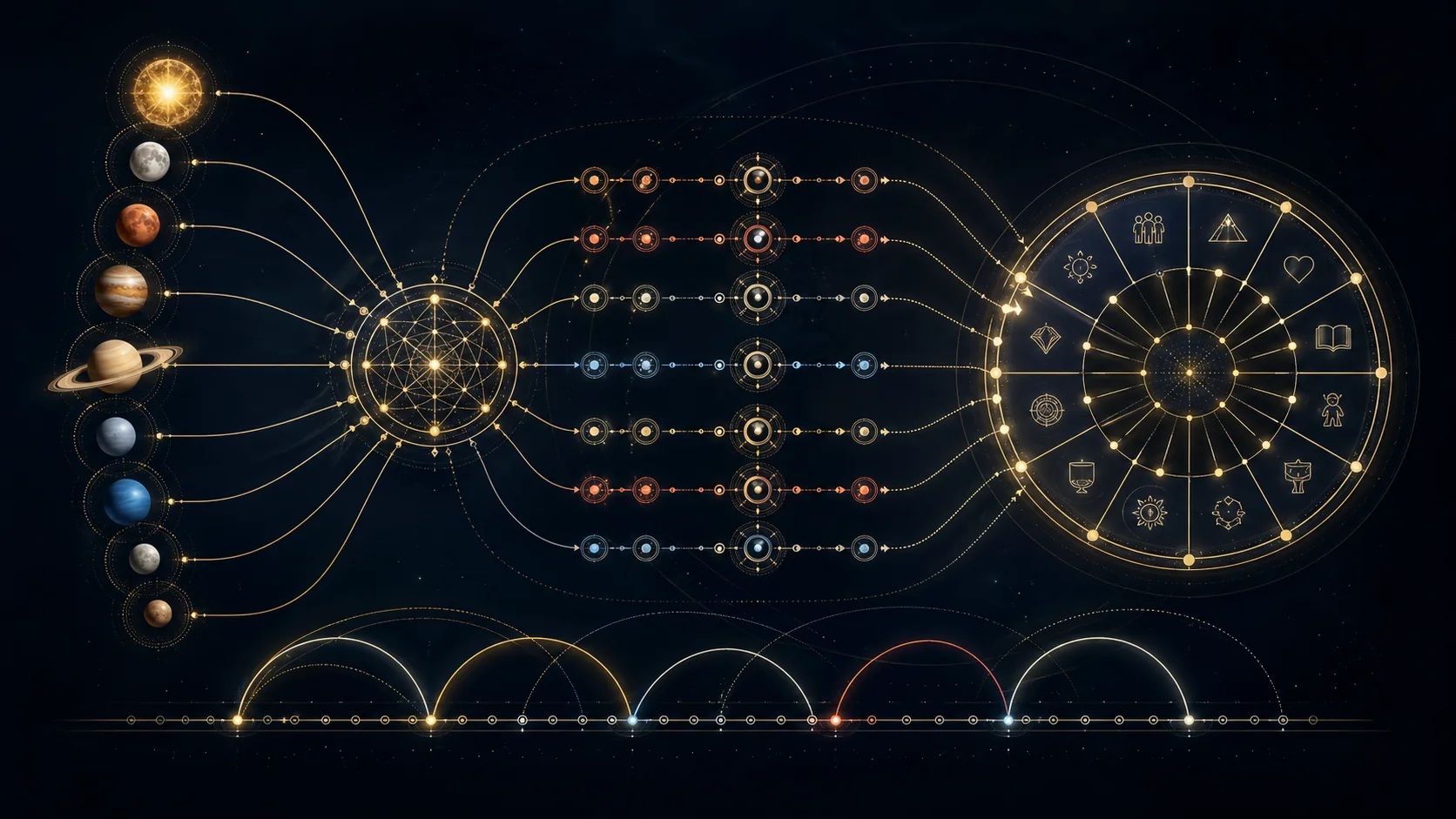
Think of it like searching for a train in a large station. First you identify the platform, then the coach, then the door, and finally the exact seat. Transit analysis works the same way: each layer removes another set of possibilities.
The layer-by-layer method also prevents a very common mistake: trying to use one transit alone as if it were enough. A Saturn transit may describe the year. A Sun transit may describe the month. A Moon transit may describe the day. But the event usually appears only when all of those fit the promise of the natal chart and the running period.
Why Exact Date Timing Is Possible in KP
The practical strength of KP transit analysis comes from combining different speeds of movement with the natal promise. Slow-moving planets help define the broader background, while fast-moving planets sharpen the timing. The method is not based on intuition alone; it is based on checking whether the right significations are active at the right time.
A person may, for example, be running a period that supports career change, but that does not mean the job joining will happen any day within that long span. The event needs a more specific trigger. That trigger may be seen when Saturn or Jupiter activates the relevant significators, then the Sun narrows it further, and finally the Moon and Ruling Planet match confirm the exact day.
In real life, this matters because timing often has consequences. Someone may need to resign from a job only after the offer letter is certain. A student may want to know the likely exam result period. A family may want to know when the house purchase paperwork will move. When timing is handled carefully, planning becomes more grounded and less stressful.
The Layered Transit Method
Finding the exact date of a life event is not about jumping directly to the Moon transit. It begins with the chart promise and moves outward in concentric layers. Each layer should answer a different question.
Step 1: Confirm the event is promised in the natal chart
Before any transit work, the event must have support in the natal promise. If the chart does not show a relevant promise, transits cannot create it from nothing. This is the foundation of the method and one reason KP remains disciplined. The chart says what kinds of outcomes are possible; transits say when those outcomes are likely to unfold.
For example, if someone asks about marriage timing, you would first look for marriage indicators. If someone asks about job joining, you would look for career and service indicators. If someone asks about a home purchase, you would look for property-related significations. The exact combinations depend on the event, but the logic remains the same: the natal chart must support it.
A useful way to understand this is through a simple story. Imagine two friends applying for jobs in the same month. One has a chart strongly connected to 6th and 10th house themes during the running period; the other does not. Both may attend interviews, but only one may receive the confirmation in the window. The transit can time what is already capable of happening in the chart.
Step 2: Identify the Dasha-Bhukti window
The Dasha-Bhukti period creates the main framework. In KP analysis, the event generally occurs only during a Dasha-Bhukti where the relevant lords signify the houses connected to that event. This creates the broadest usable window, often spanning months and sometimes longer.
For marriage, the focus is commonly on significations of the 2nd, 7th, and 11th houses. For a job-related event, the emphasis may involve 2nd, 6th, and 10th houses. For a move, education, or a family milestone, the relevant houses change accordingly. The important point is that the period itself must support the event category.
This stage answers a question many beginners ask: “If the event is promised, why not just wait for the right transit?” The answer is that transits without the correct period are usually too weak or too unstable. The Dasha-Bhukti is the stage on which the event is allowed to appear. Transits then choose the timing within that stage.
Step 3: Use Saturn and Jupiter to narrow the year or a few months
Once the broad period is clear, slow transits are used to narrow the field. Saturn and Jupiter are especially useful because they move slowly enough to describe a larger interval while still being specific enough to matter. When one of these transits activates the star or sub of the Dasha-Bhukti lord, the event window becomes much tighter.
Suppose a person is in a job-confirmation period. Saturn may transit through a Nakshatra linked to the service or responsibility theme, while Jupiter may support growth, approval, or expansion. If one of these planets hits the relevant star or sub during the Dasha-Bhukti, the timeframe becomes more pointed. Instead of “this year,” the likely period may become “this quarter” or “this month.”
This is where many people begin noticing how the timing becomes practical. A person waiting for a promotion might have been expecting it “sometime this year,” but the transit layer shows a much shorter window. That short window helps with decisions such as delaying another offer, preparing paperwork, or planning a family discussion around the expected date.
Step 4: Use the Sun transit to identify the month or two-week band
The Sun is one of the most effective monthly timing markers because it changes Nakshatra roughly every 13 days. When the Sun transits the star of the Dasha lord or Bhukti lord, the event window becomes much narrower. This often points to a period of around one to two weeks.
The Sun works well as a mid-level trigger. It does not move too fast to be meaningless, and it does not move too slow to be vague. If the larger period is already promising, the Sun transit can indicate when the event is ready to manifest within that month.
A practical example: a woman waiting for her final interview result may know that the larger period supports career advancement. When the Sun enters the relevant Nakshatra, she notices emails becoming more frequent, documents being requested, and HR moving faster. The Sun itself does not “cause” the job, but it reflects a period when the promised event can crystallize.
Step 5: Use the Moon transit and Ruling Planets to isolate the day
The Moon is the fastest standard timing layer in this method. Since the Moon moves through one star in about a day, it is ideal for narrowing an already promising window to a specific day. But the Moon is not used alone. It is checked together with the Ruling Planets at the time of analysis and with the event significations already identified.
When the Moon transits the star of a key significator and the day’s Ruling Planets also match the Dasha-Bhukti lords, the probability of the event becoming visible is highest. This is why the daily layer is often the one that turns “likely this week” into “likely today.”
For instance, a family may be expecting a property registration on a certain week. The slower layers may show that the broader period is correct. The Sun may indicate the right week. Then the Moon passes through the relevant star on the exact day the paperwork is completed and the Ruling Planets confirm the same theme. The date that matters is then no longer an estimate; it becomes a focused prediction.
How the Layers Work Together in Real Life
The easiest way to understand the method is to imagine a real consulting scenario. A client wants to know when they will start a new job. They already have an offer in discussion, but the formal joining date has not been fixed. The astrologer begins by checking whether the chart promises job entry, not just interviews or application activity.
Next, the running Dasha-Bhukti is examined. If the period supports service, income, and career activation, the event becomes plausible. Then Saturn and Jupiter are checked to see when they activate the relevant star or sub. If those transits line up during a reasonable timeframe, the astrologer can narrow it further using the Sun.
Finally, the Moon and Ruling Planets are watched carefully. On one day, the Moon may be in a star linked to career activation, and the Ruling Planets may also support Mercury or Saturn themes, depending on the chart. That day may coincide with the offer email, the joining conversation, or the signing of documents.
Even when the final manifestation is slightly different from what the client expected, the timing logic still holds. Sometimes the “job start date” appears first as the receipt of the appointment letter. Sometimes the actual joining happens a few days later. Sometimes the event is the date of resignation from the old job rather than the first working day in the new one. Precise timing requires not only identifying the category of the event, but also recognizing which moment within the sequence is most likely to show up.
Practical Example: Finding a Job Start Date
Consider a native running Saturn Dasha and Mercury Bhukti, with both lords connected to houses 2, 6, and 10. The chart supports work, service, and income-related activity. The person has been interviewing for a role for several weeks, and the HR team has said the decision is likely soon.
At the slow-transit level, Jupiter transits Revati, which is Mercury’s star, from April to June. That places a supportive window over the career period. Then the Sun enters Rohini, which in this case is linked to a relevant significator, on May 22. That narrows the likely timeframe to around that week.
Now the last layer is checked. The Moon transits Pushya, Saturn’s star, on May 25, and that day is a Wednesday, which resonates with Mercury. The Dasha-Bhukti lords, transits, and day indicators are all pointing in the same direction. In such a case, May 25 becomes the strongest candidate for the offer confirmation or joining-related event.
This kind of example is important because it shows how the system is used in practice. The final date is not selected because it “feels right.” It is selected because multiple independent layers converge. If the client later says the joining happened on May 25, the analysis has done its job. If it happened on May 26 instead, the astrologer would re-check which step in the sequence was being manifested and whether the event showed as offer release, document completion, or actual office reporting.
Another Example: Marriage Registration and Ceremony Planning
Marriage timing often needs even tighter handling than career timing because there can be two different events: the legal registration and the social ceremony. In real life, these may happen on different days. KP transit analysis helps separate them.
Imagine a client in a Dasha-Bhukti that supports marriage. The slower transits show a favorable window in late autumn. The Sun then transits a relevant star during the first half of November. This suggests that the marriage process may move during that period. If the Moon and Ruling Planets align on November 14, the legal paperwork or family confirmation could happen then. The ceremony, however, may happen later if the chart indicates a second layer of fulfillment.
In consultation, this difference matters a lot. A family may be asking for the wedding date, but what they really need is the date on which the engagement, registration, or announcement becomes active. A careful reading prevents confusion and helps everyone plan realistically.
People often expect one event to mean one single moment, but astrology shows that a life event can unfold in stages. A marriage may begin with a proposal, then engagement, then registration, then ceremony. A job may begin with selection, then paperwork, then joining. Transit analysis becomes more useful when it identifies which stage is being timed.
How to Read a Transit Window Without Overestimating It
One of the most common beginner errors is to see a transit and assume it guarantees the event immediately. That leads to disappointment. A more disciplined approach asks three questions:
- Is the event promised in the chart?
- Is the relevant Dasha-Bhukti active?
- Do the transit layers support the same outcome?
If the answer to all three is yes, the event window becomes meaningful. If one of the three is missing, the timing becomes less reliable. This is why exact-date work is best done carefully rather than casually.
Another common issue is focusing only on sign transits. In KP work, star-level and sub-level analysis is central. A planet entering a sign may be too broad to time the day accurately. A star or sub connection is more precise and more useful for event-level predictions. This is one of the reasons the method can appear detailed compared with broader forms of timing.
Common Pitfalls to Avoid
- Ignoring the promise: A transit cannot create an event the chart does not support.
- Relying only on sign-based movements: The useful timing comes from star-level and sub-level activation.
- Skipping the Dasha-Bhukti check: A transit outside the right period is usually too weak to matter.
- Forgetting the Ruling Planets: The day of analysis should confirm the same event theme.
- Confusing event stages: Offer letter, interview result, joining date, and first salary may not be the same day.
These mistakes matter because they often lead to overconfident predictions. A person may be told an event is certain on a particular day, when in reality only the broader period is supported. Careful layering avoids that problem and keeps the reading useful.
How to Use Transit Timing for Your Own Planning
If you are trying to estimate an event date for yourself, start by writing down the exact event you want to time. Be specific. “Career success” is too broad. “Final interview result” or “joining date” is better. “Marriage” is broad. “Engagement announcement” or “registration date” is better. The more specific the event, the better the timing analysis.
Then identify the relevant houses and the Dasha-Bhukti that supports them. After that, use slow transits to narrow the broad window, Sun transit to narrow the month or two-week band, and Moon transit with Ruling Planet verification to select the day. This is where a structured tool can save time and reduce confusion.
For readers who want to test the process systematically, the Transit Search Calculator can help layer Saturn, Jupiter, and Sun transits over the Dasha periods. A tool does not replace judgment, but it can make the search process more efficient. Instead of manually scanning broad timelines, you can quickly identify the windows that deserve closer attention.
Some users like to keep a simple event diary alongside the chart work. For example, they note the date of the final interview, the date the HR call came, the date the paperwork arrived, and the date of joining. Later, they compare those dates with the transit layers. This practice is valuable because it trains you to see how events often arrive in steps rather than as a single isolated point.
Why Consultation Can Make the Analysis Clearer
Exact-date event work can become complex quickly, especially when several outcomes are possible in the same period. A consultation helps in cases where the event is important, the timing is sensitive, or the chart has multiple overlapping possibilities. For example, a client may ask about a job while also undergoing a relocation and family decision. Each of those can have its own timing signatures.
In such cases, the value of a consultation is not just in naming a date. It is in separating the main event from the supporting events, identifying which stage is showing first, and making sure the transit logic is not being forced. If you need that kind of detailed review, you can consult I Navin.
This is especially helpful when the question involves uncertainty around birth time, because even a small correction can change the houses and the event picture. In that scenario, Ruling Planets birth time rectification may be part of the process before transit timing is finalized. A more accurate birth time often improves the reliability of event timing significantly.
Putting It All Together
To find the exact date of a life event using KP transit analysis, do not begin with the fastest planet. Begin with the promise, then the Dasha-Bhukti, then the slow transits, then the Sun, and finally the Moon with Ruling Planet confirmation. That sequence protects the analysis from guesswork and keeps the timing grounded in the chart.
For a job start date, that may mean checking career-related houses, then identifying the supportive Dasha-Bhukti, then watching the Saturn or Jupiter window, then noticing the Sun’s movement, and finally selecting the day when the Moon and day indicators line up. For marriage, property, education, or other life events, the same structure applies with different house significations.
The real power of this method is not simply that it can name a date. It is that it can give a person confidence in planning. Instead of waiting anxiously through a vague period, you can focus on the most likely window and prepare accordingly. That is what makes transit analysis in KP not only predictive, but practical.
When used carefully, the method turns astrology from a broad forecast into a timing tool. That is why people return to it for decisions that need more than a general answer. It helps them know not only what may happen, but when it is most likely to show itself.
Explore More from KP Astro Academy
Related Tools & Features
- Childbirth Selection Tool
- Birth Time Rectification Tool
- Ruling Planets Calculator
- Marriage Matchmaking Calculator
- Career & Education Finder
- Transit Search & Prediction
- Planetary Remedies Finder
- Free KP Kundli
- Daily Panchang Calculator
- Vedic Ephemeris Calculator
- Hora Chart Calculator
- Ashtak Varga Calculator
- KP Event Finder
- Personal Muhurat Finder
- Cusp Promise Calculator
- Bhav & Dasa Phal Predictions
- Dasha Promise Calculator
- KP Astrology Consultation
Further Reading
- Childbirth in KP Astrology: Promise, Delay, Denial, and Hope
- Career Prediction & Job Stability: When Will I Get a Promotion?
- Why Money Comes, Stops, or Leaks in a KP Chart
- Why all marriages should not be saved?
- Career Business Astrology Report Api
- Astrology Crm For Consultation Businesses
- Predicting Unexpected Events: When Dasha and Transit Align for Sudden Shifts
- Astrology Pdf Report Generator Api
- How to Use Ruling Planets for Instant Predictions without a Natal Chart
- Identifying Intercaste Marriage Combinations in KP
- Career Prediction in KP Astrology: What Your 10th Cusp Sub-Lord Reveals
- White Label Astrology App For Startups
Loading article...